
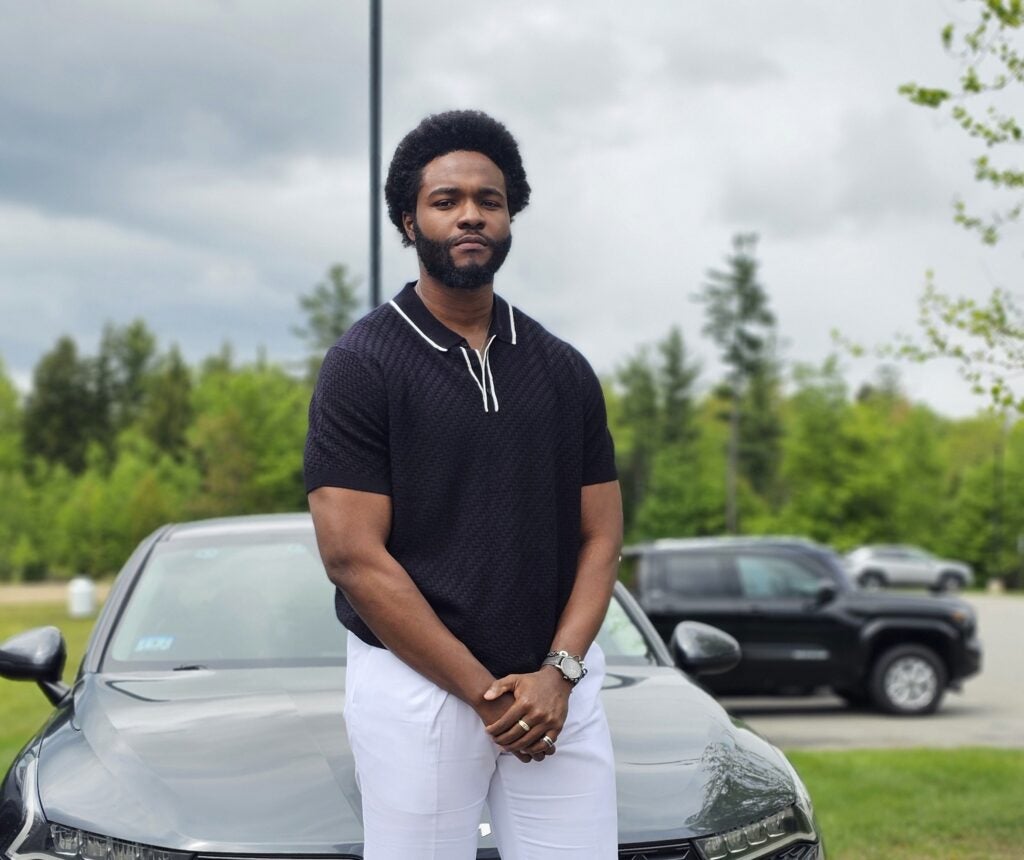
Meet ATL’s Graduate Spotlight for May 2026, Dom Banor, from the department of Chemistry, under the College of Arts and Sciences. Read his full interview below.
What course(s) do you or have you taught at URI?
I serve as a teaching assistant for an introductory organic chemistry course, working primarily with students in majors like marine biology and kinesiology, many of whom do not start out with a strong interest in chemistry. I also TA and co mentor students in an independent study alongside Dr. Mogawer, where they are introduced to research practices and instrumentation such as SEM and potentiometric methods. Working in both roles has made me more aware of how much of learning depends not just on the material itself, but on how clearly expectations are communicated, especially for students encountering something for the first time.
What is a difficult moment that you learned from in the classroom? What did you learn?
One of the most important lessons I have learned came from a mismatch I did not recognize at first. During an independent study, I noticed that students’ lab reports were consistently vague and not meeting the level I expected. I initially treated it as a performance issue and graded them based on those expectations. Over time, it became clear that too many students were struggling in the same way for that explanation to hold. When I asked about their prior experience, I realized many of them had never written a full lab report before. I had been evaluating them against a standard I had never actually taught. That shifted my approach. I began giving feedback on drafts before assigning final grades, and the improvement was immediate. What I learned is that rigor is not just about setting high expectations. It is about making those expectations visible.
What is a time when an assignment or activity did not go as planned, and how did you make it a teachable moment? What did you learn about yourself?
That same experience forced me to rethink the lab report as an assignment. I had designed it as a final demonstration of understanding, assuming students already knew how to approach it. When that assumption broke down, I restructured it into stages including outlines, drafts, and revisions with feedback along the way. Once the process became visible, students improved quickly. It also made me reflect on my own tendencies. I realized that because I am further along in my PhD, I sometimes treat certain skills as basic when they are actually new to students. Now, I try to be more deliberate about separating what I expect from what I have explicitly taught.
What do you hope students look back on in ten years and say about your classes?
I hope they remember that they did not have to understand everything in order to participate.
In organic chemistry, I am open with students that I still ask questions all the time as a fourth year PhD student, and that my own work is in physical chemistry and instrumentation, not synthesis. There are topics I revisit and relearn. That usually surprises them, but it also changes how they engage. Instead of seeing confusion as a failure, they start to treat it as part of the process. If they remember anything, I hope it is that learning is not about already knowing. It is about being willing to work through what you do not.
How do you envision incorporating teaching into your future career?
I do not plan to pursue a traditional teaching path, but this experience has changed how I think about working with others in technical environments.
In research and industry settings, there is often an assumption that people should already know how to do something, whether it is using an instrument, analyzing data, or documenting results. What I have seen is that when those expectations are not made explicit, people struggle in ways that are not always visible.
Going forward, I want to carry that awareness into how I collaborate and mentor, especially when working with new team members or training others on instrumentation. Taking the time to make processes and expectations clear upfront is not just helpful, it makes the entire group more effective.
That is probably the biggest thing teaching has changed for me, not whether I teach, but how I communicate expertise.
How do you relax after a long day of teaching?
Honestly, I keep it very simple. After teaching, I usually just go home, eat, and spend some time on my couch before calling it a night.
If I still have grading to finish, I try to get that done on campus first so I can actually disconnect when I get home. I have learned that once I leave, it helps to fully step away rather than carry everything into the next day.
There is nothing elaborate about it, but having that consistent reset makes a big difference after a long day.
What do you like to do for fun?
Outside of teaching and research, I like doing things that feel active or let me focus in a different way. I spend time lifting, mountain biking, and getting into photography, usually behind the camera rather than in front of it.
I also really value spending time with good people and being able to relax and laugh. A lot of what I do day to day is pretty structured, so I tend to enjoy things that feel more open and unplanned.
Would you like to nominate a faculty member to be included in an ATL Monthly Spotlight?
Submit this form for consideration.