
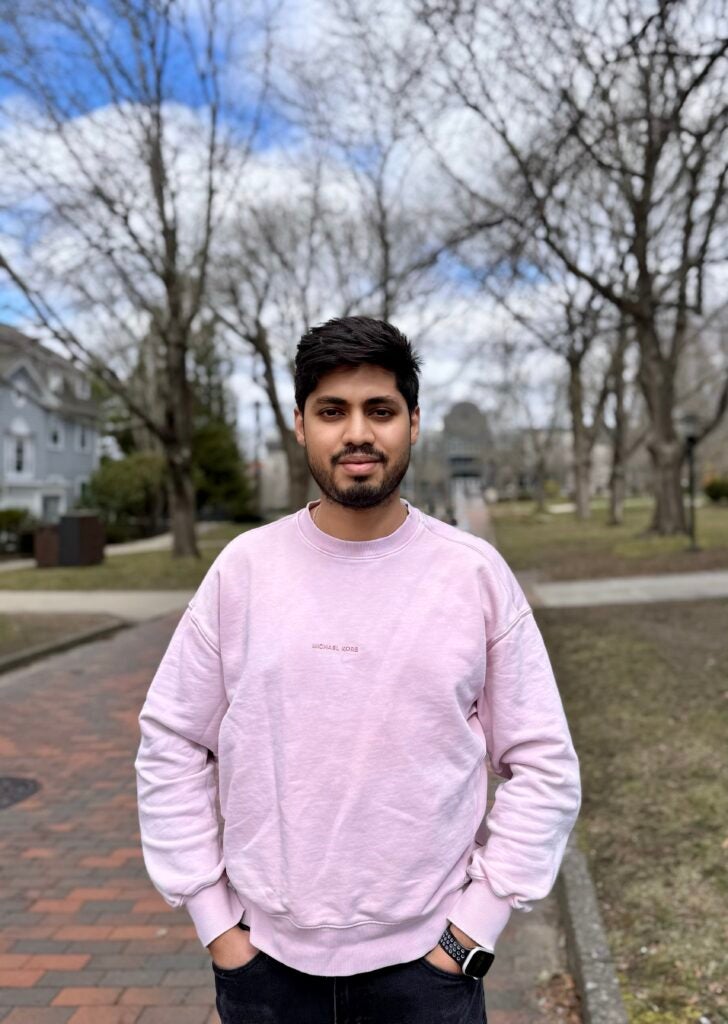
Meet ATL’s graduate student spotlight for April, Arindam Laha. Arindam is a PhD student in Electrical Engineering at the University of Rhode Island, conducting research in the CYPHER Lab on ONR-supported projects involving artificial intelligence and reinforcement learning for cyber-physical systems. Through his extensive teaching roles across chemistry, statistics, and data science, he has supported nearly 400 students over 7 courses spanning multiple departments. With a master’s degree in computer science already completed at URI and a background that bridges deep learning, generative AI, and power
systems security, Arindam brings cutting-edge research insights directly into his teaching. He is particularly passionate about making complex technical concepts accessible to students from diverse backgrounds, believing that the most transformative learning happens when students are empowered to explore, struggle productively, and build genuine understanding rather than memorize formulas. Read his full interview below.
What course(s) do you or have you taught at URI?
Over the past two years, I’ve had the privilege of serving as a Graduate Teaching Assistant across
a remarkably diverse range of courses, supporting nearly 400 students. My teaching experience
includes:
Data Science Courses:
- DSP 566: Advanced Topics in Machine Learning
- DSP 565: Computational Statistics
- DSP 568: Data Science for Business
- DSP 557: Interdisciplinary Data-Enabled Research
Statistics:
- STA 220: Introduction to Statistics
- STA 409: Statistical Methods in Research I
Chemistry:
- Undergraduate Chemistry Laboratory Sessions
This breadth across chemistry, statistics, and advanced machine learning has taught me that
effective teaching transcends subject boundaries–it’s about meeting students where they are and
building bridges to deeper understanding.
What is your proudest teaching moment?
During one of my semesters teaching chemistry labs, I had a student who was frustrated with
both the lab procedures and lecture material. Their confidence was diminishing weekly.
I started staying after class for one-on-one help. We went back to the fundamentals they were
missing and discussed the “why” behind procedures, not just the “how.” After each quiz, we’d
sit down and diagnose exactly where their thinking went wrong. Was it conceptual? A
calculation error? Over the semester, I watched them transform.
Their lab technique improved, quiz scores went up, and they went from looking anxious to enthusiastic. By the end, they said, “I actually understand chemistry now. I was ready to give up, but you made me realize I could
do this.” That’s why I teach–to help students discover they’re capable of more than they believed.
What is one piece of teaching advice that you have received that you would like to pass on to
others?
My grandfather once told me, “There are no shortcuts in learning—you must take your time
and truly understand.” That wisdom shaped how I teach.
I’ve learned to “meet students where they are, not where you think they should be.” I start
office hours asking: “What makes sense so far? Where does it get confusing for them?” That
simple check-in transforms everything. Instead of re-explaining from the top, I build on what
they understand and focus on the gaps.
This has been crucial teaching across diverse courses from chemistry labs to graduate
machine learning. When I applied this patiently, students stopped being afraid to ask
questions and started genuinely engaging with the material.
What are the three qualities that you think make for a great teacher?
Adaptability: Great teachers can explain the same concept in five different ways. In my
statistics courses, I prepare multiple pathways like Excel demos, mathematical derivations,
real-world examples and switch seamlessly when one approach isn’t landing.
Genuine Curiosity: When students ask, “why does this work?” I explore with them rather
than just citing textbooks. Some of my best teaching moments came from investigating
questions I hadn’t considered before. This creates a collaborative environment where students
engage deeply instead of performing for grades.
Practical Empathy: Students are whole people juggling courses, research, jobs, and life.
Being a grad student myself, I understand the challenges we face—funding stress, housing
insecurity, imposter syndrome. I design challenging assignments that respect students’ time
and respond when life gets in the way. High standards and humanity aren’t mutually
exclusive.
What are you excited to do next in the classroom?
I’m excited to create more interactive sessions where students work through challenges
together in real-time. Instead of me lecturing and them listening, I want to flip it around to
discuss and tackle problems as they discover solutions themselves.
I’ve seen how powerful peer learning can be. My role is guiding the conversation and asking
the right questions rather than providing all the answers. Whether it’s debugging code
together, analyzing experimental data, or working through statistical problems, I want to
build classrooms where learning is a collective exploration, not a one-way broadcast.
What is your favorite place to visit in Rhode Island? Why?
Point Judith Lighthouse, hands down. On clear summer evenings, the sunset there is
incredible, the kind that makes you stop whatever you’re doing and just watch. There are
paths that lead out to rocky outcrops where you can sit and take in the view of the ocean
stretching endlessly ahead. It’s become my go-to spot when I need to clear my head after a
long week of teaching or debugging stubborn code. Something about the combination of
crashing waves, and that golden hour light just resets everything.
What do you like to do for fun?
Hiking new trails, spontaneous road trips exploring New England’s hidden gems, and
experimenting in the kitchen with fusion recipes that sometimes work brilliantly (and
sometimes… don’t ☹). I’m always looking for new trails or random scenic overlooks with
perfect views. At least with cooking, the feedback is immediate unlike waiting days for code
to finally work!