
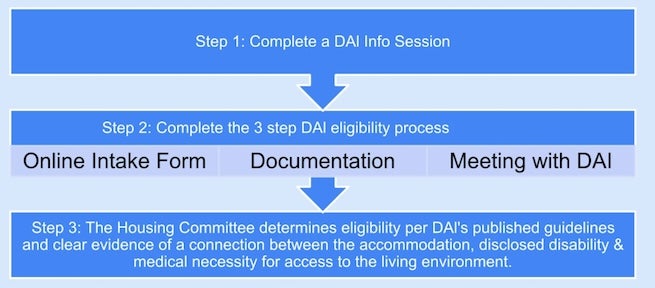
Housing accommodations at URI are designed to provide disability-related equal access to an on-campus communal living environment. When evaluating requests, DAI applies a “but for” standard: “But for” the requested accommodation, the student could not access campus housing.
Accommodation decisions are based on:
- Provider documentation
- The interactive meeting with the student
- Whether the request is directly connected to the documented disability
- Whether the requested accommodation is essential for the student’s housing access
Housing accommodations do not guarantee an offer of housing or placement by Housing & Residential Life (HRL), provide an advantage, or override standard housing processes.
How the Process Works
Once an accommodation is approved:
- DAI communicates the medically necessary request to HRL.
- HRL reviews available inventory to determine which available space is appropriate.
- If no space meets the need
- Students may be offered alternative arrangements that most closely align with the documented requirement.
- In rare circumstances, students may need to consider off-campus housing options if on-campus inventory cannot support the approved accommodation.
- If no space meets the need
Where you are placed within Housing & Residential Life’s various options remains under HRL authority.
DAI does not assign housing and cannot direct HRL to place a student in a specific residence hall, room type, or building, or with a specific roommate.
Not an Accommodation
Common Preferences
- Early housing selection
- A specific residence hall
- Apartment-style or suite-style housing
- Living Learning Community (LLC) placement
- Selecting or controlling all roommates or suitemates
- Group housing requests
Why is it a Preference?
College housing is designed as a communal living environment.
It can feel scary to live in a new space with new people. Sometimes, preferences can feel necessary, though DAI may not be able to approve them as medically necessary accommodations if they do not meet our eligibility criteria. Students should expect to navigate shared spaces, roommate dynamics, noise, smells, and distractions. That’s part of living in a community, and we have amazing HRL staff who can meet with students, help design roommate contracts, and assist with communication and conflict resolution.
Preferences are not medically necessary for equal access to housing, and therefore do not qualify as disability accommodations.
Planning Ahead for Access
About 33% of first-year students are placed in a triple (students living in a room with two additional roommates) based on HRL policy and procedures. Visit the HRL website to view the housing options for first-year students to understand where HRL typically places students like you. Medically necessary requests for housing accommodations must be submitted to DAI by the deadline of May 15, 2026. Adjustments after placement can occur a few weeks after move-in during HRL’s room change period.
Some housing-related needs require additional planning or coordination across campus.
If any of the areas below apply to you, we strongly encourage you to connect with DAI early so we can support a smooth transition to campus.
Not all needs in these areas automatically qualify as housing accommodations. However, connecting with DAI early allows us to:
- Review your specific situation
- Determine appropriate supports or accommodations
- Coordinate with Housing & Residential Life when needed
Early communication helps ensure that the right spaces are considered, campus partners have time to make a plan, and your access needs are supported as effectively as possible.
DAI does not provide:
- Early housing registration
- Priority selection times
- Override of housing procedures
Deadlines Matter!
All incoming and current URI students are the sole responsible party for meeting all deadlines published by the university without exception.
DAI cannot excuse or override any URI procedures or deadlines under any circumstances.
Documentation submission and a housing consultation meeting must occur before May 15, 2026.
After 5/15, please contact DAI for more information.
Please note that students requesting academic accommodations must complete an Intake Meeting with DAI after Orientation.
Important Context
HRL operates within a finite inventory, and DAI does not control room assignments or housing capacity.
Students are strongly encouraged to:
- Complete the DAI process early.
- Meet all published housing deadlines.
- Submit documentation before priority deadlines to maximize available options.
Dining and Food Allergy Accommodations
Dining on campus is an important part of the college experience, and URI Dining Services works with students to support a range of dietary needs, including food allergies, sensitivities, and celiac disease.
Important Expectations
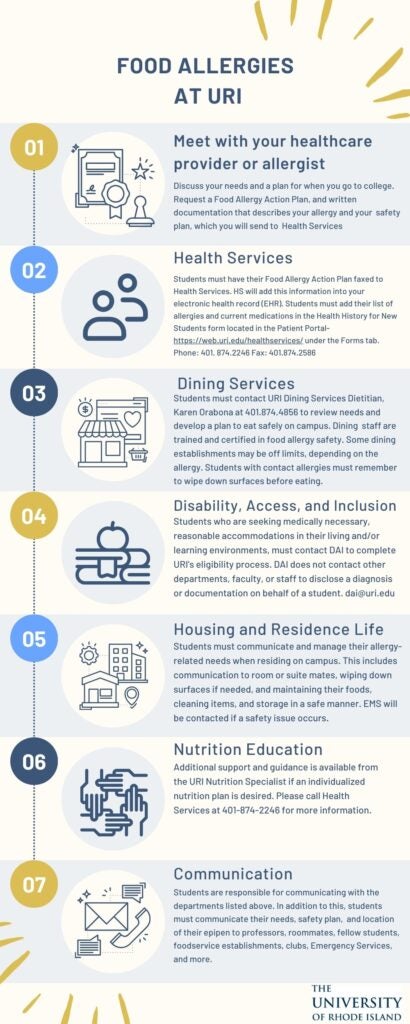
Dining facilities are not allergen-free environments. Shared kitchens and service areas create the possibility of cross-contact. Students are expected to:
- Request a Food Allergy Plan from your healthcare provider or allergist
- Send your safety plan to Health Services
- Review needs and develop a plan with the campus dietitian
- Ask questions about ingredients or preparation
- Inform Dining staff of allergies
- Wipe down surfaces before eating (those with contact allergies)
- Use allergen-aware stations appropriately
- Carry required medications (e.g., epinephrine)
- Communicate concerns immediately if safety issues arise
- Inform friends, roommates, and others about your allergies
- Maintain food, cleaning items, and storage in a safe manner
Self-management is an essential part of the college transition.
Plan Ahead
Students with food allergies or dietary restrictions are encouraged to contact URI Dining Services and the campus dietitian early, ideally before moving or eating on campus.
Early communication allows Dining Services to
- Understand specific dietary needs
- Review available dining options
- Develop a personalized safety plan
The Dining Services’ registered dietitian is available to review allergies or sensitivities, explain food preparation practices, and help students navigate dining halls safely.
Specific Supports for Allergies & Intolerances

URI Dining Services provides several ways to help students manage their food needs safely:
- Allergen-aware and gluten-free stations
- Clearly labeled menu items
- Special meals prepared separately when medically necessary
- Individual nutrition consultation with the dietitian
These services are designed to support safe participation in campus dining while maintaining shared dining environments.
When DAI Is Involved
If a student’s food allergy or dietary need rises to the level of a disability under federal law, they may request a dining-related accommodation through DAI. Students must engage in DAI’s three-step interactive process. DAI collaborates with Dining Services and other departments when appropriate, but students must initiate the process and lead communication.