
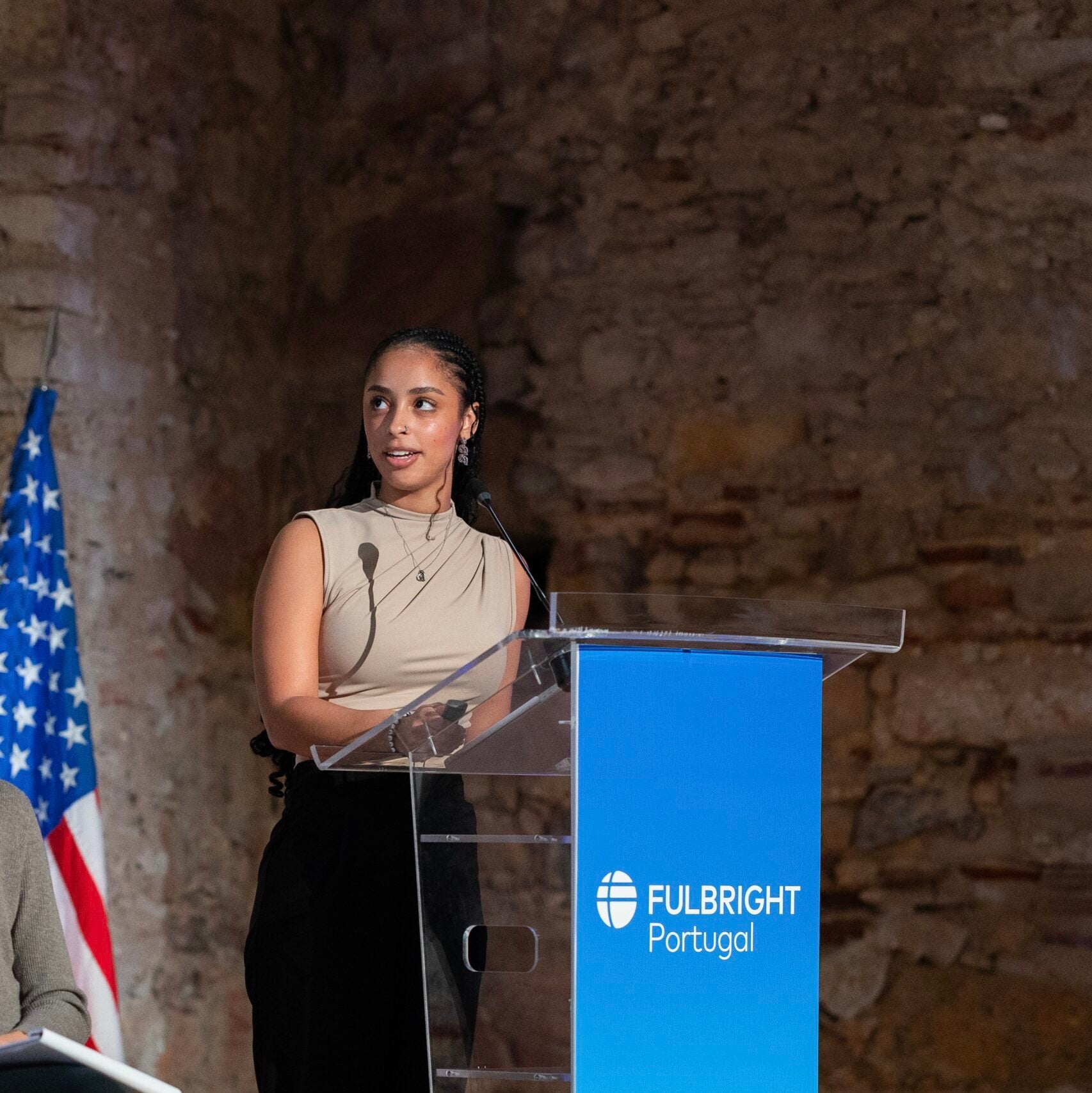
URI alumna Joceline Rodrigues ‘25 recently returned from her year as a Fulbright English Teaching Assistant in Portugal at the Instituto Superior de Gestão Business & Economics School in Lisbon. The Office of Fellowships@URI interviewed her about her Fulbright Portugal experience which has been edited for length and clarity.
Why did you choose Portugal for your Fulbright?
Because of the connection with my Cape Verdean heritage! I knew there would be a large community there, and I wanted to learn more about the history between Cabo Verde and Portugal. I also have some family there, which made the process of acclimating a lot easier.
Portugal is also absolutely beautiful! There is plenty to do here with a very diverse population and diverse landscapes. For me, diversity is important wherever I go, and being surrounded by different people from diverse backgrounds was essential. I knew that I would absolutely love it here, and I do!
What advice would you give students thinking about applying to Fulbright?
Do it, apply! Take the chance and put yourself in a totally new environment. Believe in yourself. You can absolutely obtain a Fulbright, and you absolutely will excel while you are there. Please start early and give yourself enough time to prepare; the process can be long. Most importantly, pick a location that you are very passionate about and where you can see yourself learning the most. Don’t be afraid to step out of your comfort zone!
Describe your experience in 3 words.
(I can’t do 3, but how about 4? Haha!) Find comfort in discomfort. I have done so many different things here that were out of my comfort zone. But this has taught me so much about who I am as a person. I am very capable of finding the silver lining in anything I do. Pushing myself to try new things, despite not knowing how it will turn out, has taught me the value of just putting yourself out there.
What was your biggest cultural surprise in Portugal so far?
People here like to slow down and take their time, whether that is professionally or personally. Coming from the US, I was really used to the fast-paced and demanding schedules. It took a bit of adjustment at first, but now I am so grateful for the pace here because it pushed me to explore who I am, what I love, and what I value. I have discovered so much about myself because of this slow way of life.
Do you have a favorite Portuguese word or phrase?
“Beijinhos!” This translates to “Kisses”, which I think is so cute. People typically say goodbye this way; it is very endearing.
What does a typical day look like for you as a Fulbright English Teaching Assistant in Portugal?
I usually start my day with coffee, of course. After this, I teach about 1-2 classes during the early afternoon. After I am done teaching, I usually either go to the Lisbon Project and volunteer with migrants and refugees, or I will do one of my many hobbies (painting, dancing, yoga, etc.).
What project are you most excited about?
I’m currently working on a project that evaluates the mental health and well-being of the population at my host institution, ISG | Business & Economics school!
How has Fulbright challenged you?
Being away from my loved ones is something that has been difficult for me. I grew up in a really big family that has always prioritized time together. Coming here and being completely alone is where I had to learn how to truly build my own village. Luckily, I had a few cousins here, so that made it a bit easier. But the people who have always been there for me still supported me from thousands of miles away and even came to visit me! I have learned the value of community and really cherish the one that I have in the United States. But I have also built a beautiful community of my own here in Lisbon.
What’s one thing everyone should do if they visit Portugal?
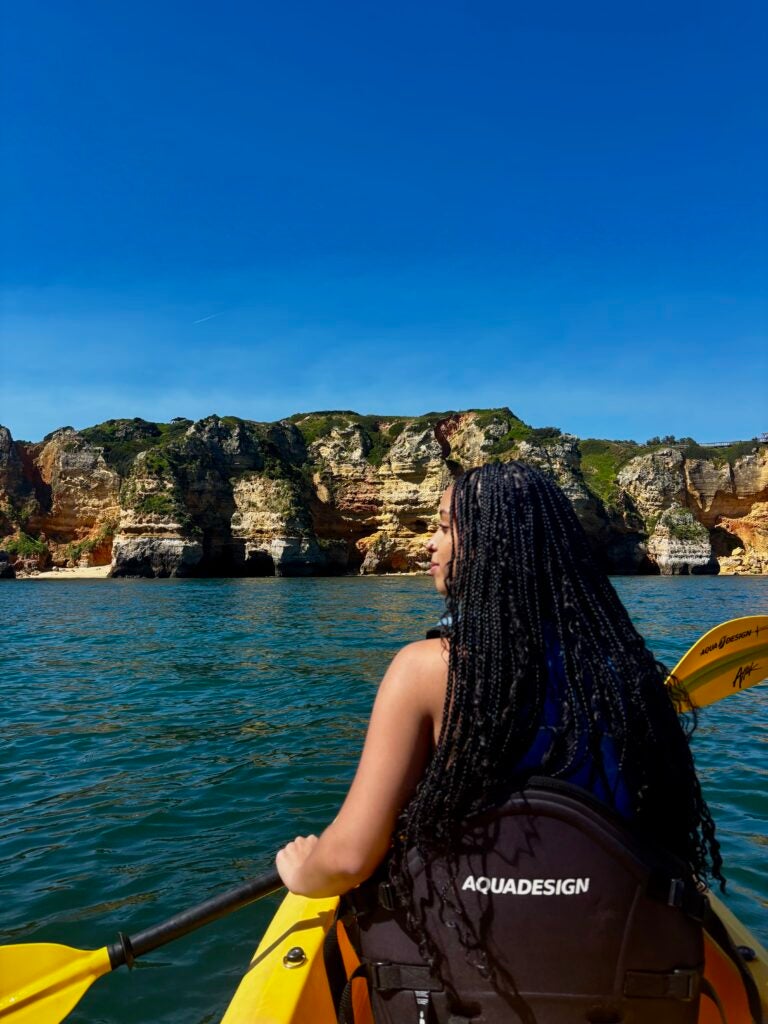
Travel to Lagos! This is such a hidden gem that is absolutely stunning. I got to kayak in the ocean and see the beautiful landscapes in the South of Portugal.

What’s the best meal you’ve had so far?
Although I love Portuguese food, I’m near a huge Cape Verdean community, and eating Catchupa has made me feel at home anytime that I am getting homesick! It has become my comfort meal. I also think Lisbon has some of the best sushi that I have ever tried, which makes so much sense considering it is right on the ocean!
How did you prepare for the application/interview process?
I worked very closely with [former director of the Office of Fellowships] Kathleen Maher. She was pivotal in my process of applying for a Fulbright. We started very early, and she worked with me on every draft. URI also provided a mock interview that helped me prepare. In terms of language preparation, my family helped me prepare for the language evaluation test.
What’s next for you after Fulbright?
I am currently in the process of applying to medical school! I am excited for this next chapter of my life and know that the skills I have built during this year will make me a great physician.
Current URI undergraduates, graduate students, as well as recent alumni from all academic backgrounds interested in the Fulbright U.S. Student Program are encouraged to visit the Office of Fellowships@URI website for more information about applying. The URI campus deadline is usually in August/September with the national deadline in early October.