
Electronic waste (e-waste) is a growing global challenge as the number of electronic devices continues to increase while their service lifespans decline. Despite the growing need for sustainable recycling and reuse, efficient methods for automated, non-destructive e-waste disassembly remain limited.
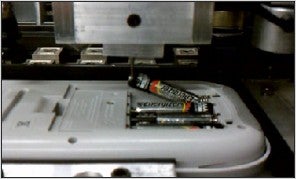
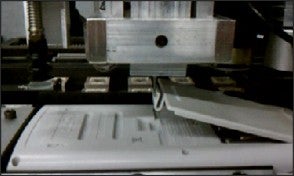
Our initial work in this area focused on the design and characterization of a prototype disassembly tool for a family of electronic devices with plastic, cantilever snap-fit covers enclosing AA or AAA batteries. The tool used a force-sensing tip equipped with three force-sensing resistors (FSRs) to release snap-fit covers and remove batteries without damage. To automate the process, we developed a prototype disassembly system that integrated this tool with a model-based computer vision application. Using a Kinect sensor and the Open-Source Computer Vision (OpenCV) library, the system identified and localized electronic devices placed on the disassembly platform.
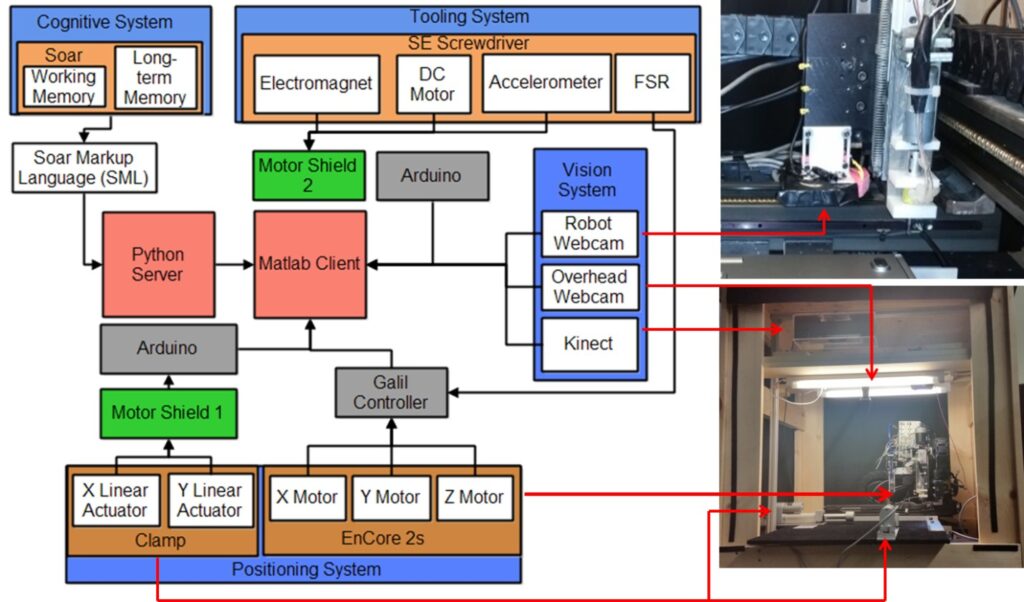
Building on this work, we next addressed automated screw removal, one of the most common fastening methods used in electronic products such as laptops. Preserving components and materials for reuse or recycling requires screws to be removed nondestructively, making reliable automated extraction an important challenge. We designed a system equipped with a three-axis positioning device, multiple cameras, and a custom sensor-equipped screwdriver that incorporated force and acceleration sensing to accommodate laptops of various sizes. The Soar cognitive architecture was used to coordinate the disassembly sequence through an automated procedure that identified, aligned with, and removed individual screws. In addition, the system differentiated between laptop models and stored screw locations for each model, reducing disassembly time when previously encountered models were processed again.
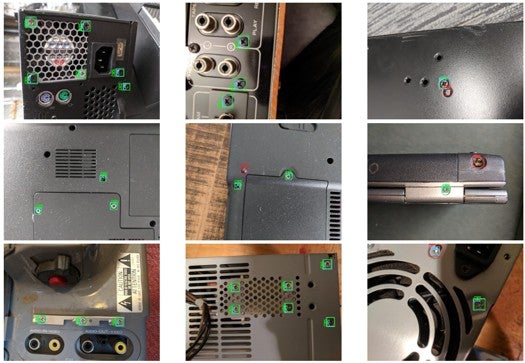
More recently, our research has shifted toward AI-enabled robotic disassembly, with an emphasis on robust screw detection and autonomous fastener extraction. We developed a deep learning object detection system based on Tiny-YOLO v2 for detecting cross-recessed screws (CRS). We also investigated the trade-off between input resolution and mini-batch size to maximize detection performance across a variety of electronic devices while efficiently utilizing GPU resources. A subsequent study using YOLO v5 further improved automated CRS detection in laptops. This work showed that several screw characteristics influence detection performance, including screw hole depth, the presence of a taper in the screw hole, screw hole location, and the color contrast between the laptop cover and the screw. Among these factors, screw hole depth had the greatest impact on detection accuracy.
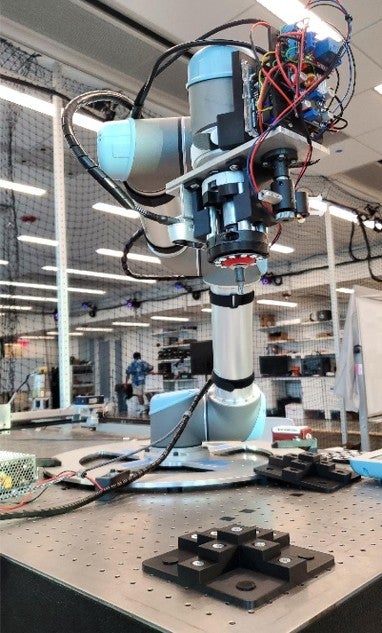
Complementing these AI-based detection methods, we developed a robotic fastener extraction system built around a UR5 robotic manipulator equipped with a specialized tool suite for removing CRS fasteners. The system combined a deep convolutional neural network (DCNN)-based screw detection with a custom software package that integrated the robot, tooling, camera system, robot controller, and RoboDK simulation environment into a unified automated disassembly platform.
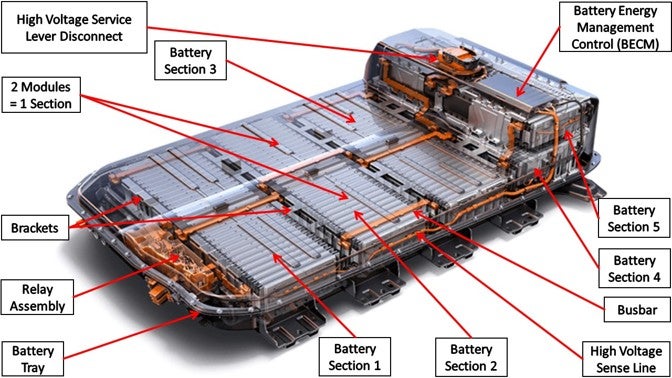
Separately, we have extended this research to the automated disassembly of electric vehicle (EV) batteries. We conducted a study assessing the automation potential of EV battery disassembly and developed an easy-to-use catalog of ten criteria for evaluating individual disassembly steps. We demonstrated the applicability of the catalog by evaluating both a plug-in hybrid electric vehicle (PHEV) battery and a battery electric vehicle (BEV) battery, providing a structured framework for assessing the automation potential of future EV battery designs.
References:
- P. Schumacher, and M. Jouaneh, “A System for Automated Disassembly of Snap-Fit Covers,” International Journal of Advanced Manufacturing Technology, Vol. 69, Issue 9-12, pp. 2055-2069, December 2013. https://doi.org/10.1007/s00170-013-5174-8
- P. Schumacher, and M. Jouaneh, “A Force Sensing Tool for Disassembly Operations,” Robotics and Computer-Integrated Manufacturing, Vol. 30, No. 2, pp. 206-217, 2014. https://doi.org/10.1016/j.rcim.2013.09.016
- N. DiFilippo and M. Jouaneh, “Characterization of Different Microsoft Kinect Sensor Models”, IEEE Sensors Journal, No. 8, pp. 4554-4564, 2015. https://doi.org/10.1109/JSEN.2015.2422611
- N. DiFilippo, and M. Jouaneh. “A System Combining Force and Vision Sensing for Automated Screw Removal on Laptops.” IEEE Transactions on Automation Science and Engineering, Vol. 15, No. 2, pp. 887-895, 2018. https://doi.org/10.1109/TASE.2017.2679720
- N. DiFilippo, and M. Jouaneh. “Using the Soar Cognitive Architecture to Remove Screws from Different Laptop Models.” IEEE Transactions on Automation Science and Engineering, Vol. 16, No. 2, pp. 767-779, 2019. https://doi.org/10.1109/TASE.2018.2860945
- D. Brogan, N. DiFilippo, and M. Jouaneh. “Deep Learning Computer Vision for Robotic Disassembly and Servicing Application”. Array, 2021, https://doi.org/10.1016/j.array.2021.100094
- J. Hellmuth, N. DiFilippo, and M. Jouaneh. “Assessment of The Automation Potential of Electric Vehicle Battery Disassembly”. Journal of Manufacturing Systems. 2021; 59, 398-412. https://doi.org/10.1016/j.jmsy.2021.03.009
- N. DiFilippo, M. Jouaneh, and A. Jedson. “Optimizing Automated Detection of Cross-Recessed Screws in Laptops Using a Neural Network”. Applied Sciences, 2024; 14(14):6301. https://doi.org/10.3390/app14146301
- A. Clark, and M. Jouaneh. “A System for Robotic Extraction of Fasteners”. Applied Sciences. 2025; 15(2):618. https://doi.org/10.3390/app15020618