
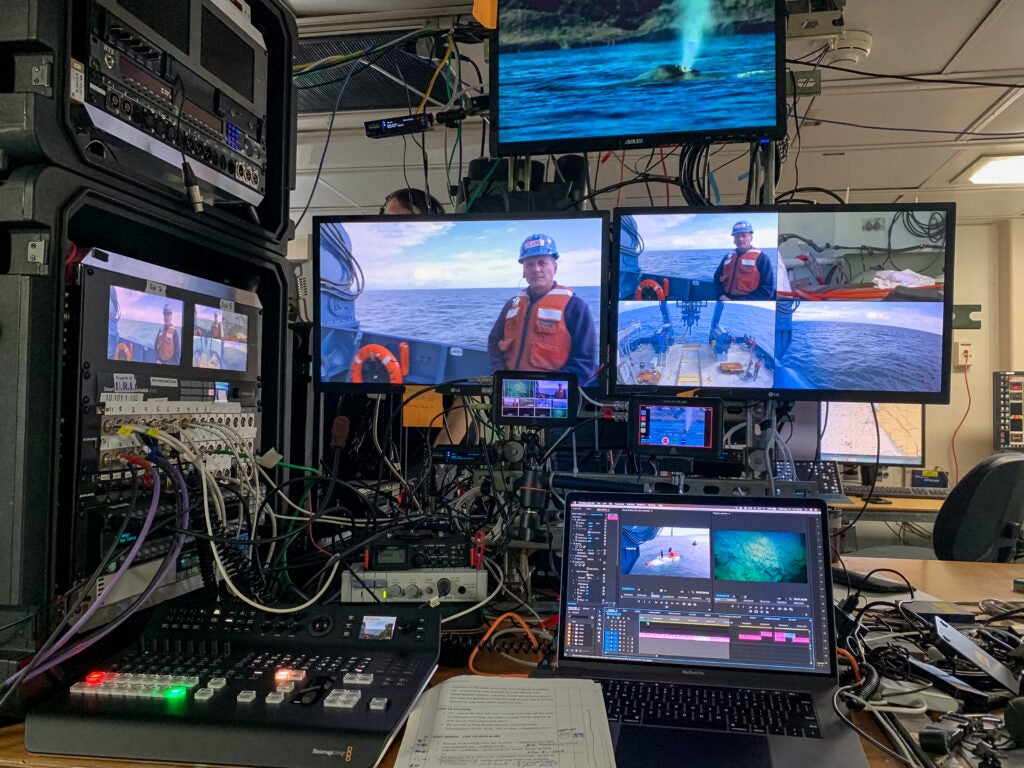
The Mobile Telepresence Unit (MTU) developed by the University of Rhode Island’s Inner Space Center (ISC) acts as a “plug-and-play” bridge that brings advanced telepresence capabilities to research vessels that lack built-in infrastructure.
The MTU enables real-time collaboration between teams at sea and on shore, regardless of the vessel’s original technical limitations and without requiring large equipment installations or permanently modifying the vessel.
Core Components of the MTU
The MTU is a portable suite of broadcast-grade equipment designed to capture, encode, and transmit high-fidelity data. The components are usually shipped in a standard ATA Category 1 flight case with 19-inch rack rails. Key components include:
- Video & Audio Capture: High-definition encoders, video switches, and audio mixers to process feeds from cameras and microphones.
- Processing Hardware: Frame synchronizers, scan converters, and video switchers for complex video effects and quality control.
- Networking Gear: Satellite antennas, network switches, and Voice-over-IP (VoIP) intercom panels that facilitate direct, two-way communication with shore-based teams.
- Integration Software: Support for VPN or GRE tunnels to ensure secure, compatible communication with shore-based infrastructure.
Enabling Capabilities
The MTU transforms a standard vessel into a telepresence-enabled platform through several critical functions:
- Bandwidth Management: Components manage satellite and internet bandwidth to ensure stable outbound streams even in remote environments.
- On-Site or Remote Expertise: Units can be deployed with an on-site technician who optimizes streams, configures hardware, and manages data transfers. However, a dedicated MTU technician is not always required and complete remote operation can be built-in for many types of MTUs.
- Virtual Watch Standing: Scientists and technicians on shore can view and access real-time data and video, communicate with distributed teams, and direct operations as if they were on the ship.
- Global Distribution: Feeds are sent to the ISC Mission Control Hub, where they are recorded and available through either ISC- or user- provided webpages.
Impact on Operations
- Increased Efficiency: Mobile MTUs are maintained by experts and updated to fit the latest technology developments and mission requirements. Research vessels with permanent telepresence capability usually need to keep large servers powered on at all times, follow complex start up/shut down procedures between uses, and require on-ship staff. Since telepresence is not required on every mission, the MTU can be easily removed from a vessel, a space-saving benefit, particularly for small vessels.
- Multidisciplinary Science: By enabling remote personnel to join virtually, missions transcend physical bunk limitations of smaller research vessels. Rather than limit expedition capabilities due to the number of experts needed, researchers can build a team that fits their science goals and have participants on ship and shore as needed. This can allow larger teams using multiple techniques and technologies to participate and increase the value of shiptime.
- Immediate Troubleshooting: Remote participants can help troubleshoot shipboard hardware or software in real-time, reducing mission downtime.