
Chemistry of the Liquid/Vapor Interface by Infrared Action Spectroscopy of Solvent-Ion Nanoclusters
The liquid/vapor interface is a ubiquitous and important chemical environment, impacting reactivity from the atmosphere to the laboratory. The interfacial region is characterized by unique properties that can dramatically accelerate chemical reaction rates. Additionally, this region is fundamental to gas-particle interconversions, facilitating reactions between molecules in the gas and liquid phases and enhancing the reactivity of dissolved molecules. Despite the importance of this region, there remains much controversy regarding its properties and how they contribute to changes in reaction mechanism and the acceleration of reactions. Understanding these processes is essential for improving our knowledge of atmospheric chemistry, air quality, and innovative chemical synthesis methods. Therefore, additional investigations are needed to elucidate the chemistry of the liquid/vapor interface.
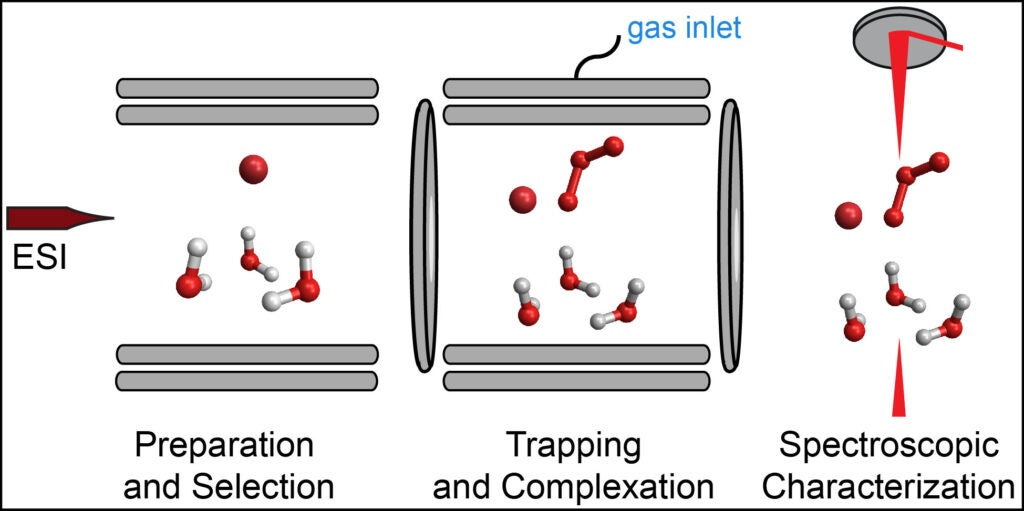
This research investigates the unique chemical reactivity at liquid-vapor interfaces using solvent-ion nanoclusters as model systems. The project focuses on three main areas: (1) the interaction of gas-phase oxidants, such as ozone and hydroxyl radicals, with ions at the interface, exploring their role in multi-phase reactions typical of atmospheric particles; (2) the solvation structures of reaction complexes and reactive oxygen species, examining how they contribute to faster reactions and redox processes at the liquid-vapor interface; and (3) the temperature-dependent structure of water around surface-active ions, which provides new insight into the molecular interactions governing these interfaces. This work is currently underway and is supported by the Department of Energy Early Career Program.
Fundamental Interactions that Govern Biomolecular Structure
The isolation of biomolecular ions in vacuum allows for precise spectroscopic interrogation of the fundamental inter- and intramolecular interactions dictating three-dimensional structure. We are interested both in the intrinsic structure of these biomolecules and in how complexation with other molecules can alter these structures. Insight into the conformational landscape of biomolecules facilitates new technologies such as the development of bio-inspired materials and support the design of novel peptide scaffolds in drug development. They can also improve our understanding of how we can use vacuum-based analysis to rapidly analyze biomolecular structure with low sample consumption.
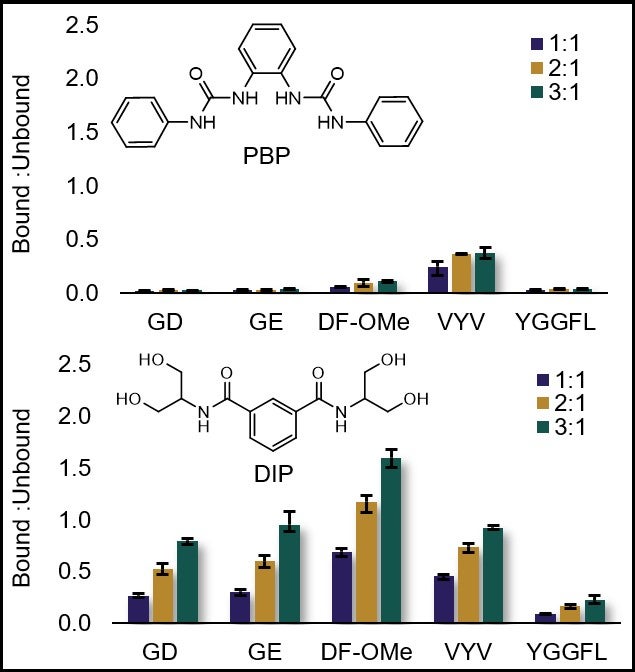
When biomolecules are transferred from solution to vacuum via electrospray ionization (ESI), the loss of solvent-molecule interactions can drive structural change, especially at charged residues, with new low-energy conformers stabilized by intramolecular hydrogen bonding. We developed a new reagent, diserinol isophthalamide (DIP), that binds to anionic sites in biomolecules to study how this complexation might influence structure. We compared this reagent to the binding of another common reagent, PBP, and found that it binds more strongly in mass spectrometry experiments (see image above). You can read more about this work in the research articles found here and here. We have also examined the complexation of this reagent with the well-known model peptide YGGFL during ESI. We found that, somewhat unexpectedly, the turn structure of this peptide is highly stable, and the complexation with DIP does not alter the structure significantly (see image below for an illustration of this experiment). The journal article related to this work can be found here.
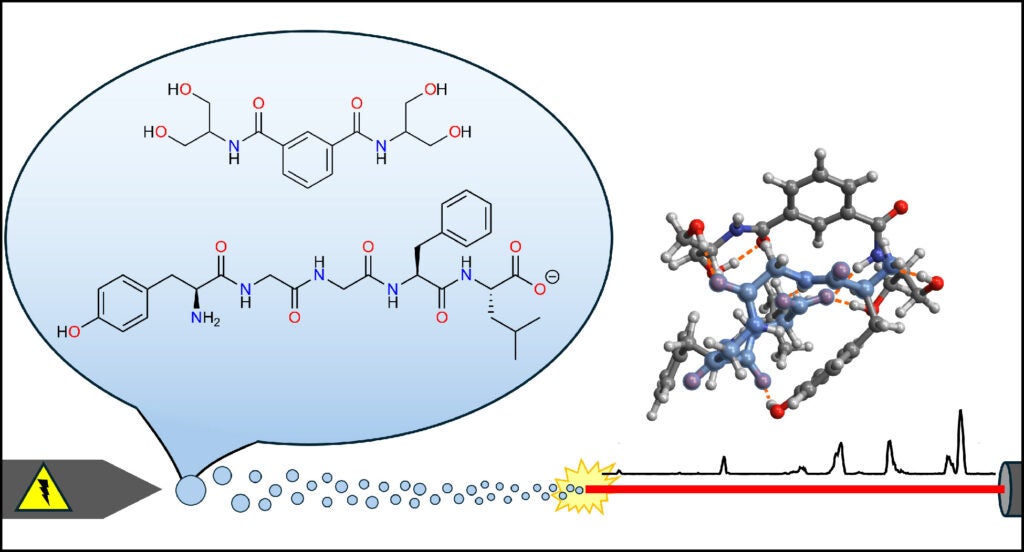
More recently, we have been expanding our studies of biomolecules to include more complex systems, including clusters between peptides, RNA molecules, and micohydrated biomolecules (those with some water molecules still bound after transfer to vacuum). This work has been supported by NSF grant CHE-2212926.
Structural Motifs in Deep Eutectic Solvents
Deep eutectic solvents (DESs) are a rapidly developing class of solvents with tunable solvation properties modulated by the selection of ionic hydrogen bond acceptors (typically quaternary ammonium species) and hydrogen bond donors. These solvents exhibit many of the desirable properties of standard ionic liquids, including low vapor pressure, high thermal stability, and tunable solvation properties. In addition, they possess several favorable attributes distinct from those of ionic liquids such as decreased toxicity, low cost, and comparatively simple preparation. For these reasons, there is great interest in the development of new DESs as well as the investigation of the structure-function relationship across solvent compositions. Central to the choice of appropriate DES components is the identification of the underlying structural motifs that govern the observed properties. Therefore, there exists the need for additional characterization of DES systems to unravel the fundamental intra- and intermolecular interactions prominent in various DES formulations.
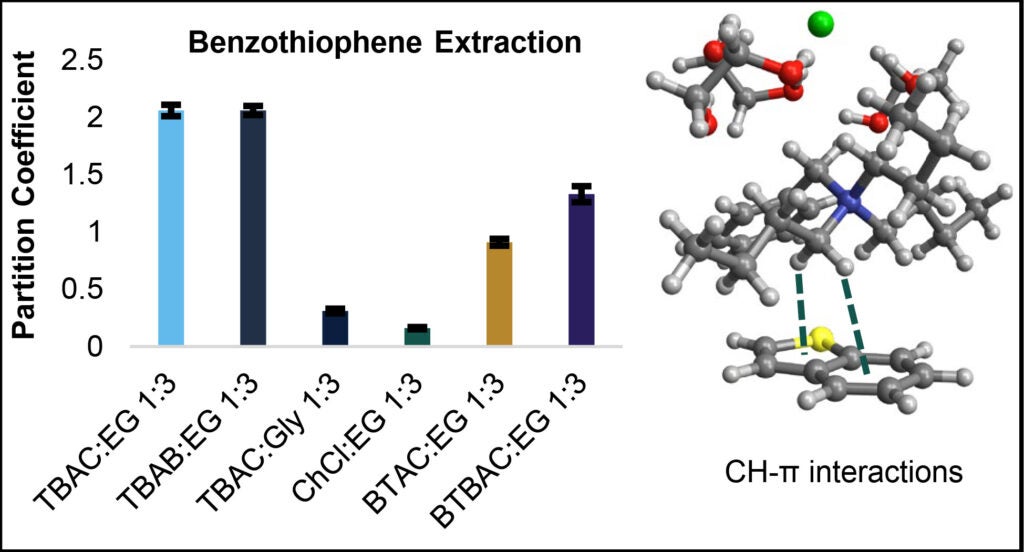
We have explored prominent molecular interactions in deep eutectic solvents using a combination of condensed-phase and vacuum isolation approaches. First, we examined the DES extraction efficiency of sulfur-containing aromatic species in model petroleum solvent (n-heptane). We found that the most efficient extraction was obtained when CH-Pi interactions when there was high potential for CH-Pi interactions rather than Pi-Pi interactions. You can read the full research article here.
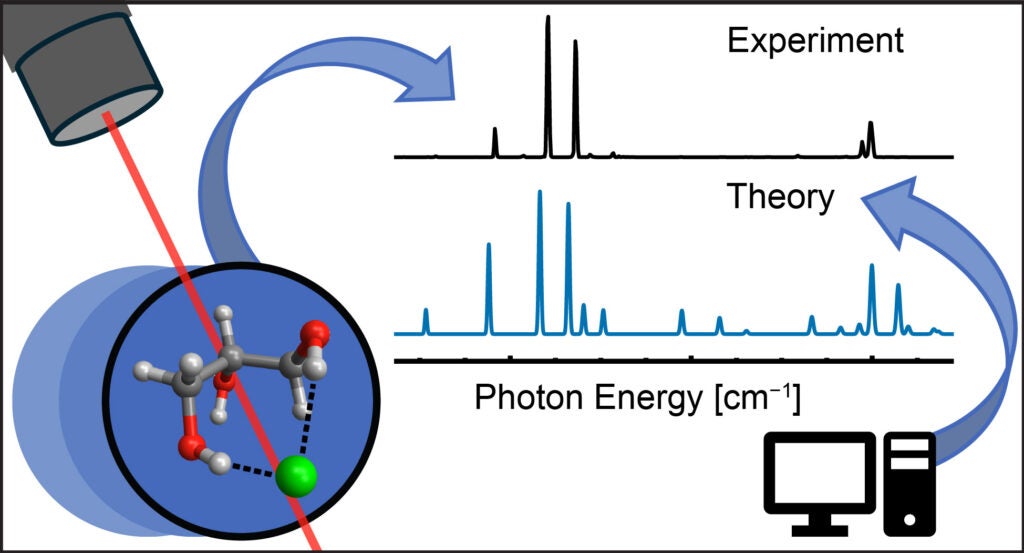
Complementary to these condensed-phase studies, we have used helium nanodroplet isolation infrared (HENDI IR) action spectroscopy to characterize isolated halide–molecule clusters relevant to DESs (see image above). Charged clusters containing DES component molecules were generated by nanoelectrospray ionization, selected and isolated by quadrupole mass spectrometry, and characterized by infrared action spectroscopy. The obtained IR spectra were matched to theoretical spectra of candidate structures to identify the observed structural motifs. Cluster IR spectra were also compared to those of bulk DESs, revealing distinctions between isolated clusters and bulk solution. This work shows the importance of assessing both intermolecular and halide-molecule interactions to accurately represent macroscopic DES structure. You can read more in the full research article found here.