
Select Publications
Shaw, C., Gordon, J.K., Ward, C., Jackson, L., Shaw, N., & Williams, K.N. (2025). The Iowa coding scheme for elderspeak: Development and validation. The Gerontologist, 65 (6). https://doi.org/10.1093/geront/gnaf093
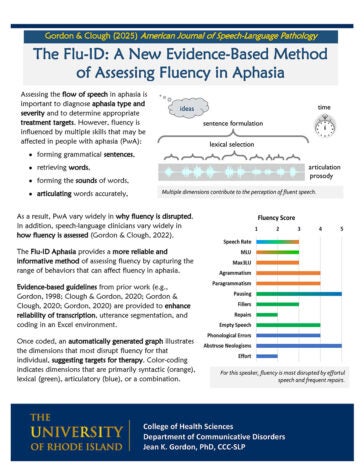
Gordon, J.K. & Clough, S. (2024). The Flu-ID: A new evidence-based method of assessing fluency in aphasia. American Journal of Speech-Language Pathology.https://doi.org/10.1044/2024_AJSLP-23-00424. FluID INFOGRAPHIC
Gordon, J.K. & Chen, H. (2023). How well does the discrepancy between semantic and letter verbal fluency performance distinguish Alzheimer’s dementia from typical aging? Aging, Neuropsychology & Cognition, 30/5, https://doi.org/10.1080/13825585.2022.2079602.
Gordon, J.K. & Clough, S. (2022). How do clinicians judge fluency in aphasia? Journal of Speech Language Hearing Research, 65, 1521-1542, https://doi.org/10.1044/2021_JSLHR-21-00484.
Boyle, M., Gordon, J.K., Harnish, S.M., Kiran, S., Martin, N., Rose, M.L., Salis, C. (published online Nov.22, 2021). Evaluating cognitive-linguistic approaches to interventions for aphasia within the Rehabilitation Treatment Specification System (RTSS). Archives of Physical Medicine and Rehabilitation.
Shaw, C. & Gordon, J.K. (2021). Understanding elderspeak: An evolutionary concept analysis. Innovation in Aging, 5(3), 1-18.
Gordon, J.K. (2020). Factor analysis of spontaneous speech in aphasia. Journal of Speech-Language-Hearing Research, 63, 4127-4147.
Gordon, J.K. & Clough, S. (2020). How fluent? Part B. Underlying contributors to continuous measures of fluency in aphasia. Aphasiology, 34 (5), 643-663.
Clough, S. & Gordon, J.K. (2020). Fluent or nonfluent? Part A. Underlying contributors to categorical classifications of fluency in aphasia. Aphasiology, 34 (5), 515-539.
Gordon, J.K.., Andersen, K., Perez, G. & Finnegan, E. (2019). How old do you think I am? Perceptions of age and communication. Journal of Speech, Language and Hearing Research, 62(7), 2455-2472. https://doi.org/10.1044/2019_JSLHR-L-19-0025
Gordon, J.K., Young, M. & Garcia, C. (2018). Why do older adults have difficulty with semantic fluency? Aging, Neuropsychology & Cognition, 25(6), 803-828. doi:10.1080/13825585.2017.1374328.
Gordon, J.K. & Kurczek, J. (2014). The aging neighborhood: Phonological density in naming. Language, Cognition and Neuroscience, 29(3), 326-344.
Gordon, J.K. & Cheimariou, S. (2013). Semantic interference in a randomized naming task: Effects of age, order, and category. Cognitive Neuropsychology, 30(7/8), 476-494.
Gordon, J.K. & Kindred, N.K. (2011). Word retrieval in aging: An exploration of the Task Constraint hypothesis. Aphasiology, 25(6/7), 774-788.
Gordon, J.K. (2008). Measuring the lexical semantics of picture description in aphasia, Aphasiology, 22(7/8), 839-852.
Gordon, J.K. (2007). A contextual approach to facilitating word retrieval in non-fluent aphasia, Aphasiology, 21(6/7/8), 643-657.
Gordon, J.K. (2006). A quantitative analysis of picture description. Aphasiology, 20 (2/3/4), 188-204.
Gordon, J.K. & Dell, G.S. (2003). Learning to divide the labor: An account of deficits in light and heavy verb production, Cognitive Science, 27(1), 1-40.
Gordon, J.K. (2002). Phonological neighborhood effects in aphasic speech errors: Spontaneous and structured contexts, Brain and Language, 82, 113-145.
Gordon, J.K. (1998). The fluency dimension in aphasia. Aphasiology, 12(7/8), 673-688.