
Our lab builds deep learning methods that decode brain activity from non-invasive neuroimaging, with a focus on functional near-infrared spectroscopy (fNIRS) and electroencephalography (EEG). We design compact networks for single-trial classification, learn shared representations across imaging modalities, and work toward large pretrained models that hold up across people, devices, and recording sessions.
AbsoluteNet
A deep network for classifying auditory hemodynamic responses from fNIRS
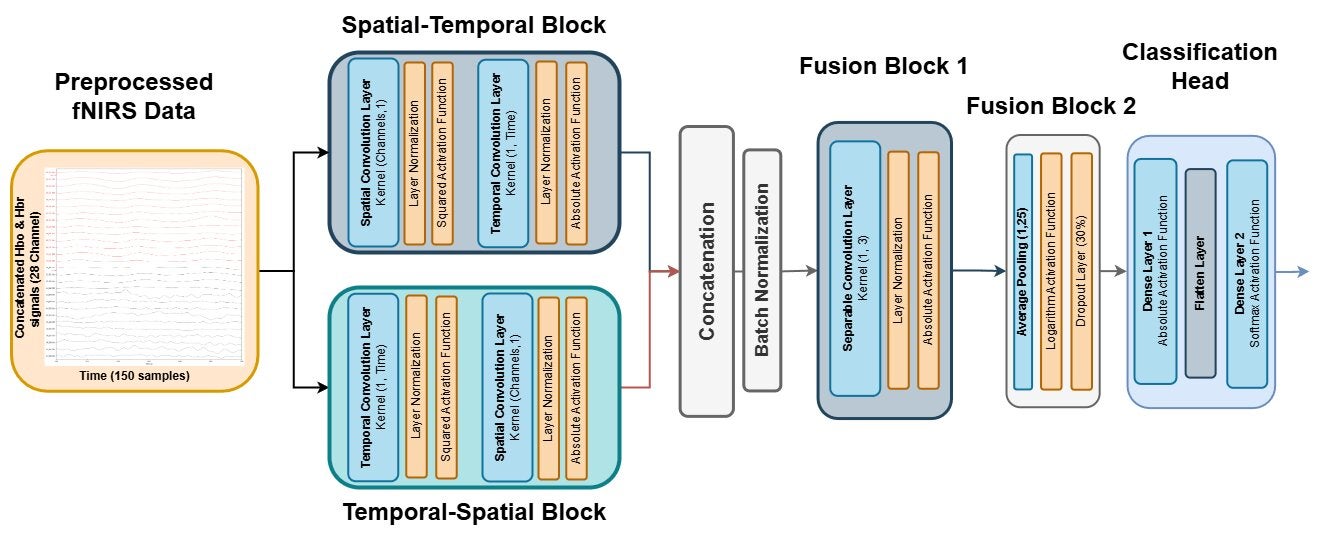
Single-trial fNIRS responses are hard to classify: the signal is weak relative to physiological noise and motion artifacts, and it varies widely from trial to trial and from person to person. AbsoluteNet addresses this with two parallel convolutional streams, one that filters across channels first and then across time, and one that works in the opposite order. The two views are fused through separable convolutions before classification. The network takes its name from its activation functions, which are symmetric around zero (squared in the early layers, absolute value in the deeper ones), so that the size of a hemodynamic change is kept whichever direction it goes. In an auditory oddball experiment where listeners heard standard and deviant sounds, AbsoluteNet reached about 87% accuracy using oxygenated and deoxygenated hemoglobin together, ahead of our earlier fNIRSNET model, while staying small at roughly 49,000 parameters.
Read the paper on IEEE Xplore | Preprint on arXiv
fNIRSNET
Multi-view spatio-temporal fusion for fNIRS-based auditory event classification
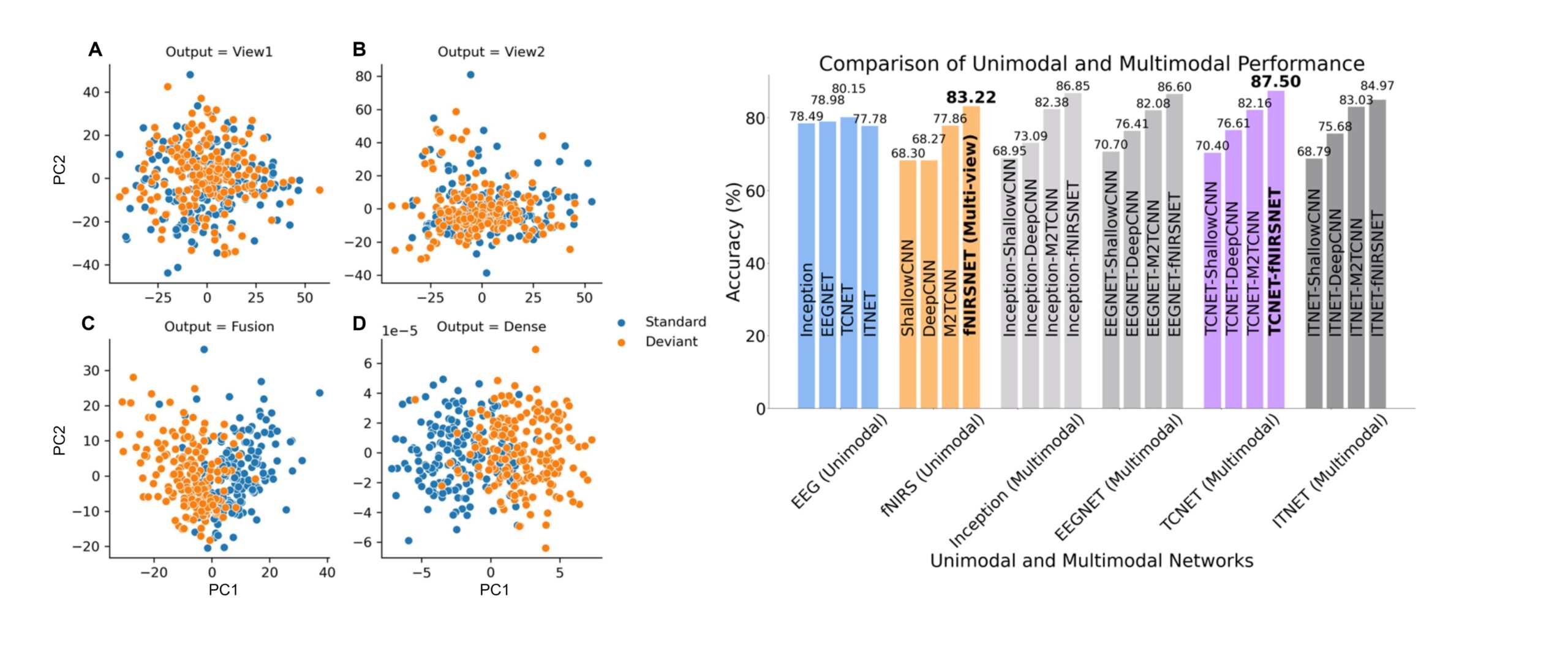
Multi-view learning, in which a model looks at the same recording from several angles at once, has worked well for other kinds of neural data but had seen little use in fNIRS. fNIRSNET is a convolutional framework that builds spatial and temporal views of the fNIRS signal and fuses them, and it examines how oxygenated (HbO2) and deoxygenated (HbR) hemoglobin are best combined, either as parallel inputs or merged into one. Tested on responses to auditory stimuli and compared against eight baseline models, the merged-input version gave the highest accuracy, ranging from about 81% to 92% depending on how the dataset was composed. fNIRSNET was also designed to pair with established EEG networks: combining the two modalities outperformed either one alone, reaching about 87% accuracy on balanced data.
Read the paper in Engineering Applications of Artificial Intelligence | Open-access copy (NSF PAR)
Contrastive Learning Between EEG and fNIRS
CLIP-style alignment of two complementary views of the brain
CLIP (Contrastive Language-Image Pretraining) learns by matching: given many image and caption pairs, it trains two encoders so that an image and its own caption land close together in a shared embedding space, while mismatched pairs are pushed apart. No manual labels are needed, only the fact that the two items belong together. We apply the same idea to neuroimaging, treating EEG and fNIRS segments recorded at the same moment as a matched pair.
The two modalities are natural partners because they measure different sides of the same event. EEG captures the brain’s electrical activity millisecond by millisecond but is spatially blurred, whereas fNIRS tracks the slower blood-oxygenation response that follows neural activity and localizes it better over the cortex. Aligning them forces each encoder to keep the information the two share, which is the underlying neural activity, and to discard what is specific to one sensor, such as muscle artifacts in EEG or scalp blood flow in fNIRS. The resulting representations can be learned from unlabeled simultaneous recordings, transfer to downstream tasks with little labeled data, and let a model keep working when only one modality is available.
Foundation Models for fNIRS and EEG
Robust, general-purpose models of brain signals
A foundation model is a large network that is pretrained once on a broad collection of mostly unlabeled data and then adapted to many different tasks, rather than being trained from scratch for each one. Pretraining is usually self-supervised: for example, parts of a signal are hidden and the model learns to reconstruct them, which teaches it the general structure of the data. Language and vision models built this way have shown that one well-pretrained model can be fine-tuned for a new problem with only a small amount of labeled data.
We are developing foundation models for fNIRS and for EEG with robustness as the central goal. Neuroimaging datasets are small and differ from one another in ways that break conventional models: different people, different devices and sensor layouts, different sampling rates, and varying amounts of noise and missing channels. A robust foundation model should give reliable results across all of these, so that a lab or clinic can adapt it to a new study, task, or population without collecting a large labeled dataset first.