Facilities
The nonlinear dynamics laboratory is located in room 270 of the Fascitelli Center for Advanced Engineering. It supports analytical, computational, and experimental research in nonlinear dynamics and vibrations, nonlinear modal analysis, system identification, structural-health monitoring, and vibration control.
Vibration Excitation and Modal Testing
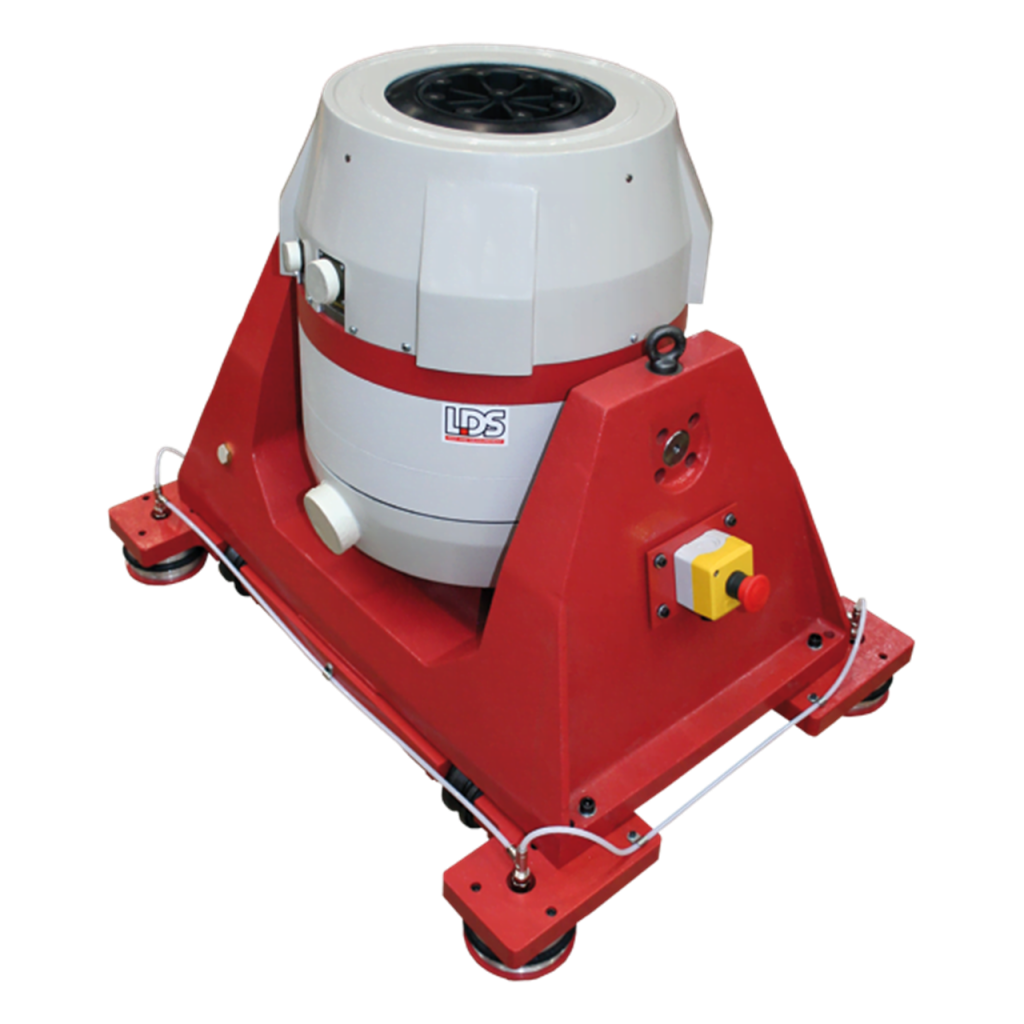
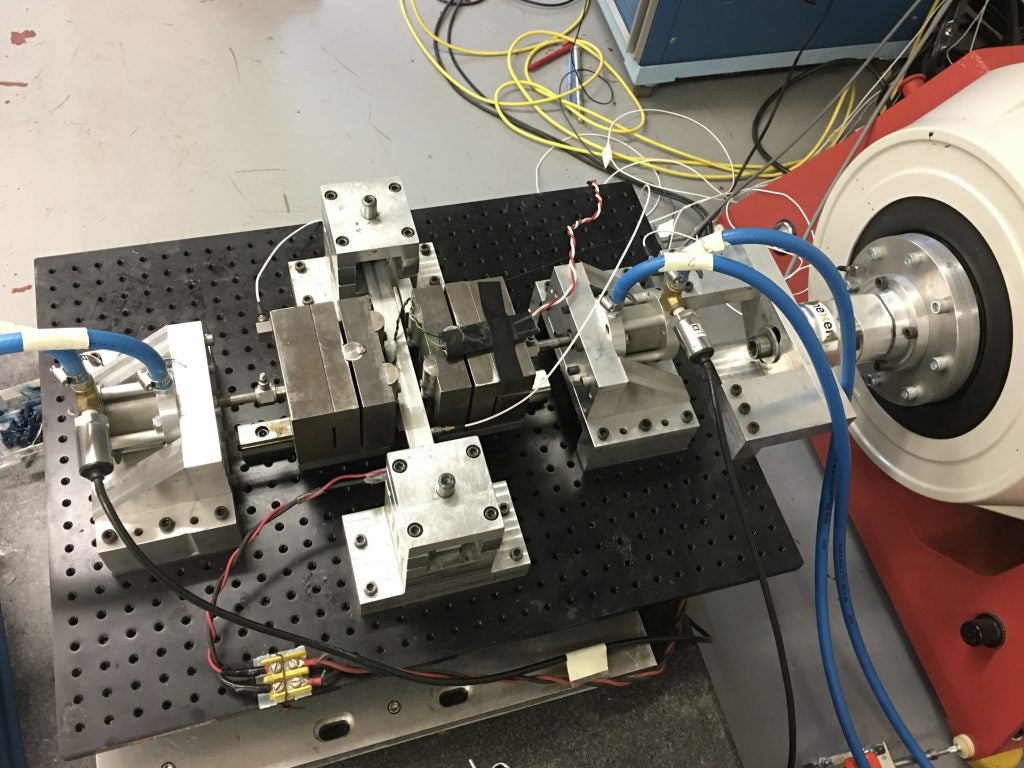
The NLD maintains multiple electrodynamic vibration-excitation systems, including LDS V721 and multiple VTS-100 electromagnetic shakers, as well as a ModalShop K2110E110 electrodynamic exciter system. The ModalShop system provides a 110-lbf peak sine-force capability with 1-in. peak-to-peak stroke and supports payloads up to 10 lb. The system includes the 2110E dual-purpose platform shaker, 2050E09-FS power amplifier, cooling package, and accessory kit.
These excitation systems provide the controlled harmonic, swept-sine, broadband, and transient inputs. They are utilized in low-amplitude linear characterization, nonlinear frequency-response measurements, activation-threshold studies, bidirectional sweeps, and validation of accessible nonlinear response branches.
The laboratory also has modal-impact testing capability, including an instrumented modal hammer and impedance-head capability. These resources support independent modal characterization of the primary structure and absorber assemblies before forced-response testing.
Multichannel Data Acquisition, Dynamic Signal Analysis, and Control
The laboratory has complementary National Instruments, DataPhysics, and Crystal Instruments platforms for synchronized acquisition, experimental control, vibration analysis, and automated testing.
National Instruments / LabVIEW system:
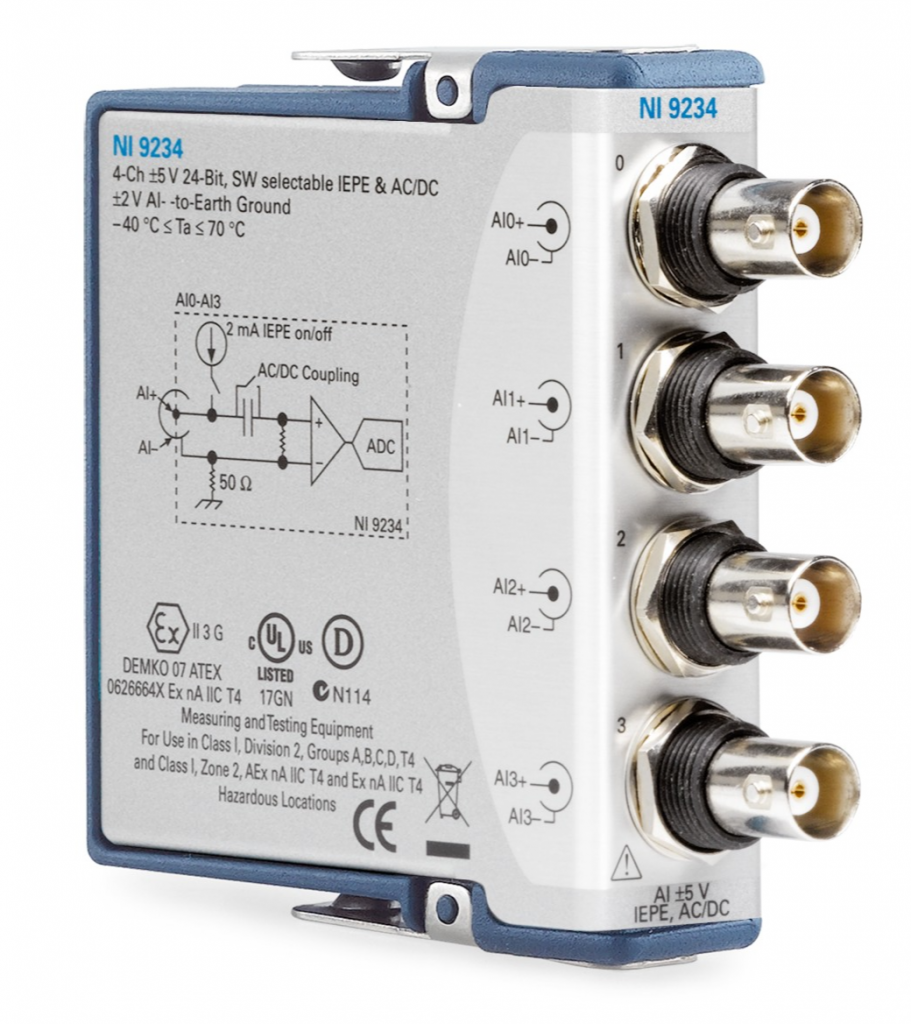
- four NI 9234 four-channel sound-and-vibration input modules, providing eight IEPE/AC/DC vibration-input channels at 24-bit resolution and 51.2 kS/s per channel;
- one NI 9215 four-channel analog-input module with ±10 V range, 16-bit resolution, and 100 kS/s per channel;
- one NI 9260 two-channel analog-output module with 24-bit resolution and 51.2 kS/s per channel; • one NI 9361 eight-channel counter-input module suitable for encoder and pulse measurements;
- an NI 9149 eight-slot Ethernet C-Series expansion chassis;
- NI LabVIEW for experimental automation, synchronized acquisition, control, and implementation test protocols.
The laboratory also has a Crystal Instruments Spider-80Xi/Spider-80Hi platform configured for multichannel vibration analysis. The system provides eight 24-bit IEPE/voltage input channels with sampling rates up to 256 kHz and includes FFT/FRF analysis and time-waveform recording. Available software capabilities include swept-sine FRF analysis, order analysis, real-time sine reduction, real-time digital filtering, shock-response-spectrum analysis, automated scheduling/limiting, and vibration-control functions.
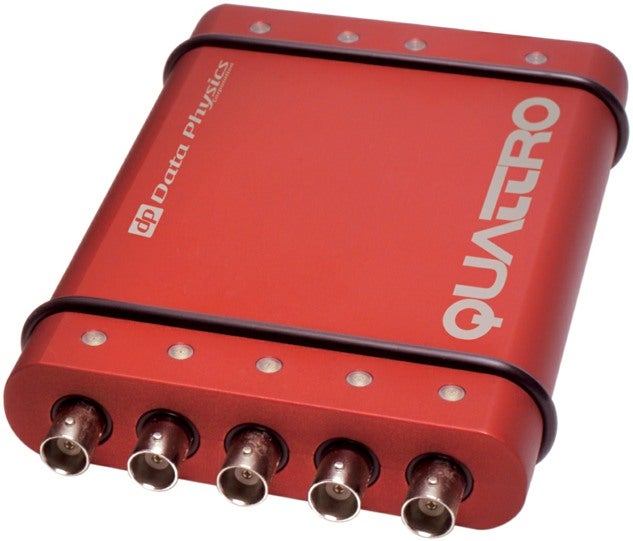
The laboratory’s SignalCalc ACE by Data Physics is an ultra-portable, USB-powered dynamic signal analyzer and data acquisition system designed for noise and vibration. Weighing just over a pound, it provides high-performance signal processing in a pocket-sized hardware platform powered by the Quattro hardware. Quatro has 4 input channels, 2 output sources, and 1 tachometer channel. Its dynamic range is over 120 dB utilizing high-quality sigma-delta converters and its bandwidth is 40 kHz standard real-time rate. It is ideal for measuring signals across time, frequency, amplitude, and order domains; field testing, structural dynamics, rotational order tracking, and general acoustic troubleshooting.
The NI, DataPhysics ACE, and Crystal Instruments systems provide complementary pathways for nonlinear FRF measurements, phase-resolved response characterization, modal testing, high-dynamic-range waveform capture, and independent verification of experimentally observed attractors and bifurcation behavior.
Sensors and Signal Conditioning
The NLD has substantial existing force, acceleration, strain, and noncontact motion-sensing capability. This includes PCB load cells, straingauges, accelerometers and conditioning hardware, Vishay strain-gauge amplifiers/conditioners, and Keyence noncontact laser vibrometers.
Mechanical Fabrication
The NLD has general laboratory tools, enclosed 3D printer, and access to institutional prototyping/fabrication resources for assembly, alignment, instrumentation mounting, and modification of experimental hardware.
Computational Resources and Software
The NLD maintains high-performance computer workstations/servers for numerical simulation, nonlinear dynamics analysis, computer-aided design, finite-element analysis, and experimental-data processing. These resources support symbolic kinematic expansion, construction of complete potential and inertial nonlinear tensors, normal-form reduction, parameter optimization, pseudo-arclength continuation, Floquet analysis, basin calculations, and experimental-data reduction.
MATLAB is the principal computational environment for numerical analysis, continuation, optimization, and experimental post-processing. NI LabVIEW supports synchronized data acquisition, automation, and experimental control. Existing CAD and engineering-analysis software supports design, fabrication, and documentation of experimental testbeds.
Software Licensing and Computer Usage Policy and Guidelines for NLD
This Nonlinear DynaLaboratory’sorNLD’sNLD’s) computer usage policy outlines the guidelines for properly using its computers and the University of RIsland’sanURI’sURI’s) network and internet.