
From early March to late April, group members learn the therapeutic benefits of tending to the earth and growing plants at URI’s medicinal garden
KINGSTON, R.I. – Jan. 29, 2026 – Students looking for more of a hands-on approach to group therapeutic support might want to check out what’s growing outside of Avedisian Hall.
A collaborative effort between the College of Pharmacy and the Counseling Center, the University of Rhode Island’s Therapeutic Horticulture Group is in its third year as one of the university’s most unique group counseling offerings.
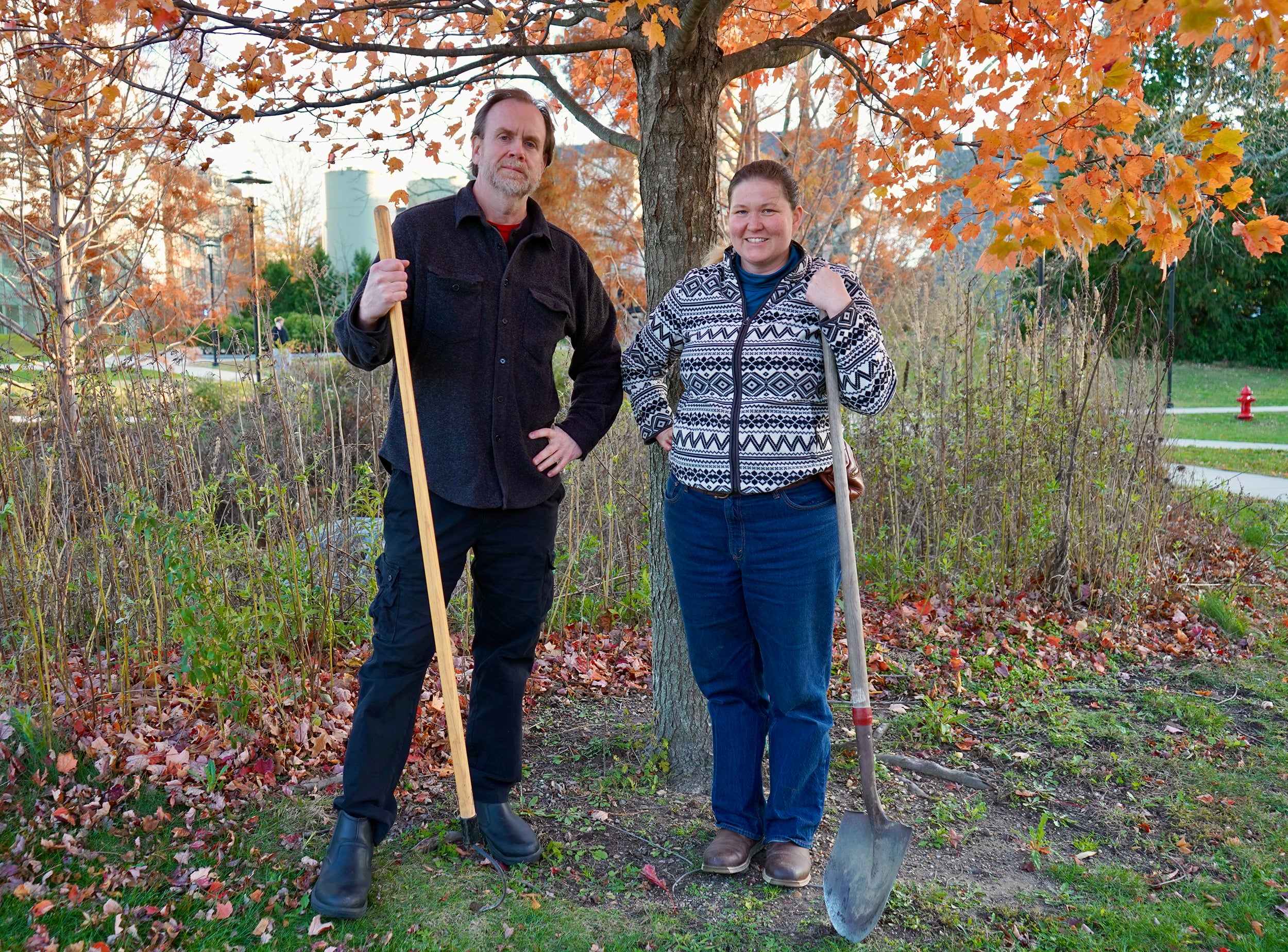
The group, led by university psychologist and URI master gardener Warren Schwartz and Elizabeth Leibovitz, coordinator of the Heber W. Youngken Jr. Medicinal Garden outside Avedisian, offers students the opportunity to create a safe, healing space on campus while experiencing the therapeutic benefits of tending to the earth and growing plants.
Students who join will spend their spring semester – typically March through April following a more thorough three-month cohort in the fall between September and November – learning about various plants and herbs in the garden, participating in stress-relieving exercises, and giving back to the campus community by designing a healing, pollinator-friendly, garden. Registration for the upcoming spring cohort is available online. The spring 2026 cohort runs from March 2 to April 27.
The concept of the Therapeutic Horticulture Group came about rather unexpectedly when Leibovitz, the coordinator of the College of Pharmacy’s medicinal garden, met Schwartz, a master gardener who had been renting space at the university’s nearby botanical gardens through the College of Environment and Life Sciences.
“It sort of just sparked from there,” Leibovitz said.
In addition to her work at URI, Leibovitz has also volunteered for the New Garden Society, a non-profit in Greater Boston that uses therapeutic horticulture to provide vocational training, skill-building, and wellness for incarcerated and formerly incarcerated individuals. Horticulture therapy, she says, has “made a comeback” with the recent uptick in mental health awareness, and her immediate connection with Schwartz prompted the two to develop a similar group wellness program at URI three years ago.
“There’s a convergence of an appreciation and destigmatization around seeking mental health services, but also a resurgence and an interest in growing plants,” Leibovitz said, “which got greatly bolstered during the height of the pandemic. A lot of people were starting gardens and there’s been this resurgence and interest in growing plants.”
The Therapeutic Horticulture Group recommends its members commit for the entire semester – eight sessions for the spring semester with 90-minute meetings each Monday – based on the amount of work it takes to start and finish a healing garden by the end of April.
“The purpose of that,” Schwartz said, “is to help ourselves and each other connect to the present moment and remove inner distractions and concerns to soothe anxiety and to help them be more in contact with what’s right in front of them. That sets the stage for the meaningful work we do with the group, such as weeding or sowing seeds or engaging with plants in the greenhouse.
“We want students in the group to connect with each other and build relationships. That is an incredibly important point and an emphasis on belonging and inclusion and inclusion of students who might not feel like they fit in other places. We provide a nice environment for them to be heard and to be seen and to be connected to other folks.”
Horticulture therapy has been linked to reducing stress, anxiety, and depression while boosting mood, self-esteem, and social skills through engaging with plants. Likewise, it improves motor skills, balance, and endurance and works cognitively by enhancing memory, focus, and problem-solving.
Leibovitz says URI’s Therapeutic Horticulture Group gives students a sense of purpose and connects them to nature by allowing them to work on projects that benefit the environment and the greater community. Students, for example, focus on ecological gardening – working with, not against, nature – to create self-sustaining ecosystems that support vital wildlife like pollinators and birds, improve soil health, and, ultimately, reduce pollution.
“Horticulture is uniquely positioned to be a useful therapeutic modality,” Leibovitz said. “For one reason is it’s been part of human history for so long. Agriculture was invented at least 12,000 years ago, but archeologists say it was even longer than that.
“We are evolutionarily wired to love nature, but to just love nature is one thing – to be able to really be engaged with nature, be involved, and manipulating and helping create these garden spaces just gives you a sense of accomplishment. When I started agriculture, I loved it right off the bat because at the end of the day, I felt I had done something useful, and I continue to feel that every day.’
The upcoming spring cohort will work in a space adjacent to the medicinal garden outside Avedisian to create what is called a pollinator pathway, a green space with native plants that provide food, water, and shelter for the aforementioned pollinators, which are essential to the reproduction of more than 35 percent of global food crops like fruits, vegetables, nuts, and spices. Schwartz and Leibovitz agree the feedback from participants has been overwhelmingly positive with students using their time in the garden to “get away from whatever’s bothering them” and focus on something that benefits others.
“We’re proud that we’ve been able to establish something that’s lasted,” Schwartz said.
###
Michael Parente, director of communications and marketing in the URI Division of Student Affairs, wrote this news release.