
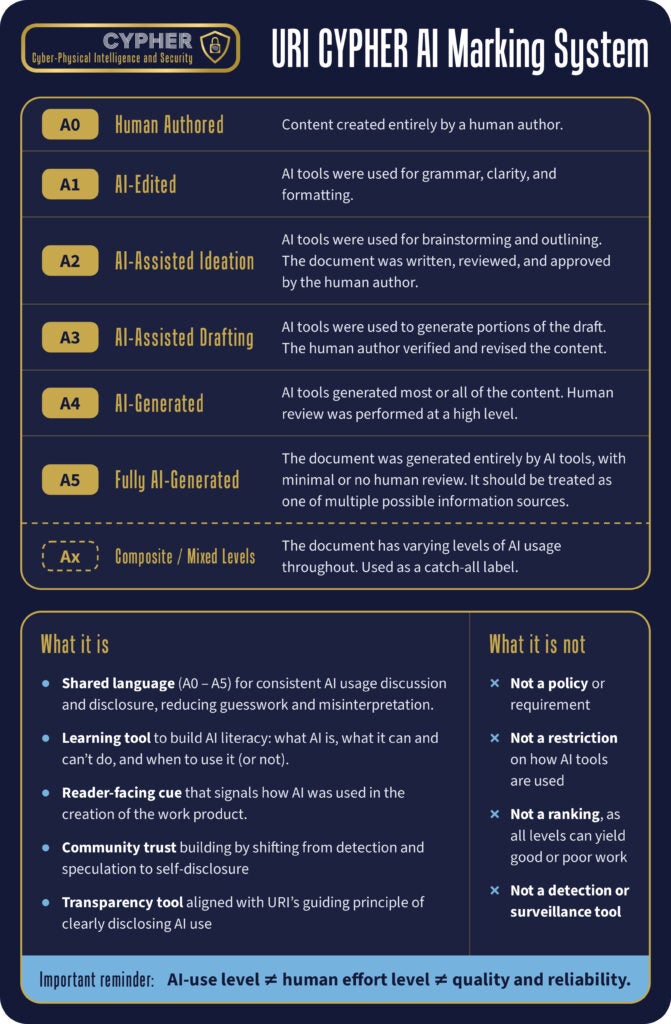
The URI CYPHER AI Usage Marking is a lightweight labeling system that helps creators clearly disclose how artificial intelligence contributed to a work product. It is not a policy, restriction, ranking, or detection tool; it is a simple reader-facing cue for communicating AI use clearly and consistently.
Who was this created for?
The URI CYPHER AI Usage Marking system emerged as a grassroots effort led by CYPHER Founding Director and ECE Professor Yan (Lindsay) Sun. It was first introduced to faculty and staff in April 2026, and more widely announced at the Talking about AI Use: Why, How, and When to Label It workshop on May 13.
As of Fall 2026, the Marking System has been recommended by the URI AI Task Force, integrated into the URI Graduate School’s Thesis and Dissertation AI Usage Agreement, referenced in the Responsible Use of Generative AI in Graduate Education guidance document, and piloted in several courses.
Resources for Instructors: How to use the AI Usage Marking System in your class
The marking system emerged to meet our community’s need for simple, standardized, non-disciplinary, precise, and equitable AI use disclosure in classrooms and among colleagues, stakeholders, and collaborators in higher education. The one-page guide and classroom examples below support instructors who want to use the marking system in their courses.
One-Page Guides
You can download this one-page PDF as a handout. The handout explains the marking system and provides examples of its use on assignments. Human-designed and AI-designed versions are available.
AI-designed (a3) human-designed (a0)Classroom Examples
The classroom examples show how the marking system can be adapted for different assignments.
Comprehensive project – ise 572 specific assignment – ele 420AI Marking in Further Detail
For more guidance and information on the marking system’s uses and development, download the full presentation from the Talking about AI Use: Why, How, and When to Label It workshop and the published whitepaper (coming soon).
Showcased Adopters
How the Marking System is Helping URI Graduate School Introduce Responsible Use of AI in Graduate Education
The University of Rhode Island Graduate School has published new resources to help faculty, staff, and graduate students navigate AI use responsibly and transparently. The Graduate School encourages faculty and students to consider using the URI CYPHER AI Usage Marking System as a common language for discussing AI use.

CYPHER Marking System Recommended by URI AI Task Force
Developed through collaboration across the URI community, the URI Academic Affairs AI Task Force Report 2026 focuses on the thoughtful and responsible use of artificial intelligence across teaching, research, and University operations. The URI CYPHER AI marking system is recommended in this report.

Fall 2026 Course Pilots
These new, showcased pilot courses are in addition to previous pilots during the Spring 2026 semester. This is not a complete list of all URI courses using the Marking System.
Have a course, project, or organization you’d like to have featured? Notify us through the form here.
| Course Code | Course Title |
| ELE 404 | Practical PCB Design |
| ELE 480 / 481 | ELECOMP Capstone Design I / II |
| LIB 250 | Information Research Across Disciplines |
| WRT 106 (sections 3, 15, 17) | Introduction to Research Writing |
| WRT 371G | Write Now: Language, Culture, and Power |
Acknowledgments
We thank Anthony J. Marchese, Ph.D., Dean of Engineering, for contributing early inspiration for including the A0 marking, helping frame the system around practical, community-centered adoption, and bringing a college-level leadership perspective. He also played a leading role in positioning URI CYPHER AI Marking as a voluntary framework for building shared understanding around AI use in higher education.
We thank Chelsie Sullivan, CYPHER coordinator, for her contributions to the project’s human-centered framing, website, and training materials. Her perspective helped keep the purpose of AI use focused on people, community benefit, and responsible practice.
We thank Steve Mullaney, ELE’85 alumnus, entrepreneur, and member of the College of Engineering Industrial Advisory Board, for encouraging this initiative and helping bring it into discussion with industry advisors.
We thank Dr. Romesh Prasad and Dr. Hui Lin, who adopted the marking system in their Spring 2026 classes and provided valuable use cases and classroom feedback.
We are grateful to CYPHER faculty and students, ECBE faculty members, and all colleagues who participated in early discussions.
We thank department chairs: Carl-Ernst Rousseau, Geoffrey Bothun, and Chris Baxter, who discussed the system with their faculty and shared feedback. Special thanks to Geoff for inspiring the “what it is not” messaging.
We thank the individual contributors to the Q&A material, including Dhaval Solanki, Romesh Prasad, Hui Lin, Anissa Elias, Chelsie Sullivan, Showrov Rahman, Dayne Broderson, John Haverlack, and Gaurav Khanna. (more names will be added)
We thank all participants in the May 13 workshop. Your questions and comments are highly appreciated.
Finally, we thank the faculty and instructors who are planning to pilot URI AI Marking in their Fall 2026 courses.
AI usage marking for this page: Content (A0), Graphic (A3)