
PI: Reza Abiri
Funding Source: National Science Foundation (NSF), CAREER Program
Amount: $546,847
Funding Period: June 1, 2025 – May 30, 2030
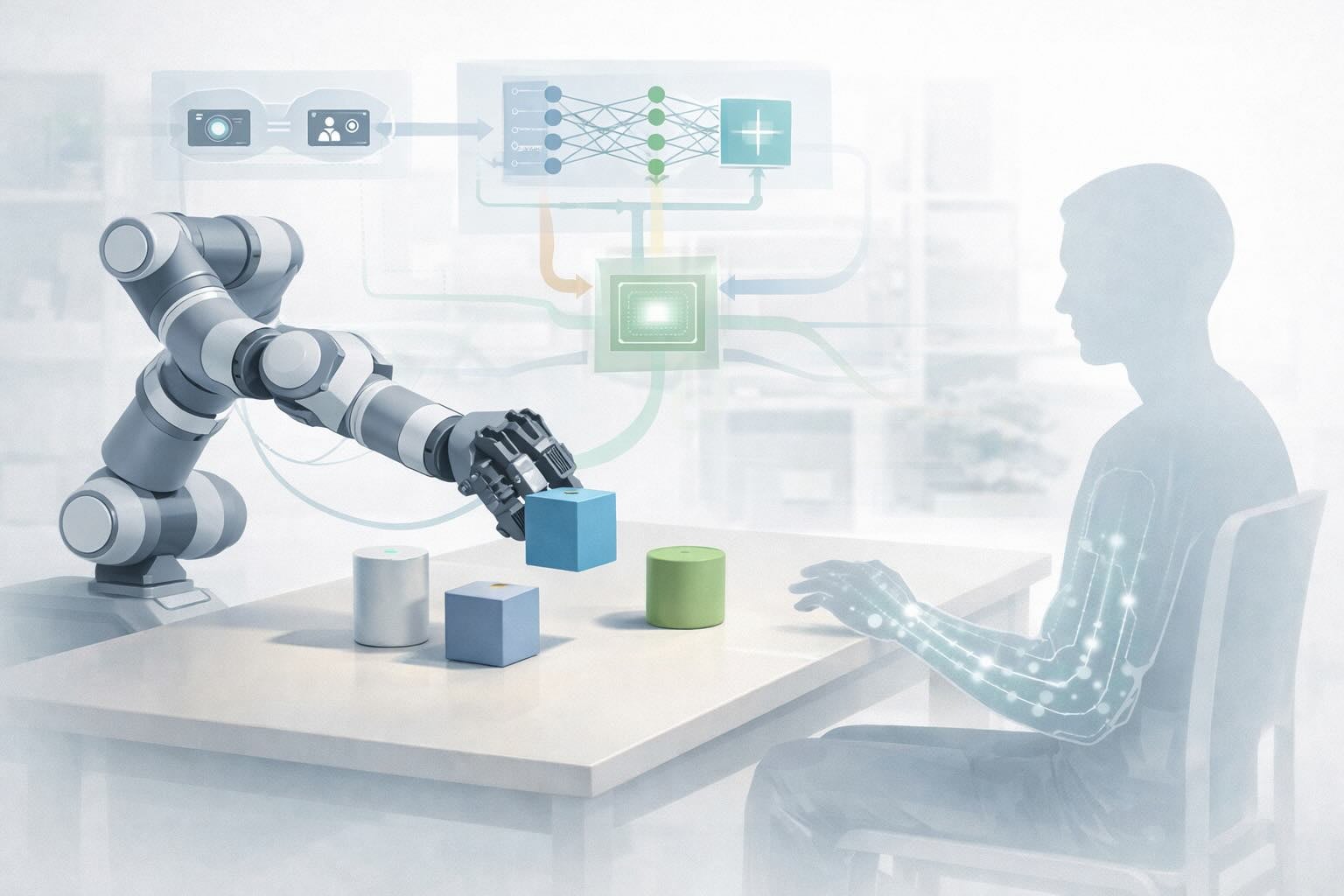
This NSF CAREER project addresses a critical challenge in assistive and rehabilitation robotics: enabling individuals with severe motor impairments, such as spinal cord injury or ALS, to independently control complex, high-degree-of-freedom robotic arms for everyday tasks like reach-and-grasp. While existing assistive interfaces can support low-dimensional control (e.g., wheelchairs or cursors), they fall short when users must operate dexterous robotic systems that require precise, multi-dimensional input.
The project introduces Human-Centered Shared Autonomy (HERO), a novel artificial intelligence framework that combines noninvasive low-dimensional human input with intelligent robotic autonomy. Using closed-loop, vision-based deep reinforcement learning, HERO dynamically interprets, amplifies, and reshapes impaired user input—preserving user agency while enabling reliable, real-time control of high-degree-of-freedom assistive robotic arms. Unlike fully autonomous systems that override user intent, or manual control schemes that demand excessive effort, HERO balances human intent and machine intelligence to achieve efficient, satisfying collaboration.
The research integrates human–robot interaction studies, multimodal sensing, and adaptive learning algorithms across three thrusts: modeling user agency and satisfaction, developing shared autonomy learning algorithms, and validating performance with both healthy participants and individuals with paralysis. By grounding algorithm design in human-centered studies and clinical collaboration, the project advances both technical performance and usability. Beyond its technical contributions, this work aims to broaden access to assistive robotics technologies, improve independence and quality of life for people with disabilities, and train students at the intersection of robotics, artificial intelligence, and human-centered computing. The project strongly aligns with CYPHER’s mission by advancing intelligent, accessible, and impactful cyber-physical systems for societal benefit.