
Jan. 27, 2026- Fusion energy is the pinnacle of clean energy and is in escalating demand as we face energy challenges of an increasingly internet-connected world with power-guzzling AI data centers popping up at an exponential rate. Fusion energy would provide abundant, carbon-free energy that essentially mimics the sun with no hazardous or radioactive waste. University of Rhode Island alum Suhas Bhandarkar, ’88, ’90, leads a team of scientists that are breaking through barriers in fusion energy and turning novel concepts into reality as head of target fabrication science and technology at the Lawrence Livermore National Lab’s National Ignition Facility in Livermore, CA.

Bhandarkar graduated from URI’s College of Engineering with a Ph.D. in chemical engineering just two years after completing his master’s program, also at URI. “I have very fond memories from my time there,” said Bhandarkar. “It was a wonderful experience, and I met my wife there, which made it extra special and nostalgic.”
He came to URI for its strong chemical engineering program and faculty that had written seminal textbooks. “It allowed for close interaction with faculty and, looking back, that was hugely beneficial in learning how to think and analyze in order to solve hard problems,” said Bhandarkar.
“I remember a couple of meetings where [Bhandarkar] would show me his recent results,” reflected Professor Arijit Bose, Bhandarkar’s Ph.D. advisor. “After thinking a bit, I would say, ‘Suhas, this might be a good thing for you to do next.’ He would smile and say, ‘I’ve already done it!’ He’s one of the best students I’ve had.”
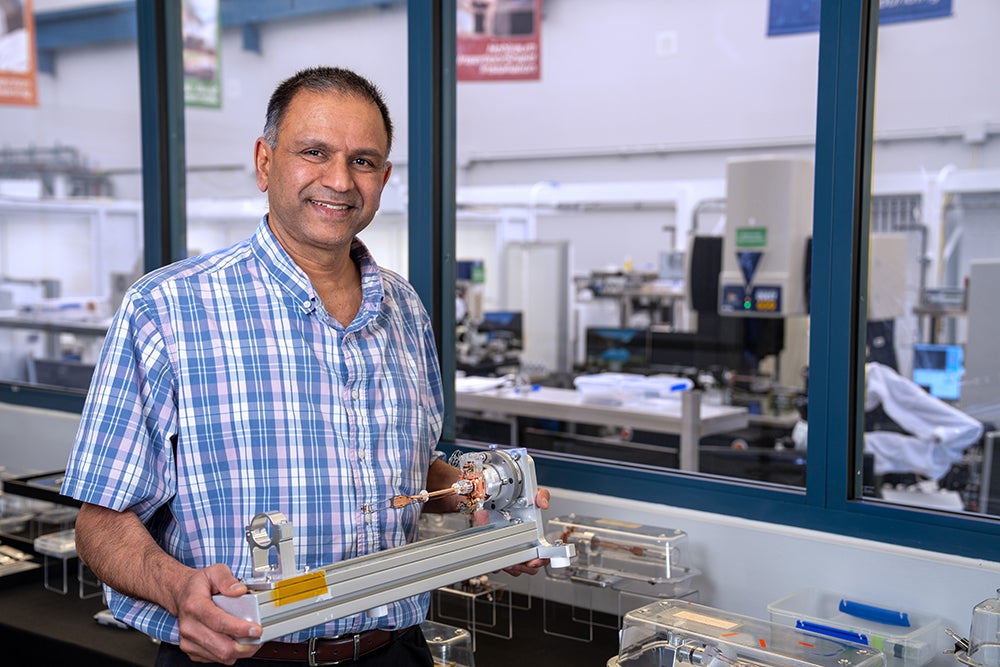
Following graduation, Bhandarkar joined Bell Labs where over the next decade he primarily focused on fiber optics and photonics before being hired by Lawrence Livermore National Labs in 2006. When Bhandarkar joined Lawrence Livermore, target fabrication became his passion. “LLNL was bit of fate really – I was hired to work on optics because of my past experience, but targets needed urgent development from ground up, so I started work on that, a completely new field,” said Bhandarkar.
Fusion ignition is a sustained fusion reaction that generates more energy output than input and was first demonstrated through a landmark experiment at Lawrence Livermore’s National Ignition Facility in 2022. This was conducted by firing the facility’s powerful lasers on a very small target capsule of deuterium and tritium, smaller than the size of a popcorn kernel. The laser drives the target capsule inward at nearly a million miles an hour, squeezing the target from the equivalent of a basketball to the size of pea — therefore the targets must be designed, fabricated, and assembled with extreme precision. Components are machined within microns, many of them a fraction of the size. To provide an idea of scale, a single human hair is roughly 80 microns in diameter.
“The performance of the target must be near-perfect for achieving ignition, which is the process of birthing a star in the lab,” said Bhandarkar. “In that sense, it is a truly remarkable achievement that started in the 1970s and has been a product of sustained teamwork with razor-sharp focus over multiple decades.”
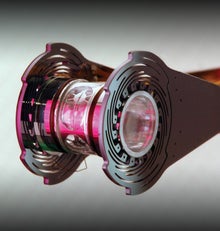
The output has gone up almost 10,000-fold from early experiments in 2010, when ignition seemed out of reach. “These achievements are a testament to what can be achieved with dedication, belief and hard work and of course essential funding from the U.S. Department of Energy,” said Bhandarkar.
His diverse team of scientists, physicists, chemists and engineers continue to innovate lasers capable of repeatedly hitting a fusion fuel target and creating targets to improve implosion quality with a keen eye on advancing the field for abundant clean energy. “It is an incredibly difficult endeavor, but a huge payoff for the future, so we live in exciting times,” said Bhandarkar.
Story written by Krysta Murray, College of Engineering