
KINGSTON, R.I. – May 06, 2026 — Mechanical engineering assistant professor Yang Lin has been awarded the prestigious National Science Foundation CAREER Award.
The CAREER program is one of NSF’s most competitive and highly regarded awards for early-career faculty, recognizing those who demonstrate strong potential to serve as academic role models while advancing the mission of their institutions. The award provides five years of support to develop a sustained and integrated program that brings together cutting-edge research, innovative teaching, and meaningful student engagement.
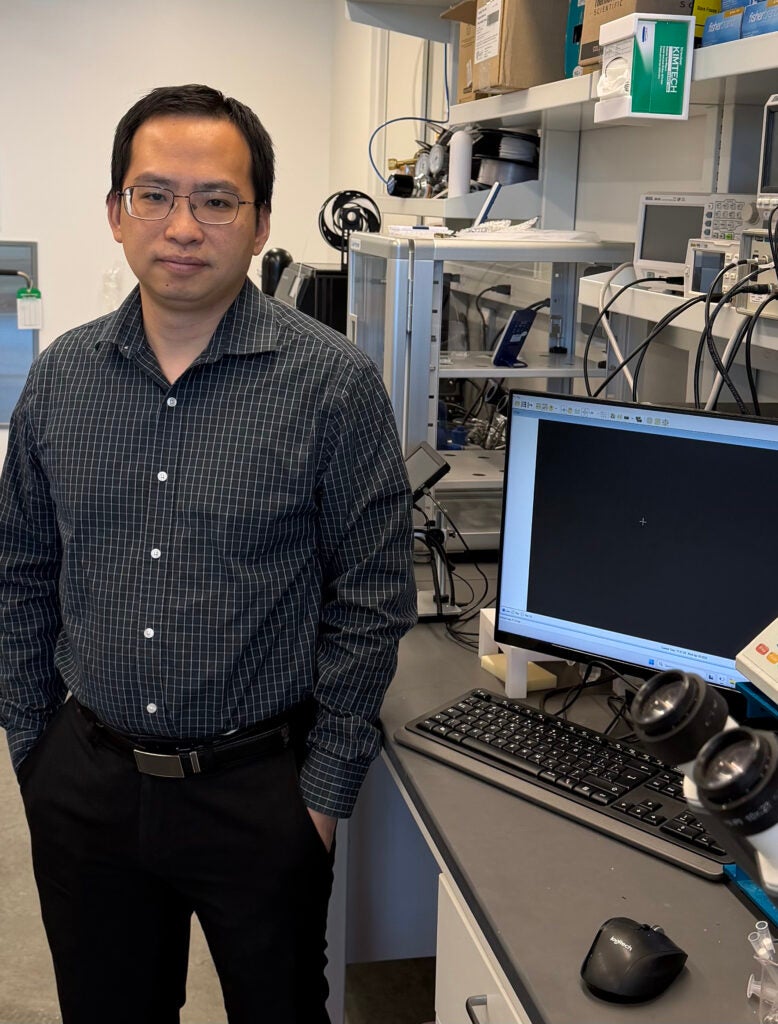
Lin earned the award for “CAREER: Low-Frequency Acoustic Damping Metamaterials Based on Trapped Bubbles.” The project explores a new approach to controlling low-frequency sound and vibration, a longstanding challenge in engineering due to the large wavelengths involved. By rethinking how acoustic energy can be manipulated at small scales, the work introduces new design possibilities that are difficult to achieve using conventional materials.
“Receiving the NSF CAREER Award is both exciting and deeply meaningful to me. What makes it especially significant is that it recognizes not only a research idea, but also a broader vision for building an academic program that integrates research, education, and student development,” said Lin.
This reflects how Lin has approached his work at URI from the beginning. “I have always believed that scientific discovery, teaching, and mentorship should not operate as separate efforts. They should reinforce one another and grow together.”
The project builds on Lin’s research in acoustics, bubble dynamics, microfluidics, and advanced microfabrication, and focuses on how sound interacts with small-scale fluidic systems. In particular, it introduces a fundamentally different physical mechanism for controlling low-frequency sound, which is traditionally difficult to manage due to its long wavelengths and the need for large, heavy materials. Instead of relying on conventional solid-based acoustic materials, the project uses structurally trapped bubbles in liquid as functional acoustic units. Because a liquid environment allows bubbles to oscillate more freely than a solid matrix, these bubbles can produce strong resonant responses and dissipate acoustic energy effectively. Carefully designed microscale structures are used to trap, arrange, and stabilize the bubbles, allowing Lin’s team to study how their geometry and collective behavior shape low-frequency sound absorption. This work draws on Lin’s experience in modeling acoustically driven phenomena, experimentally characterizing resonant systems, and fabricating highly controlled microscale architectures using both conventional microfabrication and high-resolution 3D printing.
Earlier projects helped establish the foundation for this direction. “Through those efforts, a key idea became increasingly clear: bubbles confined in liquid environments can respond to sound very strongly, and if they are structured in the right way, they may serve as highly effective elements for dissipating acoustic energy,” said Lin.
Building on this insight, the CAREER project aims to understand how trapped-bubble systems behave under different physical conditions, how their geometry and spatial arrangement shape acoustic response, and how they can be translated into stable and scalable material platforms. In doing so, the work seeks to establish the scientific foundation for a new class of fluidic acoustic metamaterials.
Understanding these systems could open new possibilities for controlling sound and vibration in ways that are lighter, more compact, and more adaptable than conventional approaches. The outcomes may advance research in areas such as noise reduction and underwater acoustics, including efforts to reduce persistent low-frequency noise in buildings and urban environments, improve acoustic performance in transportation systems such as aircraft and vehicles, and enhance sound control in marine settings. These capabilities are particularly relevant in applications where space, weight, and material constraints make traditional acoustic solutions difficult to implement.
Undergraduate and graduate students will be involved directly in the research, contributing to the modeling, fabrication, and experimental study of bubble-based acoustic metamaterials while gaining experience in a highly interdisciplinary area. The project will also connect to teaching through courses where students will have opportunities to engage with concepts and design challenges that grow directly out of the research. The project also includes outreach activities aimed at making acoustics and microsystems engineering more accessible to younger students, including a week-long annual summer workshop on acoustics and MEMS for high school students. Overall, these efforts reflect the CAREER program’s emphasis on integrating research, education, and broader impact.
Lin joined URI faculty in August 2020 after completing his Ph.D. in mechanical engineering at the University of Illinois Chicago. He was the first at URI to receive the DARPA Young Faculty Award and subsequently the DARPA Director’s Fellowship, and is also the recipient of a 2024 NSF Engineering Research Initiation (ERI) Award.