
April 17, 2026 – The University of Rhode Island American Society of Civil Engineers Student Chapter constructed a boat for the 2025–2026 ASCE Concrete Canoe Competition, Northeast Symposium, a national civil engineering student competition where teams design, build, test, present, and race a canoe made primarily from concrete.
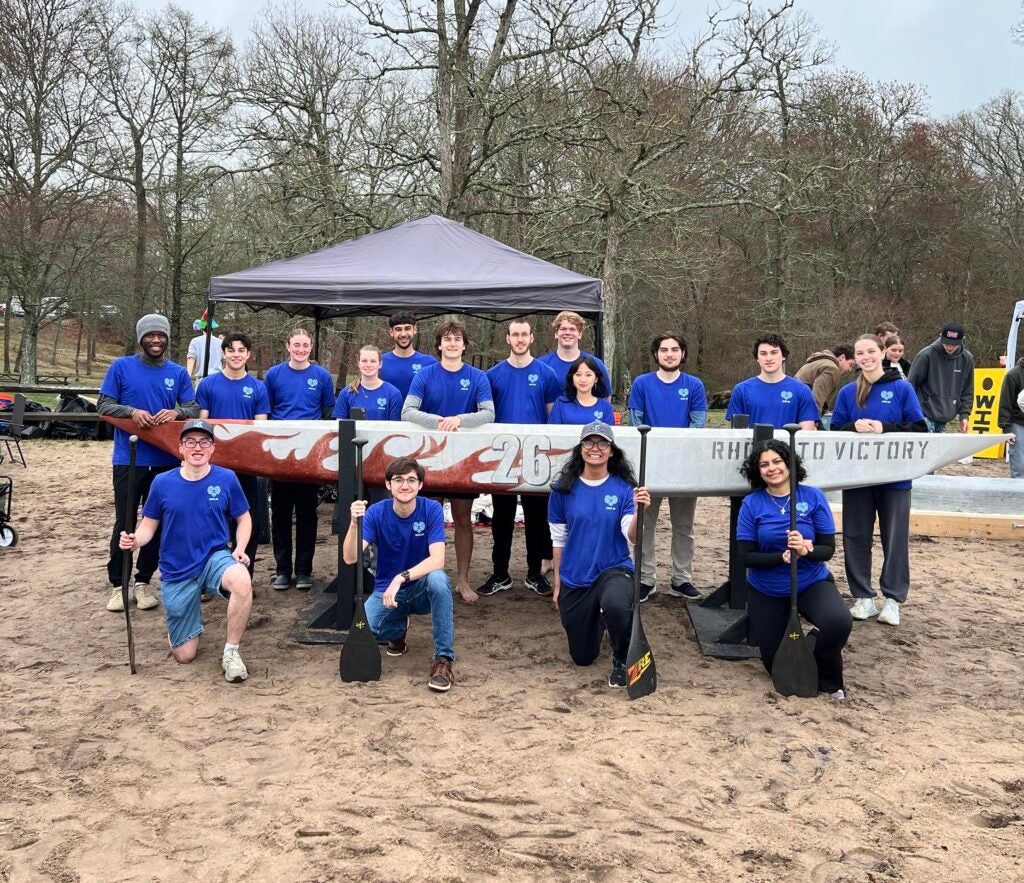
The first ASCE Concrete Canoe Competition was held in 1988, but the history of Concrete Canoe goes back to the 1960s, when a small number of ASCE Student Chapters began holding intramural concrete canoe races. The competition gives students hands-on experience in structural design, concrete mix development, project management, construction planning, sustainability, and teamwork. For this year’s competition, URI named their canoe Rhode to Victory.
This is only the second canoe the student organization has attempted post-Covid. The project challenges students to create a canoe that is lightweight enough to float, strong enough to safely carry passengers, durable enough for handling and racing, and efficient enough to perform well in sprint and slalom events.
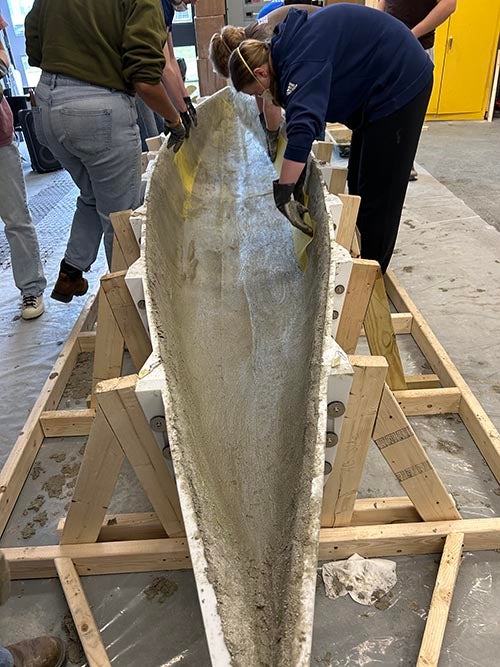
The 2026 URI team approached the project as a full engineering design-build effort, with separate groups focused on hull design, mold fabrication, concrete mix design, reinforcement, construction, quality control, and project management.
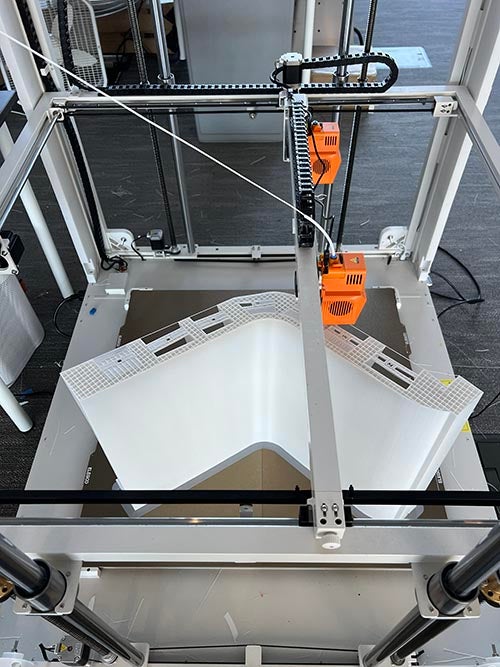
A major innovation for Rhode to Victory was the use of a 3D-printed female mold. To improve construction accuracy, the team designed the canoe digitally and produced the mold in modular 3D-printed sections.
The mold was printed using PETG filament because of its improved temperature resistance because the canoe was cured in a humidification chamber, which can become warm during the curing process. The mold was designed to eliminate the need for printing supports to reduce both fabrication time and the amount of material required. These decisions made the mold more efficient to manufacture while also supporting the project’s sustainability goals.
For the hull design, the team refined previous URI canoe concepts and added a keel to improve tracking, stability, and straight-line speed. Structural analysis considered different loading conditions, including two-paddler, four-paddler, and static display cases. These checks helped confirm that the canoe had adequate capacity for bending, shear, punching shear, and freeboard requirements.
The concrete mix was designed to balance low weight, strength, workability, and durability. The final mix used lightweight Poraver expanded glass aggregates along with cementitious materials. Fly ash helped reduce the cementitious ratio and supported the team’s sustainability goals. Chemical admixtures were used to improve workability, reduce unit weight, and support bonding. The final composite system included fiberglass mesh as the primary reinforcement and Nycon PVA fibers as secondary reinforcement to improve tensile behavior, crack control, and punching shear resistance.
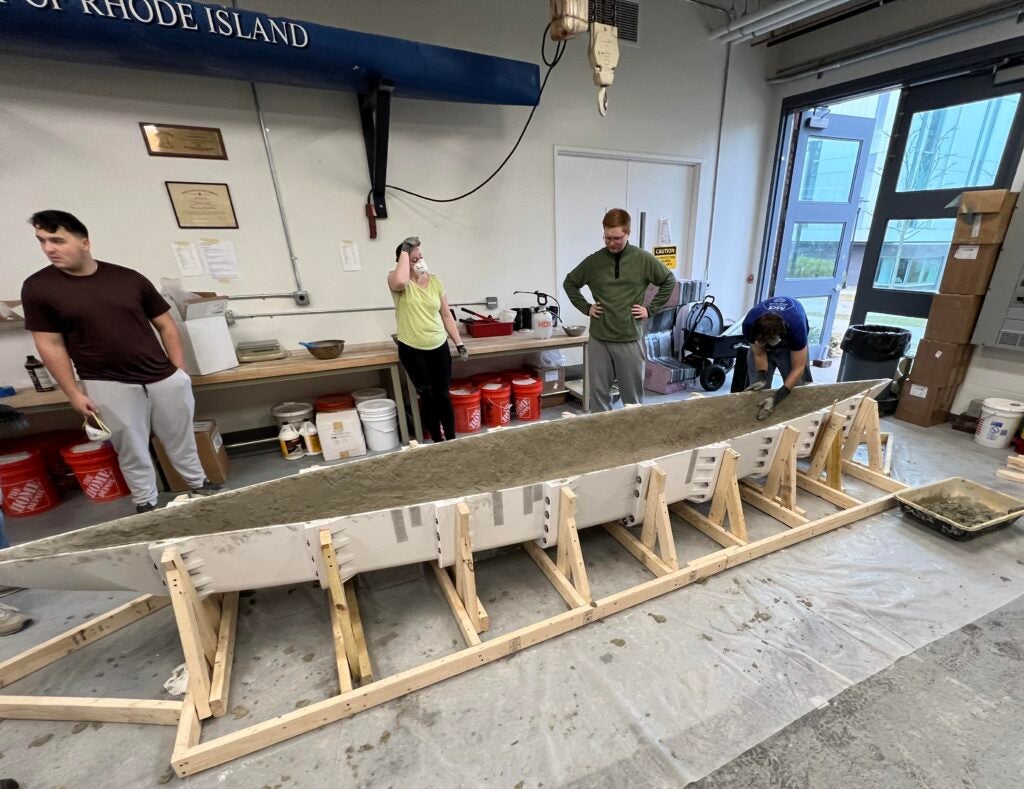
Construction was completed through careful batching, placement, reinforcement installation, and curing. Dry materials were prebatched before pour day, and concrete was placed by hand in layers. The team placed an initial concrete layer, embedded the fiberglass mesh, and then applied a second layer to create a reinforced composite section. Pre-measured wires were used inside the mold as a quality-control tool to help maintain consistent wall thickness.
Rhode to Victory reflects URI ASCE’s focus on innovation, sustainability, and practical engineering. By combining digital modeling, 3D printing, lightweight concrete technology, reinforcement testing, and hands-on construction, the project gave students a direct experience with the full design-build process. The canoes are judged based on multiple categories, such as project proposal, technical presentation, product prototype and various race results and then ranked by overall points earned.