
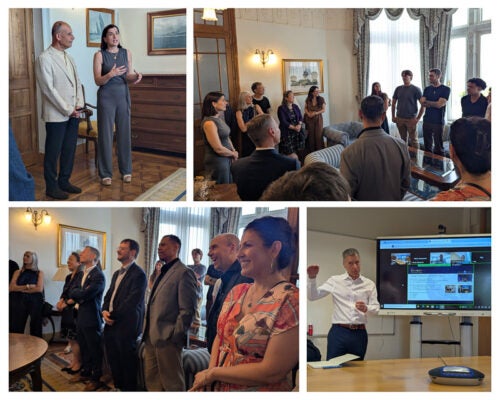
Starting with its annual board meeting, members of the IEP administration cumulatively spent about a month in Europe this summer visiting with our students, university and internship partners there in order to strengthen current relationships and propose future opportunities for IEP participants.
At the end of May, a delegation from the University of Rhode Island, led by Dean of Engineering Anthony Marchese and IEP Executive Director Sigrid Berka, traveled to Spain to meet with two of its partner universities situated on the country’s northern coast. Also participating in this visit were several IEP advisory council members as well as faculty and staff with a vested interest in furthering these partnerships.
The first stop was the Universidad de Cantabria in Santander, where the group was welcomed by UNICAN’s international relations team. UNICAN organized a comprehensive agenda for the visit, including a reception by the current mayor of Santander, Gema Igual Ortiz, at the beautiful Palacio de la Magdalena.
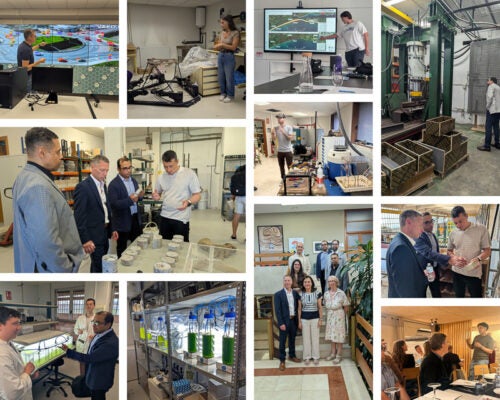
Part of the schedule involved meetings to discuss expanding dual master’s agreements between the universities as well as planning for a URI NSF-REU grant application with IHCantabria and one of URI’s German partners, TU Braunschweig. Another portion of our time was spent exploring UNICAN’s exciting civil engineering research groups. As UNICAN also played host to our annual IEP advisory council meeting this year, along with URI/IEP faculty and staff, some of our board members then had the opportunity to meet the students their work supports.
We visited four different labs associated with UNICAN where Spanish IEPers Jordan Berry ’26 (mechanical engineering), Jay Bode ’26 (civil engineering), Franklin Cruz Jr. ’26 (civil engineering), Peter Martin ’26 (mechanical engineering) and Blake Rottmann ’26 (ocean engineering) are currently completing research internships.
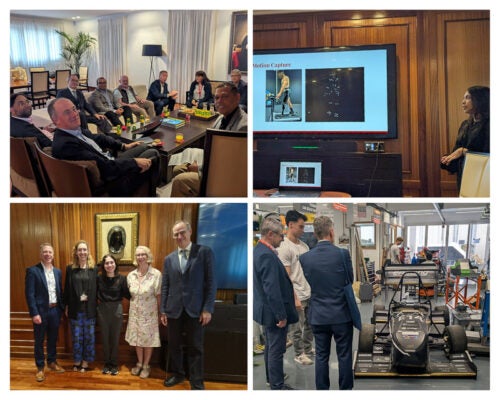
On June 1, the URI delegation arrived at the Tecnun campus of the Universidad de Navarra, located in the Basque city of San Sebastián, Spain. Here, the IEP discussed the potential of setting up a new dual master’s or bachelor-to-MBA program between URI and Tecnun.
During this visit, we also attended a presentation given by Spanish IEPer Isabella Contreras ’26 (biomedical engineering), whose research project focuses on the capture and analysis of human motion through the use of pressurized insoles and integrated software for applications in medical research. Interestingly enough, Bella’s internship supervisor Naiara Rodriguez-Florez was a researcher at URI in 2010 and had been a member of our IEP Living and Learning Community during her time on campus.
With the Spanish IEP being the IEP’s third oldest program and with the IEP preparing to turn 40 next year, these visits were a great opportunity to reflect on both its progress and trajectory. Spending nearly a week to spend in-person with our Spanish partners was invaluable to the process of strengthening existing ties, meeting those involved in the initial launch of these exchanges, and moving ahead in new and exciting directions together.
On June 2, Dean Marchese and Dr. Berka made one final stop together at the Gurit plant in Falces, Spain as a part of their Spanish delegation visit. IEP Advisory Board member Tobias Lührig, president and CEO of Gurit, facilitated an introduction to the company’s management team at its Falces site. The experience included a tour of the factory and discussions regarding future internship opportunities for Spanish IEP students. Gurit, which is headquartered in Zurich, is a leading manufacturer of advanced composite materials that empower energy-efficient solutions for its customers, e.g. in the wind energy sector.
Dr. Odile Mattiauda, our French IEP director, went on to visit another Gurit hub located in Valbonne, France, where she attended a presentation on June 3 by IEP intern Christopher Falcon ’27 (French and mechanical engineering). With Gurit’s focus on building lighter, stronger and more sustainable composite components for use in the wind energy, marine, transportation, construction, defense sectors and more, they aim to promote energy-efficient solutions across these industries and beyond. The Valbonne office’s main focus as a part of Gurit Composite Engineering (GCE) is on marine applications like boat design, but GCE’s work across other branches also includes industrial applications (like paneling for public transit systems) as well as renewable energy systems (such as the structure for the wings of wind turbines).
Following her time in Spain, Dr. Berka traveled to Germany to meet with German IEP students, host companies and local alumni. Her first meetings took place at Bosch in Feuerbach, where IEP’s Kristof Hopkins ’27 and Gabriel Stradtman ’27 (both German and mechanical engineering) intern with the company’s Power Solutions and Engineering Fuel Cell Testing and Cause and Effect Mechanism Groups respectively, and at the Mercedes-Benz office in Sindelfingen, where Nate Wright ’27 (German and mechanical engineering) works with the Wiring Harness DMU & Tools Division. The day’s events were followed by an alumni gathering in the city of Stuttgart at the Alte Kanzlei.
As tradition has had it for many years now, Dr. Ulrich May and his colleagues from Bosch joined our current Bosch and Mercedes-Benz interns at this year’s meetup. Dr. May, head of Power Solutions, Engineering Fuel Cell Testing (PS-EY/EFT) and his teams have hosted one to four of our German IEP interns yearly since Dr. Grandin’s times! But this summer, several dual MS/MBA alumni from Technische Universität Braunschweig (TUBS) and Darmstadt (TUDa) also joined in: Stefan Knipp ’18, the first electrical engineering URI-TUDa dual master’s graduate, and two URI-TUBA dual master’s alumni, Florian Werner ’06 and Timo Kehr ’99. This was the first time that the IEP has hosted such a gathering in Stuttgart, and with alumni from various grad years in attendance, the event demonstrated once again that study abroad memories last long after students return home.
Further north, in the area of Frankfurt, Dr. Berka met with colleagues at our partner university TU Darmstadt to talk about the recruitment efforts and curricula related to the undergraduate exchange and dual master’s programs. She also checked in with current undergraduate and dual MS students in the area.
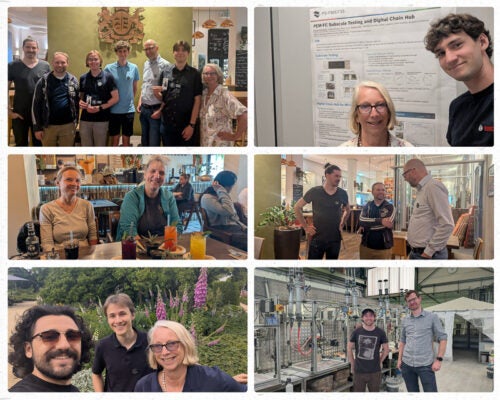
One such student is Samuel Rebuck ’27 (German IEP & electrical engineering), who is interning for Additivum, an innovative start-up out of Technische Universität Darmstadt that specializes in using proprietary 3D-printing technologies to produce biodegradable ceramic products, homeware, and memorial urns. The second student is IEPer James Russell ’26 (German & mechanical engineering), who took his internship from local to global this year thanks to new IEP Advisory Board member Ryan Light, ’15. Ryan created an arrangement with Hexagon, where he currently works, to have one German or Italian IEP intern per year following a similar trajectory to James’s – either from Quonset, RI to Wetzlar, Germany or to Torino, Italy.
Rounding out the day, Dr. Berka brought together the students and German IEP alum Cameron Hahn for a meet-up at a local establishment in Darmstadt. Cam’s time as an undergraduate in the IEP studying and performing research at TU Darmstadt clearly had an impact. He came back to Darmstadt to participate in the URI-TUDa dual master’s program with support from the Max Kade Foundation in NY. Cam is now a second-year dual master’s candidate who will receive degrees in mechanical engineering (URI) and aerospace engineering (TUDa) upon completion of the program in fall 2026.
Further north, Dr. Berka visited the TU Braunschweig’s Leichtweiß Institute (LWI) for Hydraulic Engineering and Water Resources in preparation of the planned NSF-REU grant application and met with TUBS administrators to discuss the next cohort of exchange students and their curricula. The schedule also included time at AeroData, located north of the Braunschweig at TUBS’ research airport. It is at this university start-up, whose focus is on equipping aircraft for aerial surveillance and flight inspection, where German IEPer Sylas Wojciechowski ’27 (German and computer engineering) is working on a project which involves calibrating drones to achieve safer landings like this one. The story of the IEP is a cyclical one – Sylas also happens to be the son of another IEP alumnus, Steven Wojciechowski, ’93.
Sylas and Dr. Berka also had the chance to see URI-TUBS dual master’s student and ’24 IEP grad Matt O’Donnell. Matt is in Braunschweig finishing the German portion of his dual master’s degree in chemical engineering (summer 2026) supported by both a Max Kade scholarship and by a Hiwi research assistantship in the INeS institute under Professor Daniel Schroeder. His investigations there are focused on lab-grade lithium ion batteries and the creation of models to predict battery health during and after rigorous stress testing. On the flip side, with the support of URI-TUBS matching funds, Dr. Schroeder will be visiting our chemical engineering department at URI this fall with two PhD students!
Following her tour through Baden-Württemberg, Hessen, and Niedersachsen, Dr. Berka moved on to Bavaria, where she began her time in Munich with a visit to BMW’s Research and Innovation Center (FIZ). It is here that German IEP student Piper Krause ’27 (German & mechanical engineering) is interning in the aeroacoustics department. Dr. Berka had the privilege of touring the only aeroacoustics wind tunnel in the automotive industry in Germany, which also happens to be one of the largest and quietest in the world.
An hour and a half further northeast, the architecture firm Coplan AG in Regensburg is hosting German IEP student Anne Lamendola ’26 (German and civil engineering). Anne’s project involves creating 3D models with Sketch-Up and AutoCAD for various U.S. military projects in Bulgaria, Luxembourg and Romania. Since the company’s portfolio has shifted to a more national focus in the last two years, an important discussion point was potential new placement opportunities at Coplan in Eggenfelden (headquarters, where two previous interns worked), or at Coplan Munich and Leipzig. For more information on one of their current projects (Bulgaria), check out their recent newsletter (in German).
Another hour and a half northwest, at Siemens in Erlangen, ’27 German IEP and computer engineering student Benjamin Annicelli has been working on the creation of a MATLAB controller. The goal of this program is to automate precision electromagnetic field testing for an AC current sensor (Rogowski coil). Dr. Roland Weiss, Ben’s supervisor, is a senior scientist at Siemens Cooperate Research in Erlangen and has generously hosted German IEP students (typically biomedical and electrical engineers) every year since 2010. He always comes up with hands-on projects for students in the area of magnetic sensor systems, with some of our students even having the privilege to be co-authors of joint publications of his group at Siemens.
The academic and professional network that the IEP has built over the last 40 years is one of the most important benefits that we can offer to our students and alumni. We are deeply appreciative to all of our academic and corporate partners for hosting our students/interns over the course of the last year. As a program, we are also very grateful to all of our students and alumni who participated in the variety of presentations and meet-ups over the course of the summer – as always, thank you for staying in touch!