
KINGSTON, R.I. – July 29, 2026 – A partnership between the University of Rhode Island and Rhode Island Department of Health will study manganese levels in Rhode Island’s drinking water. The project, “Statewide Support for Manganese Management in Rhode Island,” will be funded by a grant from the Emerging Contaminants in Small and Disadvantaged Communities through the health department’s Center for Drinking Water Quality and Rhode Island Infrastructure Bank. It runs through Sept. 30, 2030.
Manganese is naturally occurring and comprises an appreciable portion of the earth’s crust. New England has higher concentrations of manganese than other parts of the U.S., due to glacial drifts that make up the region’s geology. Rhode Island depends on groundwater sources that have contact with the subsurface. Groundwater supplies roughly 26 percent of the state’s population with drinking water with an estimated two-thirds of that from public water supply and another third from private wells.
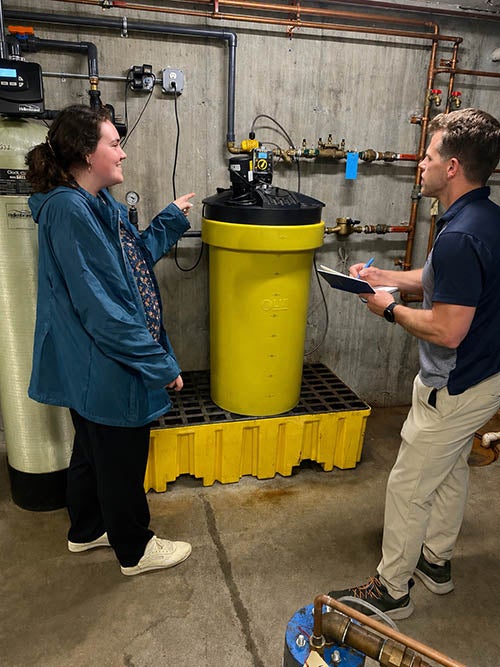
“Manganese in drinking water is a pervasive health issue and treatment challenge across Rhode Island,” said Zach Shepard, principal environmental health risk assessment toxicologist on the project for RIDOH and a URI alumnus. “Public water systems, especially small systems and private well owners, are impacted by manganese in their water. In this project, RIDOH has partnered with URI to provide technical assistance to people who are impacted by manganese.”
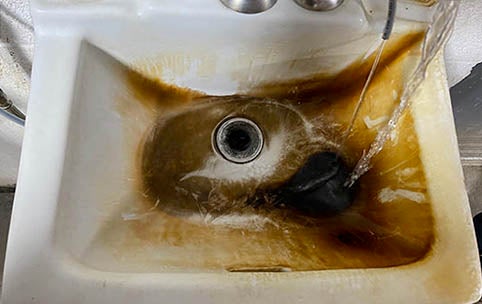
The U.S. Environmental Protection Agency established a lifetime human health advisory benchmark of 0.3 mg/L of manganese. In trace amounts, it is essential for human survival, metabolism, and bone health. RIDOH enforces safe manganese limits in drinking water at 0.3 mg/L for infants aged one year or younger and 1.0 mg/L for everyone older than a year. Too much manganese can lead to neurological effects, especially with long-term exposure.
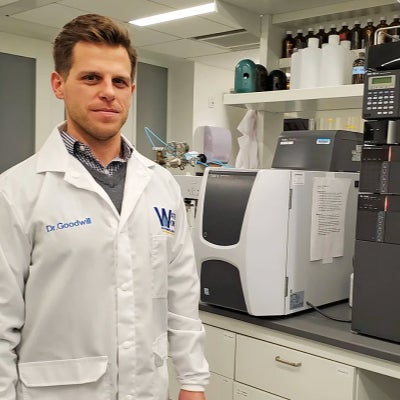
The URI team is led by principial investigator Joseph Goodwill, the Carroll D. & Charles M. Billmyer Associate Professor of Engineering, who will oversee all phases of the project, with a primary focus on improving manganese removal and management across the state. He will oversee data analysis, preparation of resources for public water system operators and private well owners, and dissemination of the final results.
The proposal is divided into four phases. To start, manganese data produced by RIDOH will be analyzed and used to create a heat map of concentrations across the state in raw and finished drinking water at public water systems.
Researchers will then use the information to write a guidance manual for water treatment that is applicable to local public water systems and private well owners. The manual will be accessible to the public and include cost guidance for various manganese treatment approaches.
Selected public water suppliers will serve as a case study for remediating manganese issues. Based on the study, the team will develop and deliver instruction at a seminar in Rhode Island for public water supply operators and private well owners. The seminar will include content on the extent of contamination, treatment guidance, and selected case studies.
“A problematic knowledge gap that still exists is a sustainable and appropriate treatment approach for small systems,” said Goodwill. His team is developing several novel treatment techniques that seek to fill this gap. The project will include piloting those technologies to assess real-word applicability. The team consists of a postdoctoral researcher and two research assistants.
“The ultimate goal of this project is to move Rhode Island water systems from a reactive posture to a proactive model with manganese. We want to know which systems are at risk, why they are at risk, and what type of response is appropriate,” said Goodwill.
By identifying geographic hotspots and relationships between manganese levels and factors such as aquifer characteristics, water chemistry, and well location, the data can be used to develop vulnerability models that predict where manganese problems are most likely to occur. This information can help RIDOH prioritize monitoring, technical assistance, and infrastructure funding.
Ultimately, the data can anticipate future problems and target resources where they will have the greatest impact. “It’s essentially going to be an excellent risk-management tool,” said Goodwill.
As the state’s only land-grant university, one of URI’s core missions is to provide education, research and outreach focused on practical service to the state. URI is well positioned to conduct this research through its expertise in drinking water quality, modern research infrastructure that provides advanced facilities and analytical capabilities, and its commitment to environmental engineering education.
The University is launching a new Bachelor of Science program in environmental engineering this fall, reflecting its growing focus on water and environmental challenges. Combined with strong partnerships with state agencies and water suppliers, these resources enable URI to translate scientific findings into practical solutions that benefit Rhode Island communities.
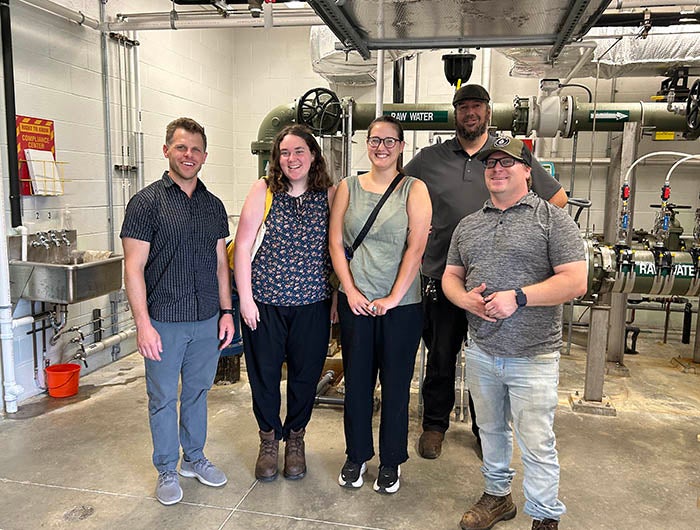
The project is currently in its early stages, with statewide manganese sampling underway and expected to continue throughout the remainder of the year. URI began its first field visits this summer. The team is also planning a manganese-focused training seminar for 2027 that will provide water system operators and engineers with practical guidance on manganese monitoring, treatment, and management.
This story was written by Krysta Murray, writer, College of Engineering.