
What drives economic growth? Why do some regions prosper while others are left behind? How do political institutions shape people’s lives and opportunities?
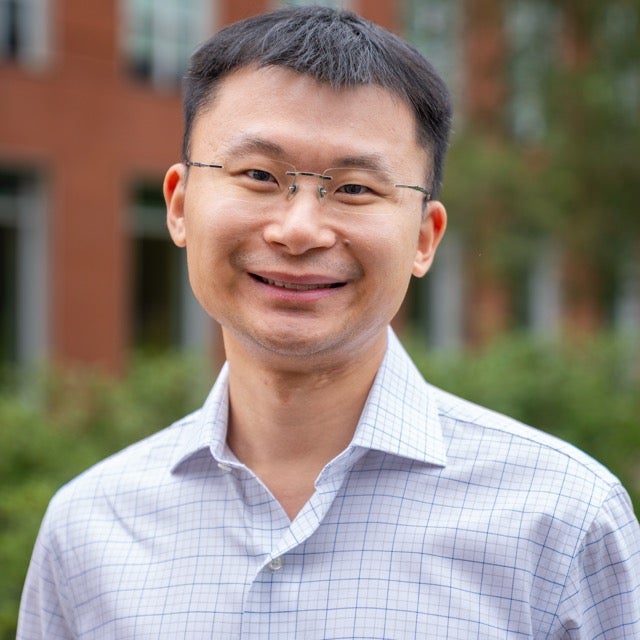
These are the questions that inspire the work of Dr. Qin Huang, assistant professor of political science at the University of Rhode Island and a faculty member helping to shape URI’s new Ph.D. in Computational Social Science.
Huang’s research sits at the intersection of political science, economics, statistics, and emerging computational methods. By combining machine learning, fieldwork, and historical research, he seeks to better understand how governments, institutions, and businesses influence economic development and inequality.
“I study how political institutions shape economic development and why prosperity is distributed so unevenly across places. Much of my work focuses on China and the relationships between governments and businesses.”
Read “Where Data Meets Society: URI Launches New Computational Social Science Ph.D.”
Bringing Disciplines Together
Dr. Huang was a Rhodes Scholar at the University of Oxford, where he earned advanced degrees in Sociology, Contemporary Chinese Studies, and Political Theory, before completing his Ph.D. in Political Science and M.S. in Applied Statistics at Northwestern University. His interdisciplinary background made URI a natural fit.
“URI is a place where I could bring those interests together and help shape a new Computational Social Science Ph.D. program.”
For Dr. Huang, Computational Social Science offers a powerful way to connect advances in data analysis and artificial intelligence with longstanding questions about human behavior and society.
“Computational Social Science brings together questions about people and society with tools from statistics and computer science. We might use machine learning to compare regional economies or analyze large collections of political speeches. The exciting part is connecting patterns in data to explanations of how society works.”
Training the Next Generation of Researchers
As URI develops its new doctoral program, Dr. Huang is particularly excited about training students who can move seamlessly between computational methods and social inquiry.
“We need researchers who understand both computational tools and the social settings in which they operate.”
The program’s interdisciplinary structure reflects that goal, combining advanced computational training with education in social theory, research methods, and ethics. The program’s embedded M.S. in Statistics also provides students with advanced quantitative training that complements doctoral research in the social sciences and strengthens preparation for careers both inside and outside academia.
According to Dr. Huang, the program will appeal to intellectually curious students from a variety of backgrounds.
“That could include social science students eager to deepen their computational skills or students in statistics and computer science interested in social questions. Strong quantitative preparation, intellectual curiosity, and a willingness to learn from others are especially valuable.”
Research with Real-World Impact
Dr. Huang sees enormous potential for artificial intelligence and machine learning to strengthen social science research, particularly when paired with traditional approaches such as interviews, archival research, and historical analysis.
“These tools could help us make connections across evidence that would otherwise be difficult to examine together. My hope is that this leads to better explanations of inequality, institutional change, and other consequential social problems.”
Among his recent accomplishments, Dr. Huang is especially proud of developing mlQCA, a methodology that combines machine learning with Qualitative Comparative Analysis to study how combinations of factors shape outcomes. He published the approach in Quality & Quantity and developed a companion R package that allows other researchers to apply the method in their own work.
“It’s rewarding to turn a methodological idea into something other researchers can use.”
Looking Ahead
As computational tools become increasingly important across industries and research fields, Dr. Huang believes the greatest opportunities lie not in the technology itself, but in the questions it helps researchers answer.
For students interested in exploring society’s most pressing challenges through data, policy, and interdisciplinary collaboration, URI’s new Computational Social Science Ph.D. program offers a chance to do exactly that alongside faculty members like Dr. Huang, who are helping define the future of the field.