
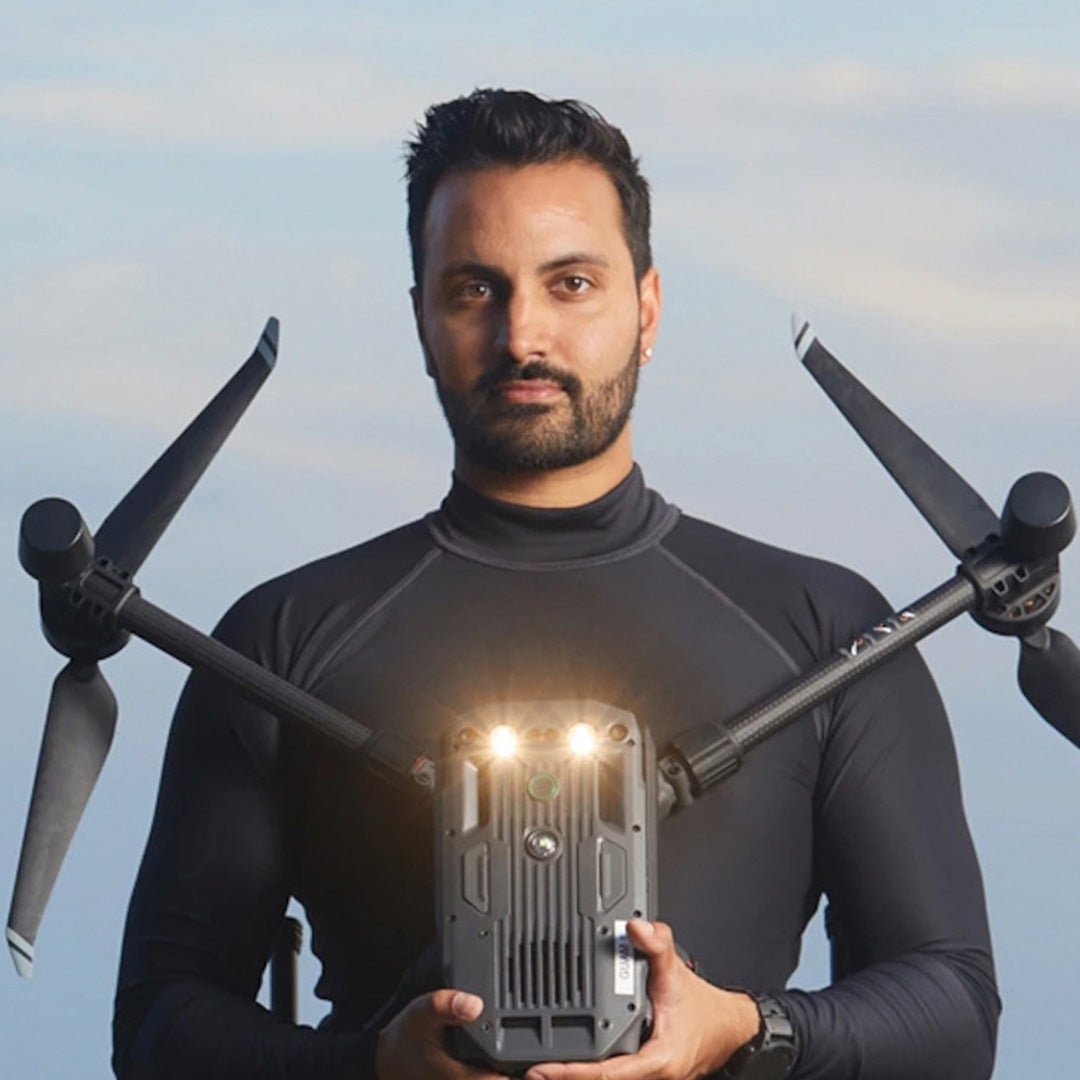
Ved Chirayath is the G. Unger Vetlesen Endowed Chair and Professor of Earth Sciences, Mechanical & Aerospace Engineering, a National Geographic Explorer, and Moore Inventor Fellow. He directs the Aircraft Center for Earth Studies (ACES) at the University of Miami’s Rosenstiel School of Marine and Atmospheric & Earth Science. Formerly, he directed the NASA Laboratory for Advanced Sensing (LAS) as a civil servant at NASA Ames Research Center in Silicon Valley, CA for ten years.
Ved’s research focuses on inventing, developing, and testing next-generation sensing technologies for studying the natural world. Ultimately, his aim is to extend our capabilities for studying and protecting life on Earth as well as aid in the search for life elsewhere in the universe. He leads a multi-disciplinary team developing new instrumentation for underwater, airborne, and spaceborne remote sensing and communications. He validates instrumentation through scientific field campaigns around the world, often in extreme environments that serve as analogs for planetary science and ocean worlds applications. I work to ensure our innovations, developed for exploration and discovery, are broadly available to the public. My team and I also develop machine learning algorithms to process big data on supercomputing facilities. I am the inventor of FluidCam, Fluid Lensing, MiDAR, NeMO-Net, and other technologies. I grew up in Southern California with a passion for NASA’s mission and space exploration. In 2003, a sophomore in high school, I modified a consumer digital camera and telescope to successfully detect an extra-solar planet, 150 light years away and roughly twice the size of Jupiter. Since then, my research interests have relied on the intersection of multiple disciplines including aeronautics, astrophysics, earth sciences, engineering, and optics.
In 2024, I was selected as a Moore Inventor Fellow to invent a full ocean depth space telescope. In 2021, I was one of 30 finalists of 12,000 for the NASA Astronaut Candidate Class of 2021. In 2020, I received the AGU Falkenberg Award for “contributions to the quality of life, economic opportunities, and stewardship of the planet through the use of Earth science information and to the public awareness of the importance of understanding our planet.” In 2019, my MiDAR invention was awarded a NASA Invention of the Year. In 2017, I received the NASA Early Career Award in recognition of “significant advances in aquatic remote sensing technology.” I am the recipient of the Equal Employment Opportunity Medal from the US Government for my work in diversity, equity, and inclusion at NASA.
Watch