
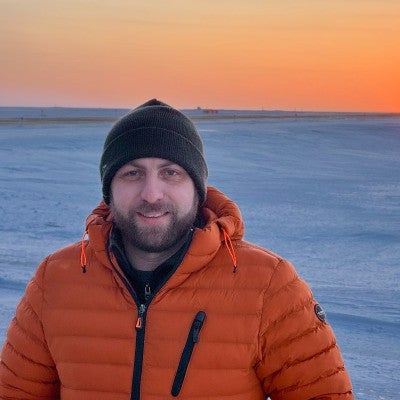
Dr. Russell Shomberg is a Research Associate at GSO and an Adjunct Professor in the Department of Ocean Engineering. Dr. Shomberg gained experience applying IDR methods while working under Dr. Christopher Metzler at UMD. He will be acting as project lead. His experience with both ocean robotics and AI applications will be valuable in bridging both fields.
QUESTIONS & ANSWERS
- Could you tell us about the focus of your research and what scientific questions you’re addressing?
My research bridges the gap between technology development and ocean science field applications. I work closely with field researchers to develop an understanding of their goals, methods, and struggles. At the same time, I keep a close eye on emerging technology from the engineering fields. I’m particularly passionate about using technology to lower costs and improve ocean science accessibility for local communities. I especially enjoy working in difficult environments like the polar oceans and deep sea. Most recently, I have focused on leveraging multi-sensor fusion and inverse differential rendering techniques to develop 3D reconstructions of deep sea habitats and icebergs. - How has access to URI’s research computing resources and team impacted your ability to pursue this work?
Utilizing URI’s research computing resources has allowed me to pull students and collaborators into my work and scale my computing resources to match my needs and team. While I personally have access to a modern GPU, I am interested in developing methods that can be shared and utilized across the wider ocean science community. I can introduce students to the work without worrying about resource limitations. I can even temporarily scale to meet the needs of teaching applications or workshops. - Can you share a specific project or breakthrough where HPC, AI, quantum or data resources played a critical role?
HPC has been incredibly important for my work developing 3D reconstructions of icebergs. I have been working with a student team from the AI lab for this project comparing reconstructions using neural radiance fields (NeRFs) to ones made with traditional photogrammetry methods. URI’s HPC resources have allowed the student team to form quickly and work independently due to their access to resources. - What kinds of challenges (computational, data-related, or otherwise) have you faced, and how has our team helped you overcome them?
One of the biggest challenges for the iceberg reconstruction project is the difficulty of installing all the necessary software packages. Each requires conflicting versions of python and other dependencies. With Unity, and help from the support team, my student team was able to install the different packages utilizing Conda environments following easy to replicate instructions. - Have you or your team participated in any of our training programs, workshops, or consultations? If so, how did they contribute to your research?
The iceberg reconstruction student team participated in the recent Hack@URI event on campus. In particular, Matthew Barbrack represented us with a live demonstration using Gaussian Splatting to develop 3D reconstructions of interested students and guests. This live demonstration helped develop interest in potential applications for inverse differential rendering methods throughout the URI community. - In what ways have collaboration opportunities through computing enhanced your group’s productivity or broadened your research opportunities?
For the iceberg reconstruction project, I was able to start working immediately with a student team from the AI Lab as well as get access to HPC resources through Unity. Through this relationship, I was able to develop a relationship with the AI Lab and have even submitted a proposal for an internally funded grant to continue our collaboration on more applications. - Looking ahead, how do you see your research evolving, and what role do you anticipate research computing will play in that future?
I see massive growth in applied AI applications in the future. While AI research has exploded in recent years, much of that work as gone towards solving toy problems to demonstrate the technology and benchmarking of new models. In the ocean sciences, very little AI is used outside extremely established methods like object classifiers for images. I believe there is still tons of potential for existing AI methods to find applications across many scientific disciplines. I want to continue to look for new ways to apply established AI methods in ocean sciences. Furthermore, I’d like to get more AI researchers out into field, so they can imagine new collaborative possibilities! - What advice would you give to other faculty or students considering leveraging URI’s research computing resources?
I strongly recommend faculty and students take advantage of URI’s computing resources. The AI Lab in particular is a great resource for finding out what may be possible even if you don’t yet know how AI can be applied to your specific research.