
About Ambarish
Dr. Ambarish Karmalkar is an Assistant Professor in the Department of Geosciences at the University of Rhode Island. He is a climate scientist studying regional climate change and its impacts on human and natural resources. Two broad themes—physical science and climate science translation—encapsulate his research interests and activities. As a physical climate scientist, he uses observations and numerical model simulations to investigate atmosphere and ocean processes that shape our climate at local scales. As a climate science translator, he collaborates with scientists, state officials, and managers to produce actionable climate science. He was a fellow in the 2024 cohort of the SciComm Identities Project (SCIP).
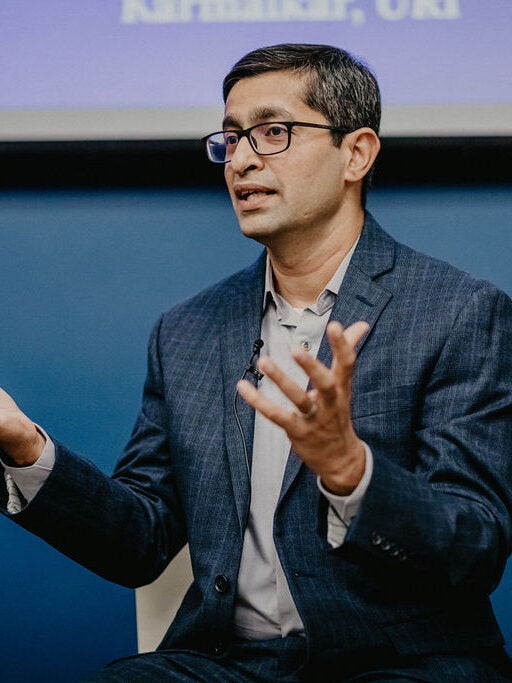
Ambarish spoke with Metcalf’s Abbie Lahmers about framing scientific research for a wider readership, the critical need to understand Antarctic ice sheet melting in the context of broader climate issues, and how he uses his Metcalf training to better communicate and collaborate.
Can you tell us about the process of translating your research on the Antarctic ice sheet melting to develop the article you published in The Conversation?
AK: One lesson I have learned over the years is the importance of turning your science into a compelling story. This often requires building a narrative around one key finding, leaving out many details that are often part of your broader research. The research paper we published describing the connection between climate change and Antarctic ice sheets contains a number of important findings, but for this piece in The Conversation, we decided to only emphasize the sea level rise component, which we felt would resonate most with the global community. The Conversation is a great medium to share research, especially because its editors help make the writing clear and accessible for general readers. The lead author of the paper, Shaina Sadai, and I prepared and shared a very rough draft of the story with the editor. The editor asked questions about the research and helped us refine the narrative so it would be more accessible to a general audience. There was a lot of back and forth between us and the editor during the process. Avoiding jargon was very important, and it was also important for us to write it in a way that would resonate with readers around the world. The melting of the Antarctic ice sheet results in sea level rise across the globe, but that increase is not uniform everywhere, which was the key point of our research that we decided to highlight. It was great to see that the story was translated into French and Portuguese and received a wide global readership. I was particularly happy to learn that people on some of the small islands in the Pacific, regions that will be disproportionately affected by melting Antarctic ice, read the story.
Why is studying the connection between ice sheet loss and sea level rise so important, especially right now?
AK: Understanding what happens to Antarctica’s ice is critically important because it contains enough frozen water to increase the global mean sea level by about 190 feet or 58 meters. As the ice melts, it poses an existential threat to coastal communities and ecosystems around the world. If greenhouse gas emissions due to human activity continue to rise, large-scale loss of ice sheet mass could occur in the future, exposing communities worldwide to rising sea levels. As we mention in the paper, over one billion people could be living in low elevation coastal areas by 2060, increasing the risks for populations that are already socially and geographically vulnerable. Current pledges submitted by countries under the United Nations Framework Convention on Climate Change remain insufficient for meeting the Paris Agreement’s long-term temperature goal of limiting global mean surface temperature rise. Strong and sustained mitigation efforts will therefore be crucial to preventing Antarctic ice sheet mass loss and the resulting sea level rise. To help these efforts and clearly communicate the seriousness of the problem, we must improve our understanding of the interactions between ice sheets and the broader climate system. This helps us better assess the future stability of the Antarctic ice sheet and its implications for changes in global climate and sea level.
What’s giving you hope these days?
AK: There is a lot happening right now that’s really troubling: attacks on science, dismantling of scientific enterprise, spread of misinformation, etc. Amid all of this, what gives me some hope is the substantial work on the climate adaptation, mitigation, and resilience space taking place at the regional level. Many states in the Northeast have developed climate action plans, and there is real interest in making progress toward the goals outlined in those plans. For instance, I have been asked to write a chapter on temperature changes for the Massachusetts State of the Climate assessment report, which will be published later this year. The report will be a comprehensive physical science synthesis describing the climatic changes that have occurred in Massachusetts, along with projections for the coming decades. This synthesis will support vulnerability assessment projects across the state and inform decisions to increase climate resilience. Many states are undertaking similar efforts, in different forms, to help prepare communities for climate change. Despite slow or even absent action at the federal level, these local and regional initiatives give me reason for optimism.
How has your experience with Metcalf impacted you and your career?
AK: I started out as a physical scientist just trying to understand how the climate system works, how it is represented in computer models, and what these models tell us about how climate will change in the future. In recent years, though, there has been a growing interest in using climate data and regional projections to design adaptation and conservation strategies. As a result, my role as a climate scientist has evolved beyond just providing scientific information to also include offering guidance on best practices for using that data effectively. That is where the concept of science translation becomes important. It’s a challenging task, though. One challenge I have faced is connecting with different types of audiences. I engage with the general public, work with state officials, and collaborate with scientists from different disciplines. They’re all interested in the climate information I produce, but I often find it difficult to figure out how to craft my message for different audiences. The SCIP fellowship and Metcalf activities have been incredibly valuable in helping me grow as a communicator and collaborator. I have developed strategies for thinking intentionally about my audience and my main message. When I work with collaborators, I have also learned to identify needs and goals of the people I am working with. My experience with Metcalf has encouraged me to be more thoughtful and strategic about how I share my research and scientific knowledge.
What are you currently working on?
AK: I am currently working on a more regional question: why coastal land areas in the Northeast U.S. are warming faster than the interior areas, and how these changes may be linked to large-scale changes in atmospheric and ocean circulation. I started working on this problem a few years ago when I noticed a rapid increase both in air temperature over land as well as sea surface temperature in the adjacent shelf region of the Atlantic. I published a study in Nature Climate Change in 2021 showing how the atmosphere and ocean work together to shape temperature changes along the coast. But there are still many unanswered questions. My students and I are now analyzing the seasonality of these changes. For example, why is coastal warming particularly pronounced during the summer months and how does it relate to variations in sea surface temperatures and wind patterns? These analyses will help us better understand how local climate may change in the future.
This interview has been edited for length and clarity.