
About Raphael
Raphael Bosano, 2024 Metcalf Fellow, is the lead science reporter for Philippines broadcast ABS-CBN News. He covers climate, disasters, and public health. He is the host of “Oh, MD!” and a graduate of Trinity University.
Raphael spoke with Metcalf’s Fara Warner about his experience at the 2025 UN Conference of the Parties (COP), his reporting on coastal resiliency in the Philippines, and what he remembers most about his time at Metcalf.
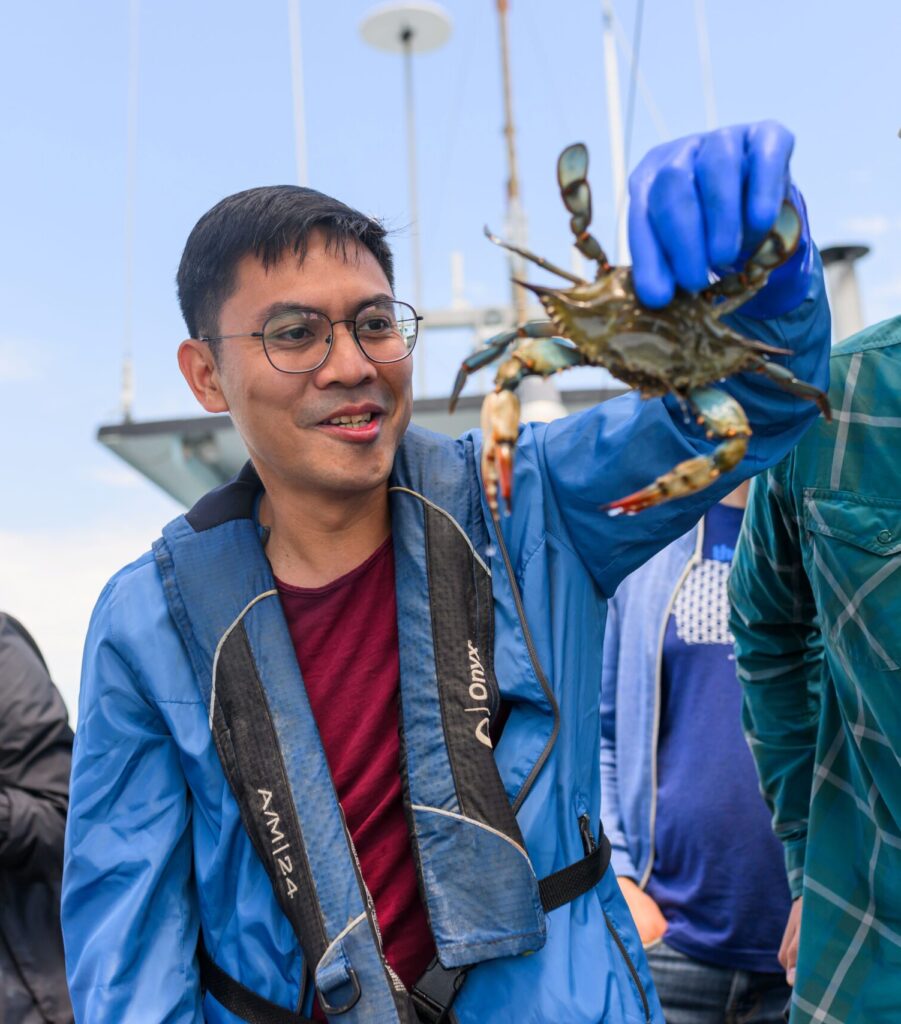
What’s different about your work now after taking part in the Metcalf Institute’s Annual Science Immersion Workshop?
RB: Metcalf was the first extensive science training that I had received even though I was nine years into my career at the time. It was an eye-opening experience and it has made me take my job even more seriously because of the weight of the topics we discussed. The exposure and interaction with different scientists and journalists who were covering the same topics as I am really gave me a focus for the things that I want to do in my work. The theme of water was relevant to me because I could apply what I learned to my journalism here in the Philippines. Here we have to deal with the excess of water because of the typhoons, and then immediately after that, it was the lack of water because of the El Nino. I feel that Metcalf was an affirmation that I’m in the right job, and I’m doing it at the right time.
What are you currently working on? I saw that you were at COP (Council of Parties) in Brazil in November last year?
RB: It was my first time to cover a UN climate talk as big as COP. It was really physically impossible and mentally impossible to cover everything, so I’m focusing on stories that are relevant to our context here in the Philippines. One of those is nature-based solutions. I met a lot of experts at COP from different countries who have been doing work in the Philippines. I want to highlight the future of nature-based solutions and spread awareness, especially in light of the recent typhoons that we’ve experienced. On the opening day of COP, there was a super typhoon in the Philippines. I had this cognitive dissonance, because I thought “What am I doing at COP when I should be in my country reporting on the devastation of this super typhoon?” The typhoon claimed 40 lives so it was a struggle for me.
What types of nature-based solutions are you focusing on?
RB: I’m looking at coastal resiliency in communities so I’m focusing on mangroves. But I’m learning that you need to plant the right types of mangroves. This is why I’m thankful for being involved in science communication and science journalism. I wouldn’t know that the right types of species have to be planted in a specific location. There’s no one-size-fits-all for mangroves. Flooding is also a major climate impact, especially in Manila. The city is very densely populated and we have very poor zoning practices and land use policies. People can just buy land and build whatever type of building they want and that is driving massive flooding here. In speaking with a scientist from the Marine Science Institute of the University of Philippines, I learned there are solutions to flooding in urban settings, such as permeable roads. It’s something that’s still new here, but is being tried in the U.S. and other countries. [This reporting is important] because people are starting to feel the effects of climate change. The Philippines is one of the most vulnerable countries to the impacts of excessive greenhouse gases and global warming. It’s no longer just a concept. Climate change is a shared reality that many people around the world are now feeling.
What’s giving you hope these days?
RB: People are becoming more aware, so that’s hopeful. A decade ago, people didn’t really care about climate change in the Philippines. When a typhoon would hit, they’d say it’s part of nature. It’s how the world works. Now people are becoming more aware. That’s why working on these stories before and during COP as two typhoons battered the Philippines was especially important. It’s not just that people are more aware, but that people who didn’t really care are now becoming interested and curious about the environment and the climate. Sure, there will always be those who will deny climate change, but I’m sure there will come a time when they also realize the gravity of this issue. I feel that they’re being challenged by the sheer number of those who are experiencing it. In the Philippines, we’re very big now on climate solutions and climate talks, so more people are now more willing to share their stories. Instead of dwelling on climate deniers–why should we put the spotlight on them–[I’m focusing on] the people who are willing to talk about what they’re going through.
What do you remember most about your time at Metcalf?
RB: Aside from being able to network with other journalists and experts, I was especially fond of the time when we were taught to read through scientific papers because that was something that intimidated me prior to Metcalf. It was really a game changer for me. I remember working with Kathleen Donohue and I asked “how do I do this? What do I do with this?” She taught me that the first thing you need to read is the summary, and you don’t need to read through everything, such as the methodology, because your audience wouldn’t be interested in how scientists gather their data. Then read the conclusion and the recommendations. Now when I look at scientific papers, I read through the first page, and then the last few pages. It was something I learned from Kathy and I still use it to this day.
This interview has been edited for length and clarity. Find Raphael’s work here.