
About Kelesha Williams
Kelesha Williams is a multi award-winning journalist at Television Jamaica, a member of the RJRGLEANER Group in Kingston, Jamaica. She is a reporter/producer and news anchor for the station’s flagship programme – Prime Time News. While she covers a variety of beats, her work is mostly centered around climate change, biodiversity, and other environmental issues. Over the years, she has gained international recognition for her work on climate change, beginning in 2019 when she was awarded the prestigious United Nations RAF fellowship, and then the Internews Earth Journalism Fellowship to cover COP15 in Montreal, Canada in 2022.
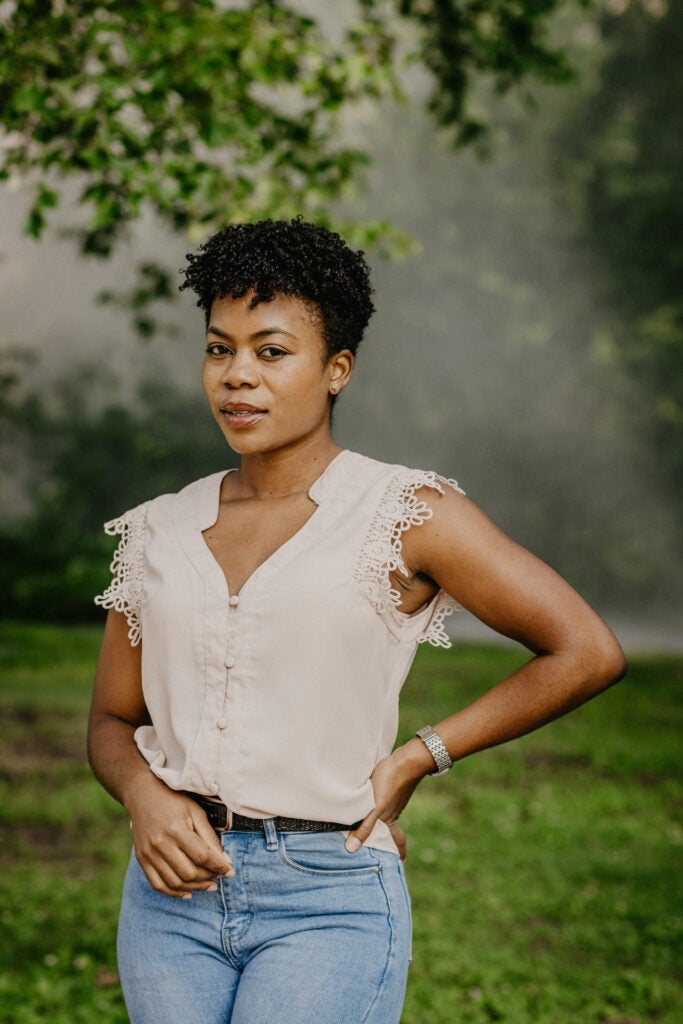
Kelesha spoke with Metcalf’s Ethan Brown about her documentary showing the effects of Hurricane Melissa on a coffee farm in Jamaica for Television Jamaica, how to tell climate stories that inspire readers to be part of the solution, and the impact Metcalf’s AWJ fellowship has had on her career. She’ll be on a panel at the Society for Environmental Journalists conference on April 17!
Tell us a little bit about what you’re currently working on.
KW: I’m working on a documentary on climate change and Jamaica’s Blue Mountain Coffee. It’s one of the most premium coffee brands in the world, but it’s under severe threat from drought and intense weather events. We had Hurricane Melissa in October, which really devastated coffee farms, and the authorities are now trying to see how they can best preserve the brand. They’re looking at alternative varieties of coffee that may be more resilient to climate change. So it’s a one-hour piece that will be on Television Jamaica. I’ve finished reporting it, and I’ll begin editing soon. [Being a part of the Annual Science Immersion Workshop for Journalists] was able to kind of set a foundation for getting the science and the data to support my work.
I’m working on other pieces, too. I write stories daily for Television Jamaica. I also started working with an online news agency in November called The Energy Pioneer, based in the United States, and I’ve worked on a piece looking at Jamaica’s energy grid, how Jamaica’s energy sector has become more vulnerable to the impacts of hurricanes, and what the way forward is in terms of finding greener solutions, especially solar.
Why would you say this work is so important, especially right now?
KW: It is important because we’re living it. We’re living it, and we’re seeing the impact. After Hurricane Melissa in Jamaica, food prices for fruits and vegetables went through the roof, and there was a shortage. Right now, we can’t even get bananas and plantains in the market. I think it’s important to tell the story so people can understand how we can all be part of the solution. It’s not just about being alarmist and saying, “Oh yes, climate change is impacting the environment,” but also about finding ways to get people to act. It’s like a call to action.
I think it’s important for me as a journalist to play this role, to try to find the people on the front line, connect them with policymakers, and see how we can better adapt to this changing climate. And not only with hurricanes, but with drought, because we’re in a drought right now. We’re moving from one extreme to the other. It is impacting our daily lives, food security is at risk, and our overall economy is at risk because Jamaica depends heavily on agriculture. And it’s not just in Jamaica; we’re seeing it globally, too. With snowstorms in the United States and drought in other parts of the world, I think it is very important for us to tell these stories, especially now.
It can be a bit intimidating when it comes to climate science, so I think it’s my role to [tell] these stories in a way that people can understand, so they can be part of the change and not be intimidated by the data and all these reports that we see coming out every year.
What’s giving you hope these days?
KW: People’s perceptions of climate change are changing. Oftentimes in a country like Jamaica, people would be more concerned about the things they can see readily impacting their lives, like crime and violence, but now people are actually taking the climate crisis seriously. It is no longer something we can say is futuristic, or something that’s going to happen 10 years from now. They’re seeing the impact, and they’re talking about it. Even interviewing farmers and talking to the average person on the road, hearing them say, “Listen, climate change is real,” is giving me hope, in the sense that we are controlling the narrative and continuing the conversation, no matter how small it may be. Small countries like Jamaica are not among the big global emitters, but I think we all have a role to play.
Also, seeing my work impact others gives me hope. Especially since the hurricane, the past few months have been very devastating for my country, but walking on the road and hearing people say, “Kelesha, keep telling these stories because I was really moved by it, and I want to be a part of the change,” gives me hope. My newsroom prioritizing these stories also gives me hope. Years before, we were struggling to get climate change stories into the first segment of the newscast, but now, it’s happening. I’m happy to be a part of it.
How has your experience with Metcalf impacted you and your career so far?
KW: Metcalf has made me feel like I’m part of a community, and I think that is very important, especially when it comes to getting support for the stories that you do each day.
Last year in Rhode Island, it was actually my first time interacting with climate scientists, so I think I’m much more confident now writing these stories. I can pick up a report, and I’m not going to lie and say that I understand everything, but I feel much more confident in how I use the data. I’m using [academic research] much more to inform my stories. Also, the support I’ve gotten from the Metcalf community has meant a lot. Even since the hurricane, they were some of the first people to reach out to me, and I felt that support was really there. I was very grateful for that.
The panel [on Climate Attribution Science organized by Metcalf at the Society for Environmental Journalists conference] coming up in April will be my first time speaking on an international panel, and I’m so excited to share this story. It’s an unfortunate story, because we’re talking about how climate change is leading to more intense and extreme weather events on the heels of Hurricane Melissa in Jamaica, but I’m so excited to be part of the conversation and even to be considered. I’m really looking forward to that, and I know it will be an insightful and engaging conversation.
I’m looking forward to it as well, and I’m glad that you’ll be able to share your insights. One last question: what do you remember most about your time with Metcalf?
KW: There are so many things. It was such a packed schedule for that one week in Rhode Island. One was going to the Lobster Lab [at the URI Graduate School of Oceanography], seeing how climate change has been impacting different species of shellfish, and particularly lobster, and the research [URI] is doing. I was pretty excited to get hands-on experience and learn about the history of how important shellfish are to the Rhode Island story, how difficult it has been for farmers over the years, and how the changing climate will continue to impact these vulnerable species. So it was very insightful. What I really appreciate about the workshop is that it was not just about the theoretical part of it. It was quite practical, and I think that’s why I remember so much from it.
Going to the [oyster hatchery at Roger Williams University], getting in the water, and understanding that whole process was also really insightful. It was fascinating to see the different stages of development of the oyster, and also how this species is under threat, and how important the research is. That is something that is lacking, especially in Jamaica. Even in writing my stories, sometimes if I’m doing something on agriculture or looking at fishing in Jamaica, it’s so hard to find the data and the statistics to support my stories.
Being part of the workshop in Rhode Island last year, being part of the Metcalf community, and getting that hands-on experience has really been good for me. It’s something I’ll never forget.
This interview has been edited for length and clarity.