
The Workday implementation at URI will modernize administrative systems and business processes across the University. The project is being completed in stages, with opportunities for faculty, staff, and stakeholders to participate throughout the implementation.
Where Are We Now?
Current Stage: Architect and Configure
URI is currently designing, building, and configuring Workday during the Architect and Configure stage.
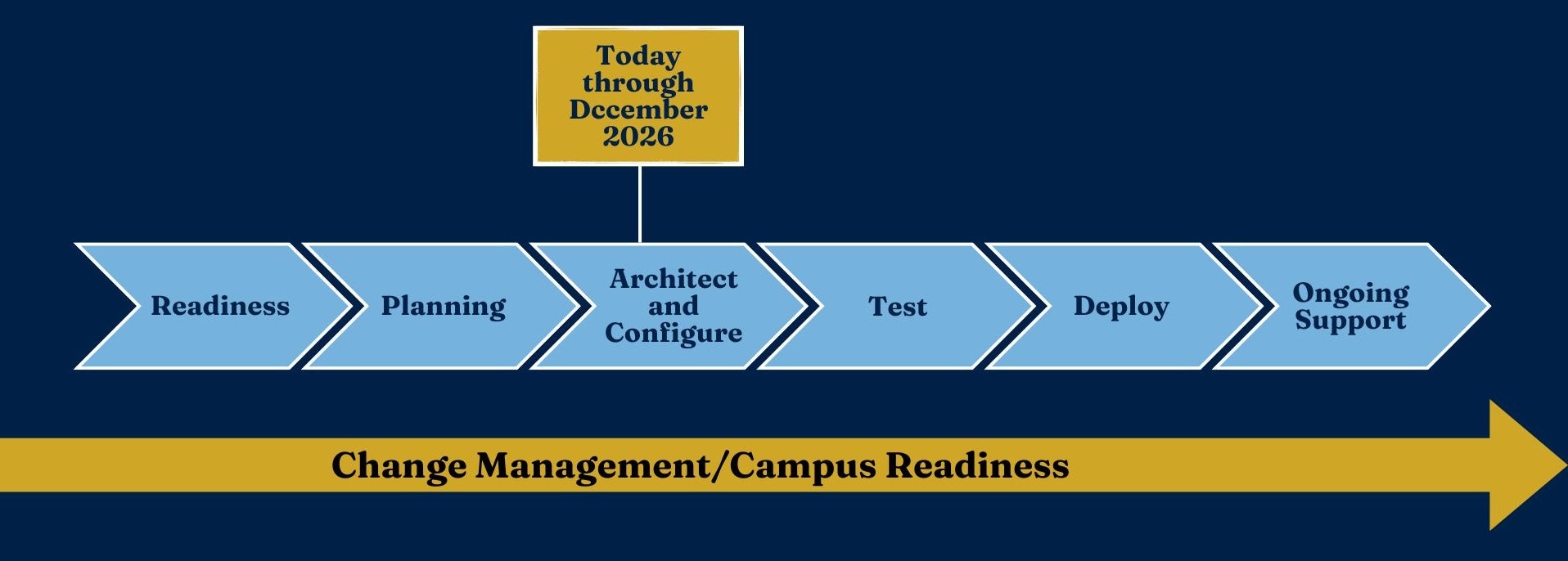
Architect and Configure Stage
The Architect and Configure stage is where URI begins building Workday.
During this phase, URI project teams work closely with Workday consultants to design and configure business processes, security access, reporting, integrations, and organizational structures that will support human resources, finance, payroll, and other administrative functions.
The decisions made during this stage will shape how Workday operates at URI and help create more consistent, efficient, and user-friendly processes across the University.
What This Means for You
Most work during this phase happens behind the scenes as project teams design, configure, and validate the system.
Some faculty and staff may be invited to participate in stakeholder engagement activities, process reviews, reporting discussions, or functionality review sessions. Opportunities for broader participation will increase during future testing and training phases.
Key Activities
- Design the System: Collaborate with Workday to define business processes, security access, organizational structures, data flow, and reporting requirements.
- Develop Reporting: Identify reporting needs across the University and build reports that support operational, financial, and workforce decision-making. Reports will be tested for accuracy, security, and performance.
- Build Integrations: Design, configure, and test integrations that allow data to move between Workday and other University systems.
- Prepare for Testing: Develop testing plans, scenarios, roles, and success criteria to help confirm Workday meets URI’s business requirements before deployment.
- Validate System Functionality: Review configured business processes and functionality with stakeholders to confirm Workday supports the University’s operational needs and expectations.
- Test Configured Components: Conduct testing of configured Workday functionality to verify individual components operate as intended before broader end-to-end testing begins.
- Engage Stakeholders: Continue stakeholder engagement activities to build awareness, gather feedback, and keep the campus community informed about project progress.
Why the Architect and Configure Stage Matters
The Architect and Configure stage helps URI:
- Define how data will move from current systems into Workday
- Design integrations between Workday and other University systems
- Establish reporting capabilities that support decision-making across the University
- Build the financial structure that will support budgeting, reporting, and financial management in Workday
- Configure business processes and security access that support day-to-day operations
These decisions create the foundation that will guide testing, training, deployment, and ongoing use of Workday.
Architect and Configure Stage Timeline
The Architect and Configure stage runs from May through December 2026.
During this time, project teams will design the system, configure business processes and security access, build integrations and reports, validate functionality, and prepare for formal testing.
What’s Next: Test Stage
The Test stage begins in December 2026.
During this phase, URI project teams and stakeholders will test business processes, reports, integrations, security access, and data to confirm the system is functioning as expected and ready for deployment.
Testing will help identify issues early, validate system performance, and ensure Workday supports the University’s operational needs before launch.
Stages of the Workday Project
| Readiness Building a Foundation for Success | Planning Defining the Future | Architect and Configure Modernization at Work | Test Ensuring Success | Deploy Moving URI Forward |
|---|---|---|---|---|
| During the Readiness stage, URI evaluated existing systems, business processes, data, and organizational needs to prepare for the Workday implementation. Project governance, staffing, planning, and support structures were established to create a strong foundation for the project. Initial stakeholder engagement planning also began during this phase. | During the Planning stage, URI finalized project scope, established implementation plans, and began preparing data, reporting, and integration requirements. Work also began on foundational structures, including the University’s financial framework and management hierarchy. Stakeholder engagement activities launched to begin informing the campus community about the project and its future impact. | During this stage, URI and Workday are designing and configuring business processes, reporting, integrations, security access, and organizational structures. The project team is building the foundation of the system and validating that it aligns with URI’s operational needs. Stakeholder engagement activities continue throughout this phase, and selected stakeholders may participate in reviews and validation activities. | During the Test stage, URI will evaluate configured business processes, reports, integrations, security access, and data to confirm the system is functioning as intended. Data validation activities will occur, and stakeholders may participate in testing activities to help identify improvements before deployment. Training materials and readiness resources will also begin to be developed and delivered during this stage. | During the Deploy stage, URI will prepare the campus community for Workday go-live. Training will be delivered, system access will be assigned, support processes will be finalized, and final readiness activities will take place across the University. Following launch, enhanced support and training resources will help ensure a smooth transition to Workday. |
Ongoing Support
Supporting Continuous Improvement
Following deployment, Workday will enter ongoing operations and support.
The University will continue providing training, support, reporting enhancements, system maintenance, and process improvements to help ensure long-term success and adoption.