
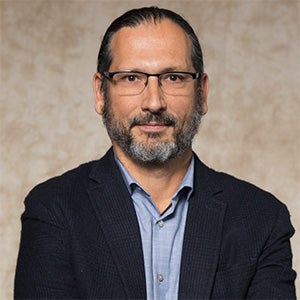
- Professor, Department Chair
- Department of Psychology
- Phone: 401.874.2818
- Email: david.schnyer@uri.edu
- Office Location: Social Science Research Center, 130 Flagg Road
#115 - Accepting Students: Not at this time
Accepting Students: Dr. Schnyer will not be accepting new doctoral graduate students for the 2027-2028 academic year.
Biography
David Schnyer, Professor of Psychology and Department Chair received his doctorate in Clinical Psychology with a specialization in Neuropsychology from the University of Arizona in 1998, training under Dr. Alfred Kaszniak. Following postdoctoral and research appointments at Massachusetts General Hospital and Boston University School of Medicine, he joined the University of Texas at Austin faculty in 2006, rising to full professor and serving two consecutive terms as Department Chair before his recruitment to URI.
Research
Dr. Schnyer’s research sits at the intersection of cognitive neuroscience, clinical psychology, and translational medicine, unified by a commitment to understanding neural systems supporting memory, attention, and cognitive control, and how these systems are disrupted by injury, illness, aging, and sleep. His methodological toolkit spans EEG and event-related potentials, structural and functional MRI, diffusion tensor imaging, MEG, and ambulatory mobile sensing.
A cornerstone of his work is his involvement in the TRACK-TBI study, one of the most consequential longitudinal platforms in neurotrauma, in which he has been a site principal investigator since its founding in 2008. TRACK-TBI research has established the clinical utility of blood-based biomarkers — including GFAP, UCH-L1, and neurofilament light — for characterizing injury severity and predicting functional recovery and has demonstrated that advanced MRI techniques detect pathology and predict outcomes in patients appearing normal on conventional imaging. These findings have directly informed regulatory development of TBI diagnostics.
His second major research focus concerns sleep, circadian health, and cognition. His laboratory has developed and validated ambulatory monitoring pipelines using smartphones, smartwatches, and environmental sensors to study sleep and rest-activity rhythms in free-living individuals. This work has demonstrated that circadian rhythm regularity predicts white matter microstructure and hippocampal-dependent memory in aging adults, and that physical activity patterns systematically influence sleep architecture in naturalistic settings.
The third pillar of Dr. Schnyer’s research addresses the neurobiology of depression. His laboratory has used fMRI and EEG to characterize prefrontal and cognitive control network contributions to negative attention bias in major depressive disorder. A co-led randomized controlled trial established that changes in attention bias mediate depression symptom improvement following attention bias modification training, providing the first clinical trial evidence for the proposed mechanism of action.
Throughout his career, Dr. Schnyer has maintained a strong commitment to mentorship, training doctoral students to completion, sponsoring NRSA F31 fellowships, and supporting postdoctoral fellows to independent faculty positions.