
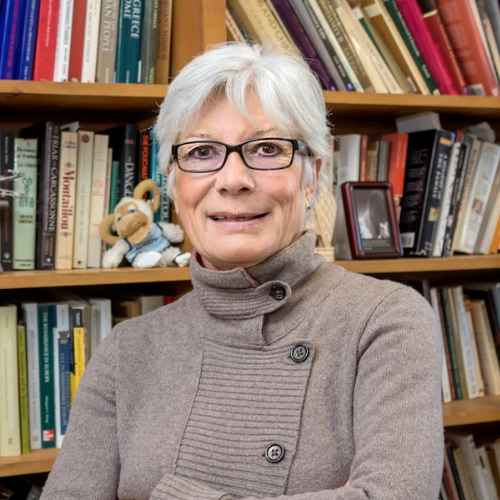
KINGSTON, R.I. – Joëlle Koster, professor of medieval history, will retire at the end of spring 2026 after three decades at the university. Through her engaging approach, Koster turned dusty papal ledgers into living lessons on empathy, showing generations of students that history is not only engaging and meaningful, but deeply relevant to understanding our shared humanity. As a key member of the College of Arts and Sciences, she leaves a legacy reminding students that history is both engaging and meaningful, encouraging them to empathize with subjects from the past, attempting to see how they saw.
“Most of her students don’t know it, but Professor Joëlle Rollo-Koster doesn’t just teach about the crusades, she is an actual bona fide knight herself,” said Bridget Buxton, colleague and history professor. “Her colleagues appreciate her for the many other knightly qualities she has brought to URI over the years: fearless leadership at the department and faculty senate level, true empathy, and an unwavering commitment to the highest principles of quality in academia. Many generations of URI graduates have benefitted from her teaching, and her contributions to scholarship on the papacy are seminal. She will be greatly missed at URI, but Professor Rollo-Koster has certainly more than earned whatever new adventures await her in retirement.”
Koster grew up in the south of France; enthralled by history from a young age, she later pursued history and geography in her undergraduate and graduate studies, culminating in her Ph.D. research on the Avignon Papacy. As a teacher, she emphasizes the importance of analyzing historical texts and understanding the lives of ordinary people. Koster is also a world-renowned researcher and teacher specializing in medieval history and the papacy, who was knighted by the French government with the medal of Chevalier des Palmes académiques in December 2016, a fellow at The European Institutes for Advanced Study in 2017, and recently elected fellow of the Medieval Academy of America in 2024.
Born and raised in Toulon, a large Mediterranean coastal town in France, Koster was an only child to a newspaper deliveryman and a seamstress. Toulon was the number one port town at the time, which resulted in a culture where American GIs and the French Navy often drank and caused trouble. Koster was not allowed to leave the house. To fill her time, her father, who had access to news kiosks, would bring home magazines and cartoons for her to pore over.
“That was my youth—locked in a small apartment, reading with my dog. As I grew up, I realized I always loved history, and with school, I got good at geography,” said Koster.
History and geography are inextricably linked in France, unlike how history is taught in the United States. Overall, history in France is considered a social science rather than a part of the humanities. French historians in the early 20th century embraced a new approach that focused on human interaction and social dynamics. This influenced Koster’s own educational background and research methodology. With sociology and anthropology as the foundation of her studies, she had the advantage of learning history through the lens of human groups in action: culturally, economically, and socially. Further, Koster found that studying the physical environment of a place gave way to a deeper understanding of its history.
Koster completed her undergraduate studies in history and geography and earned a master’s degree in medieval history at the University of Nice, France. Her interest began with the French Revolution, which remains dear to her heart, but quickly grew into a fascination with medieval history. Medieval history is vast but largely untouched because it is difficult to access. However, Koster had the exact skillset needed to learn more about our past. With years of Latin training and fluency in four other languages, along with her passion and knowledge for geography and history, she became the ideal candidate.
“Few people study medieval history, but research opportunities are abundant. Many untouched archives exist, and linguistic skills are rare,” said Koster. “My university in Nice taught us to read old handwriting. While that skill is fading, AI transcription makes many mistakes with shorthand or abbreviated Latin.”
The enormity of sources in medieval history, and being a native of the south of France, gave Koster ample opportunity to tap into the 100-year history of the papacy in Avignon. In the 14th century, Popes could not maintain their presence in Rome, always the prey to internecine wars between aristocratic factions, and instead occupied the small town to fulfill their papal duties. Since many medieval archives are largely untouched, Koster found herself going through hundreds of documents, in this case connecting the dots between the papacy and the mercenaries they employed.
Koster went on to marry an American man and move to upstate New York after completing her education. She secured a full-ride scholarship to SUNY Binghamton to pursue her Ph.D., during which she had the opportunity to work with the founder of Renaissance historical anthropology, Richard C. Trexler. Following her social science track, she earned her Ph.D. focusing on the social and demographic history of the papal city of Avignon, capital of Christianity between 1309 and 1378.
“He had me do a classic Ph.D.—an edition of a medieval text. He said, ‘Once you do this, your foundation is set, and you’ll be seen as a real medieval historian.’ So I went to the Vatican, transcribed documents, and uncovered a 1371 census of Avignon’s population. I found 3,800 entries of everyday people—first and last names, birthplaces, and sometimes occupations. I was the first to touch these documents and, in a way, bring these people back to life,” said Koster. For a moment, the weight of the past settled in—a silent connection bridging centuries. “As a historian, you can’t beat that feeling.”
She defended her dissertation in January 1993 and became a part-time adjunct professor at Castleton University in Vermont. She officially joined the URI community in 1996, after being interviewed by former history faculty members James Finley, Bob Weisbord, and BobGutchen.
Throughout her thirty year career at URI, Koster impacted majors and nonmajors. She especially values teaching History 112, a survey course she enjoys for its diverse students and emphasis on analytical skills over memorization. She engaged classes of up to 175 using teaching assistants for recitations and textual analysis. She noted that the popularity of the medieval history course has fluctuated, sometimes influenced by political factors in education.
As her chapter at URI comes to a close, Koster is far from done. After she retires, she is to become a grandmother for the first time. She has talks scheduled in Rome and Prague. The University of Toronto Press requested her to rewrite their number one textbook in medieval history. Her continued research will delve into areas never explored before in the papacy: the scents associated with the pope and ecclesiastical dignitaries. She still keeps active with a public facing approach writing for The Conversation, TedEd, and Medievalists.net for example.
While there are several academic milestones and awards to decorate Koster’s career, some of her proud moments are found in unlikely places. Sometimes it’s out to lunch, and a waiter recognizes her from a history class he took ten years ago. Or she bumps into a former student at the mall, who enthusiastically tells her children that Koster was her history professor. There’s a good reason why they remember her, regardless of their studies or career path.
“It’s good to have passion for what you’re doing,” said Koster. “Dates are not the fabric of history, but a sense that those were living, breathing people. Like you and me. And we need to remember them. It’s just compassion and empathy for those past lives.”