

KINGSTON, R.I. – September 29 – Travess Smalley, an assistant professor of print media in Art and Art History, has had an exciting year. He published a new book, took part in an artist residency, used grant funding to make new work with students, and showed his art at a gallery in Paris.
“My art practice is about how we bring digital things into the real world. In the Print Media studio, I explore this idea with students. In a way, my book is the result of that work,” said Smalley.
Pixel Rugs
Vetro Editions, an independent publisher and creative studio in Berlin, Germany, released Smalley’s first book, “Pixel Rugs,” which debuted at the Museum of the Moving Image in Queens, New York, in May. It was also featured at Off-Print London, Europe’s biggest artist book fair, and is available at Museum of the Moving Image, as well as at ZKM | Zentrum für Kunst und Medien in Karlsruhe, Germany, and Fondazione Camera in Turin, Italy.
“Vetro is the perfect publisher for my practice, they are focused on digital art and print,” Smalley said. “When we started talking, it was going to be a book on ‘Pixel Rugs,’ but that idea expanded. One problem the book tackles is how to show digital color physically. Digital color is backlit by the computer screen. So we printed the book using Quadrifluox, an experimental fluorescent ink printing technique that creates chromatic depth.”
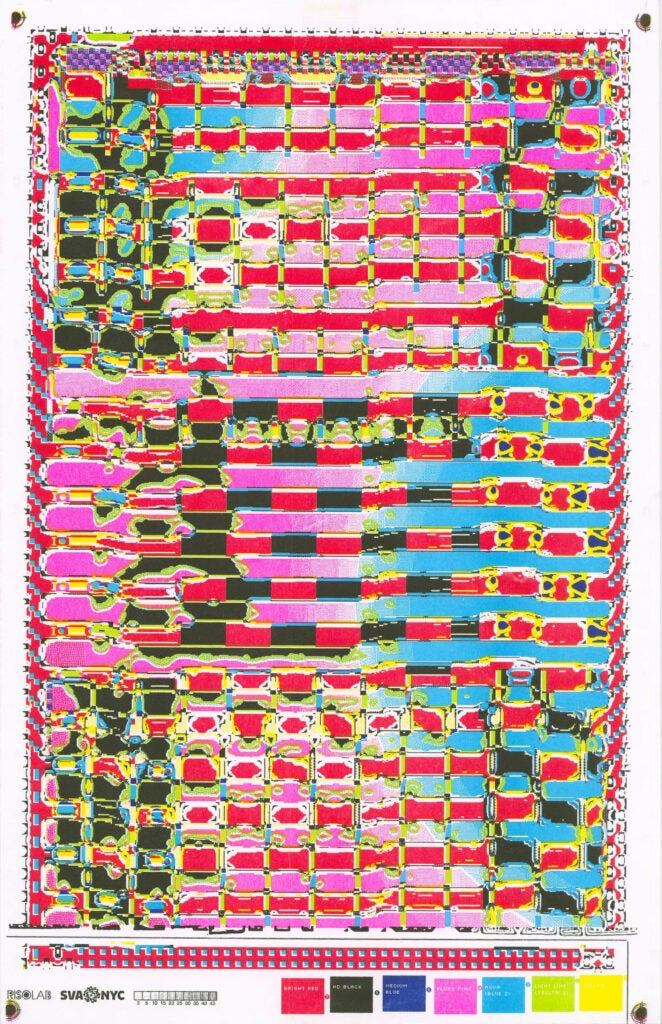
Travess Smalley
06_01_26_Pixel_Rug_01_RISO, 2026
Risograph, seven colors
The book includes pages that change under UV light, and looks at how generative code and pixel images move between software, pen plotting, digital publishing and the visual style of woven textiles. “Pixel Rugs” started as a study of pattern symmetry and generative gestures. In 2019, Smalley drew on ideas from Peter S. Steven’s “Handbook of Regular Patterns” to experiment with making computerized generative patterns. He was also inspired by American weaver and archivist Frances Louise Goodrich, whose watercolor drawings double as weaving instructions.
“I’m interested in how small grids of pixels, when manipulated, can create a seemingly endless number of forms,” Smalley said “At its core, my work has always been process-driven. Surprise and structure work together, letting me stay engaged with image-making, texture, scale, and connecting ideas from the screen to what happens in the print shop.”
Paris and New York
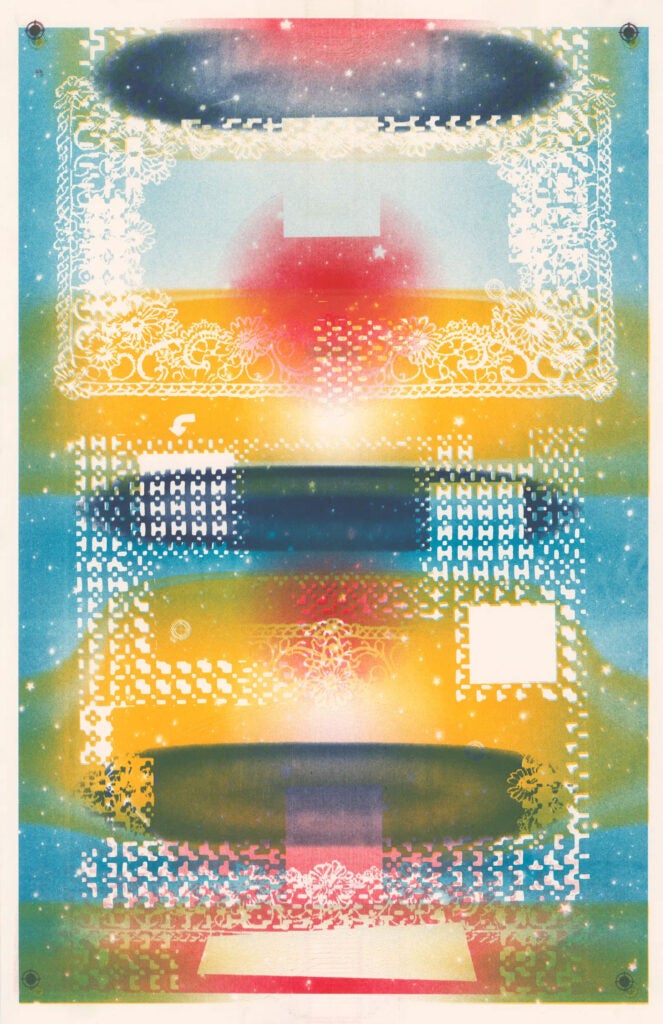
Travess Smalley
gradient study, 2026
Risograph, three colors
Along with launching “Pixel Rugs”, Smalley is exhibiting his work at the Artverse Gallery in Paris, France, in the show “Ghost in the Thread.” The exhibition, running from Sept. 11, through Oct. 26, explores how fleeting digital signals—the glowing, sometimes glitching ghost of code and light—are captured and turned into physical or digital-physical materials. Visitors can see Smalley’s pin plotter drawings, a risograph print, and a full woven rug. He attended the opening with special copies of his book.
Smalley also spent the summer as the RisoLAB Artist-in-Residence at the School of Visual Arts in New York City, where he worked in the studio printing his art following his own creative rules and discovered many new possibilities. He explored how digital images from the internet could become physical objects, making dozens of risograph prints that are now on display at an art gallery in Paris.
“When I started teaching at URI, I used a portion of my funding to buy a Risograph machine for the Print Media studio to create prints with students. Doing the artist residency at SVA this summer taught me loads of new printing and preparation processes that have helped me grow as a printmaker and as an educator,” said Smalley.
Physical Outputs
After finishing a digital design, Smalley turns his grids into physical art using pen plotting, risograph printing and hand-woven rugs. He first experimented with pen-plotted drawings, where each pixel becomes a square made of four drawn lines.
“Black pens on cream cardstock unified the images with a threadlike quality, where each line acted as both an outline and a weave,” Smalley said. “While the code still generated the structure, the physical act of plotting added irregularities, evoking the nature of textiles and traditional print media.”
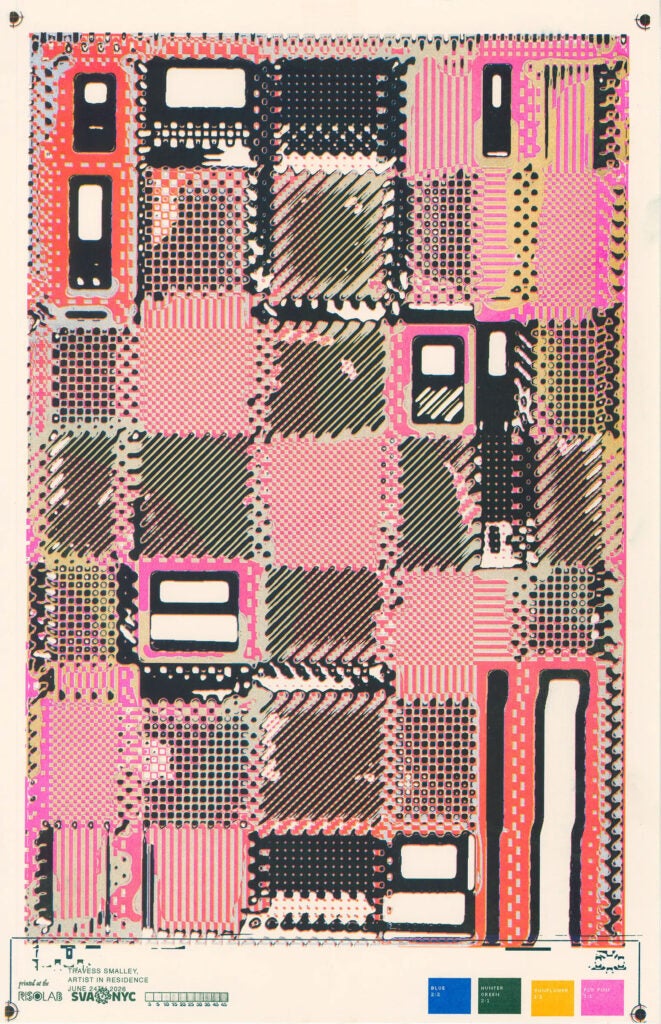
Travess Smalley
06_24_26_Pixel_Rug_01_RISO, 2026
Risograph, four colors
The risograph machine was first introduced in Japan in 1980 for high-volume photocopying and printing, once common in schools, churches, colleges, political campaigns, and other short-run print jobs. In the past decade, though, artists have brought the risograph back for its unique, tactile results.
It looks like a photocopier but works like a screen printer, using rich spot colors and stencils to create tactile, vibrant prints affordably and with little impact on our environment. Each color is printed in a separate pass, so overlays, shifts, and misregistration are unavoidable. In turn, this becomes part of the art.
“The risograph became more than a tool for reproduction. It brought the logic of transparency, layering, and interference into physical form, and opened up a new terrain for exploration,” Smalley said.
How does a digital image turn into a hand-knotted textile? Smalley worked with Los Angeles artist and Maman Rugs owner Samira Gagné Ludwin to make this happen. Together, they turned digital images into guides for weavers, resulting in unique rugs. Like other ways of making Pixel Rugs, this process is fleeting. Bright white pixels become soft cream tufts, and colors are no longer lit from behind but woven into the fabric.