
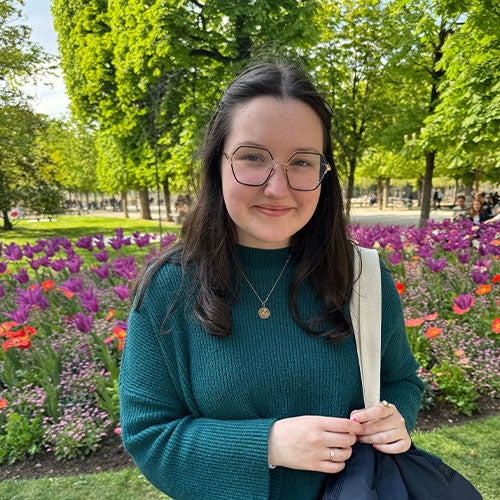
Graduation Year: May 2024
Major: Public and Professional Writing B.A., French B.A.
Hometown: Fairport, NY
Where you lived and taught in France: Châtenay-Malabry, France – a suburb just outside of Paris
When did you know you wanted to study French?
I knew I wanted to study French in college as early as middle school. I chose French in 7th grade as my language because it seemed like the cool thing to do. I didn’t realize that one decision at 12 would shape my life so profoundly for years to come. I just knew I liked the language, and I fell in love with the culture as I continued to improve my skills.
What experiences did you have in the French program that prepared you for Teaching Assistant Program in France (TAPIF)?
Everything I did in my program was a way to prepare me for my life in France, and my job with TAPIF. I used every bit of the French language and culture taught to me in undergraduate while I was abroad. Going to France and immersing myself in the language and culture felt like a direct pay off of my time in the classroom with my professors. Setting up a bank account, getting to know my landlord, going to the pharmacy, socialising with my colleagues – everything was rooted in the conversational skills taught to me at URI.
Why did you apply to TAPIF?
I applied to TAPIF because of my professor, Lars Erickson, actually. He shared the experience his daughter had in the program with the French class I was taking at the time, and I knew I wanted that for myself. I am lucky enough to have a great support system, professors and family alike, who supported me in my goals and are the reason I was able to move halfway across the world. Leslie Kealhoder-Kemp helped with filling out the application itself and gathering the information needed. I had never studied abroad in undergrad at URI. I actually finished my degrees in three years, which left me with what felt like an open year that would’ve been spent studying to do something else. It was a “now-or-never” type of realization, as there wouldn’t have been a better time for me to drop everything and move to a brand new country.
What were some of the biggest learning curves while in the TAPIF program?
While I had learned a lot about the cultural differences between France and the United States, experiencing them was a completely different thing. Adjusting to a different way of life and embracing that change took some doing. Much like a chilly swimming pool at the start of the summer season, I had to dive in head first, or else I knew there was no way I was getting in. I am grateful to myself that I did that, because I believe having an open mind allowed me to optimize my experiences, and form deeper connections with friends and colleagues. I will say, I never looked so put together as I did walking the streets of Paris, and that is thanks to embracing a very Parisian way of life.
Learning to manage a classroom was also a huge learning curve for me. The French education system holds students to a different standard than students in the U.S. are held to, some could say stricter, so I learned fast that I needed to adjust the approach I had been carefully crafting in my mind. I eventually found a nice balance between what my teaching style is and the cultural expectation of a French middle school (or college, to be more technical in the name).
What do you hope to do next?
I’ve spent a lot of time with this question. Right now, I’m a teacher aide for a class of fifth graders, and I adore my students. They mean the world to me. I feel very privileged to be there for them every day, supporting them and guiding them through a very fun and transformative time of their lives. Life in France taught me to take everything one step at a time. If you had asked me “what’s next?,” at my college graduation, I would have pulled out a step-by-step, minute-by-minute plan of my entire life, and probably would have told you I was already behind. Now, I am enjoying exactly where I am and who I am in my life. I might not have all the answers of what lies next, but what I am doing now is making a difference in young children’s lives, and to me, that’s everything.
Why do you think it’s important to study a language as an undergraduate student?
Language, quite literally, opened a whole new world to me. I would not have been to live where I lived or worked the job I had if I had not studied a second language in school. A deeper understanding of a second language also helped me in my own language. As I was earning a degree in Public and Professional Writing, I felt the more I studied French, the better my writing became in English. There also has not been any downsides to studying a language. It is not something to look at and say “well if I do study a language, this is what it takes from me.” It only gives. It gives opportunity and connection and a new perspective that can only be gained through language acquisition.