
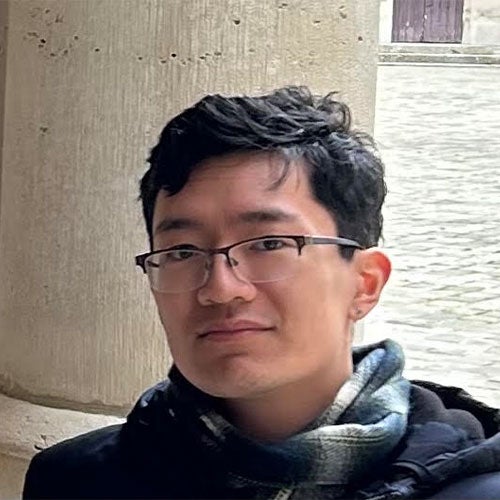
Graduation Year: 2025
Major: Chemistry (BS), French (BA)
Hometown: Coventry, Rhode Island
Where you lived and taught in France: Dunkirk, Hauts-de-France
When did you know you wanted to study French?
I knew that I wanted to study French after completing a two-way exchange program during my first year of learning the language in high school. During this exchange, students from France came to the US to observe life as an American high school student in October, and in April, American students traveled to France to observe French high school student life. It was the latter that cemented my desire to continue studying French. It is one thing to learn about the language and culture but a whole other to experience it.
What experiences in the French program prepared you for TAPIF?
In general, the lessons on French socialization and university life have been the most helpful for preparing me for TAPIF. During the contract. I rented a room from a French person’s house, so knowing how French people spend time with each other prepared me for encounters with his friends and acquaintances. Professionally, learning about university life created realistic expectations for interactions with students and colleagues. In particular, learning that French teachers tend to be more emotionally distant from their students than their American counterparts ensured that I did not overstep professional boundaries, which would otherwise have been easy because the students are generally curious about foreigners, such as myself.
Why did you apply to TAPIF?
I initially applied to TAPIF for a long-term stay in France. During my undergraduate studies, I worried that my sequential chemistry classes would mean that I might not graduate in time if I studied abroad and the classes that I took abroad were not considered sufficiently equivalent to those offered at URI. As a surface-level solution, in the summer of 2024, I spent a month in Grenoble, a small city in southeast France, for a month-long intensive French language program. However, due to its length, it felt more like an extended vacation.
I was also not sure about the direction of my career while applying to it, so taking a year to explore my options also seemed like a good idea. It was not until November 2024, well into the application process, that I figured out that I wanted to go to graduate school. While teaching English is not directly related to chemistry, it develops skills such as adaptability and reflection that are useful in chemistry.
What were some of the biggest learning curves while in the TAPIF program?
Some of the biggest hurdles during my stay included opening/closing a bank account and adapting to different students’ English levels. I’ll start with the bank account situation. Because I am a US citizen, it was difficult to find a bank that would let me open an account there. I attribute this difficulty to the extra paperwork that French banks would have to undertake due to tax agreements with the US and the fact that US citizens report their income to the IRS regardless of where they live. Fortunately, I found a bank that would open an account for me.
In terms of work, learning to adapt to different English levels was one of the biggest challenges. I worked at a high school where students’ English abilities varied widely. While some students could hold a full conversation with me about topics such as art or current events, others struggled to understand basic questions I asked or small corrections that I would make to project scripts. I gradually learned the English levels of each class through the work that the teacher assigned and by helping them with their work.
What do you hope to do next?
I am currently reapplying to graduate school for chemistry and looking for a job in the meantime. To this end, I am applying for three PhD programs in the US and a master’s in France. (In France, chemistry students usually complete a master’s before a PhD unless they enroll in an integrated PhD program.) Because master’s programs in France are not financially supported by the university, I have applied for a Fulbright Scholarship and am working on the application for the Lafayette Scholarship.
Why do you think it’s important to study a language as an undergraduate student?
I think that there are several good reasons to study a language. At a higher level, part of a good university education is to learn to question the world around us. Because language learning requires acquisition of cultural knowledge, it is inevitable that it will present beliefs and assumptions that challenge our own. One example is with France and the US’s work-life relationship. Many of my former grade-school teachers have connected personal anecdotes to their lessons. However, while working in France, I observed that the teachers tended to stay impersonal, and even if they mentioned a personal experience, it usually remained vague and happened in passing. This difference made me question our relationship with our work and why, as a population, Americans tend to make our line of work such an integral part of our identity.