
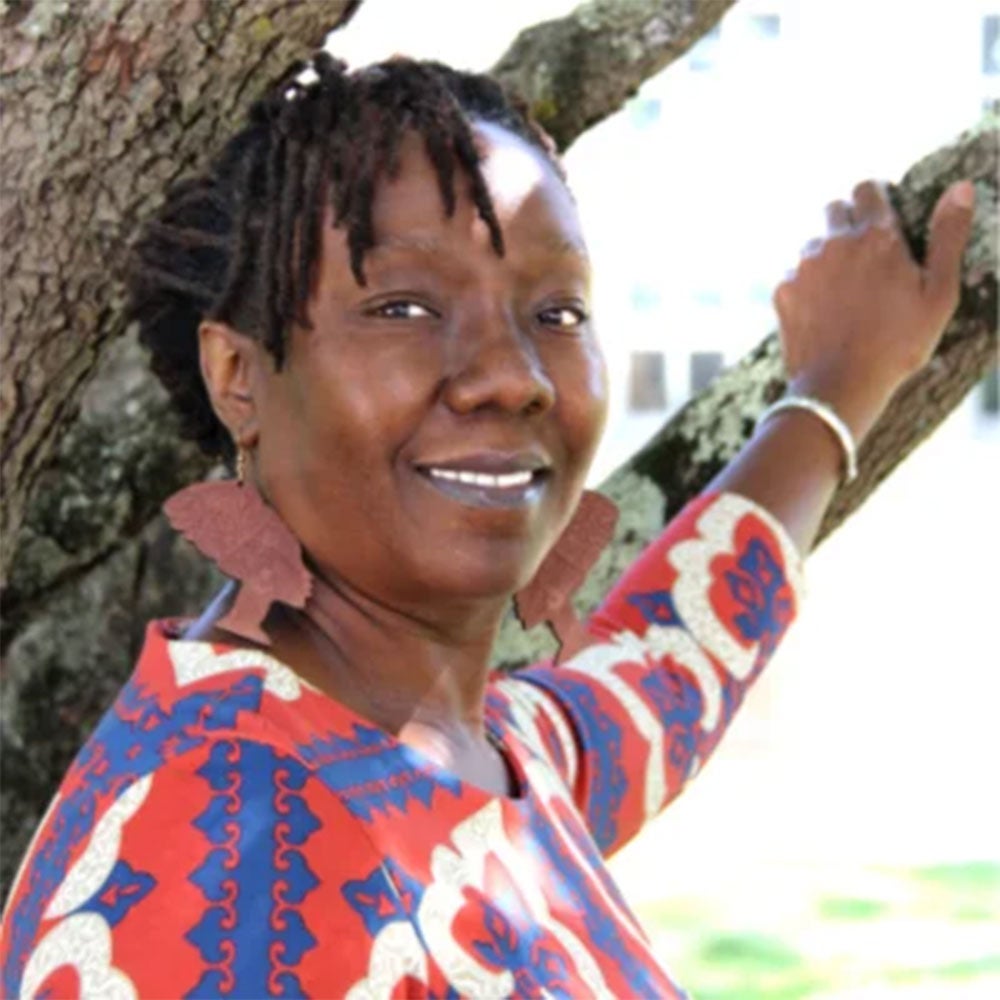
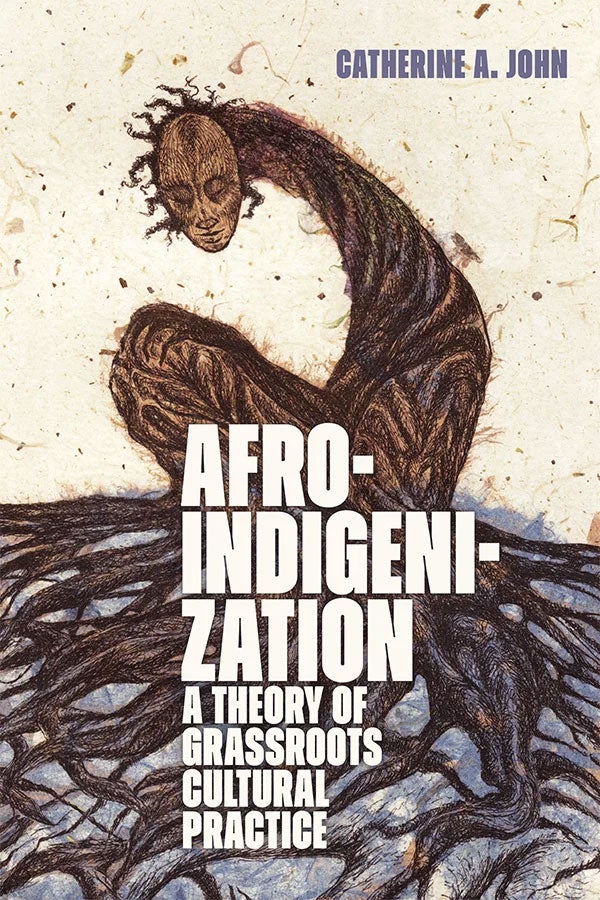
KINGSTON, R.I. – August 13 – Afroindigenization describes how descendants of enslaved Africans cultivated internal power, drawn from ancestral knowledge, religion, spirituality, and cultural memory as a survival mechanism in the absence of collective economic, political, and social power. The term “afroindigenization” was coined by Catherine John, professor and department chair of Africana Studies, for her latest publication, Afroindigenization: A Theory of Grassroots Cultural Practice.
“The internal power that enslaved Africans and their descendants enact is sourced from and connected to a submerged consciousness that operates beneath the surface of everyday life, and that is not consciously organized or named by those who embody it,” says John. In Afroindigenization, John asks a deeper question: Where did this internal power come from and how was it manifested?
“The power was spiritually sourced, emerging from a fusion of personal and familial lineages; from African cultural traditions that were embedded and hidden within Christianity and Islam when original languages and religions were banned; from ancestral worldviews that went underground rather than completely disappearing,” says John.
One way of understanding the concept of Afroindigenization is as cultural expression such as music, dance, poetry, humor and spiritual ways of being that are tools of psycho-spiritual survival for insiders to Black culture, despite the fact that outsiders may perceive them as beautiful or inspirational forms of art.
Expanding on John’s first publication, Clear Word and Third Sight, which argued that the descendants of enslaved Africans share a diasporic consciousness, Afroindigenization also addresses what it means to speak of indigenous consciousness – not from the context of First Nations peoples in the Americas, nor from the perspective of Afro-indigenous populations like the Garifuna, Cherokee Freedmen or Black Seminoles, and also not from the position of continental Africans such as the Yoruba, the Asante, the Malinke or the Zulu who never left continental Africa. Indigenous consciousness here is explored specifically from the perspective of what it means to be descendants of enslaved Africans in the diaspora outside of Africa.
Contemporary African political boundaries are colonial constructs, not reflective of pre-existing ethnic/cultural land/space boundaries. The majority of enslaved Africans transported from these regions did not come to North America. Most went to Brazil, while others were distributed throughout the Caribbean as well as parts of Central and South America in which histories of African enslavement are still denied or minimized. This dispersal throughout the Americas of enslaved Africans further explains the cultural connective tissue between various Black populations in the West despite varying geographic locations.
From mermaid lore in rural Jamaica to hip-hop trance-induced dance in Los Angeles to the stories of two debaters-turned-social-media-influencers, John shows how the descendants of enslaved Africans express the signs and substance of their afroindigenized power through collective cultural creativity. Drawing from scholars such as Vèvè Clark, Hortense Spillers, Dianne Stewart, and Sylvia Wynter, Afroindigenization exposes the cultural and spiritual ancestries that lie at the heart of modern black identities and practices.
Afroindigenization: A Theory of Grassroots Cultural Practice is scheduled for official release by Duke Press later this month and is already available on Amazon. John will discuss her book in several upcoming engagements. On August 19th at 11:30am, she will join a livestream with George Lee and Rashid Campbell. On September 5, she will appear on the New Books in African American Studies podcast, organized by Brown University graduate students. October 20-23, she will be speaking at Rhodes College in Memphis, TN, and November 11-13 at the College of William and Mary in Williamsburg, VA. In early 2027, John will participate in a talk at Sankofa Video & Books in Washington, D.C and Northeastern University in Boston, MA.