
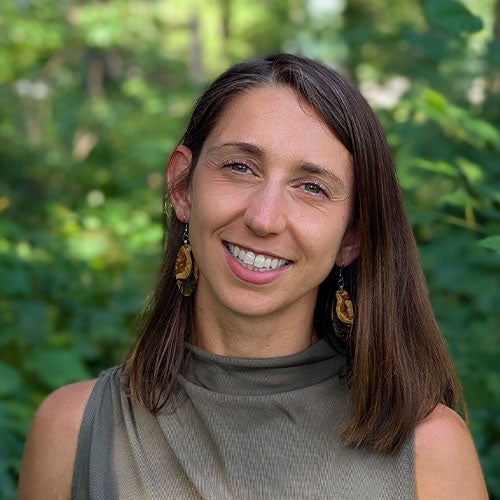
KINGSTON, R.I. – Sept 1 – URI Graduate School of Library and Information Studies assistant professor Dr. Jacqueline ‘Jacquie’ Kociubuk received an Institute award to further her research on professional development for libraries.
The Institute of Museum and Library Sciences (IMLS) grant (specifically from the Early Career Laura Bush 21st Century Librarian Program funding stream) will focus on improving how public libraries serve self-care children, formerly known as “latchkey children.” The grant will fund a case study across six public libraries of varying sizes and geographic locations, culminating in a scalable model and a publicly accessible website with training resources for library professionals. Her goal is to shift library culture from viewing self-care children as a burden to recognizing them as a valid and valuable patron population worthy of intentional, developmentally appropriate service.
“The work of childhood is play,” says Kociubuk. “You’re developing into a person, and play is a joyful, wonderful way to undergo that holistic development. Libraries are really unique in that they are a safe space for self-care children to go and be themselves.”
Originally, Kociubuk studied biology and chemistry while working various fisheries-related jobs in Washington State. After relocating to Ohio, she worked in multiple library systems, where she fell in love with community-centered learning. She went on to pursue a dual master’s degree (MLIS/MEd) and worked as a children’s librarian for several years before completing a PhD in Information at University of Wisconsin-Madison.
“Over time, I grew increasingly interested in research and recognized that I could have a broader impact on the field through academia than through serving one community,” says Kociubuk.
Why Libraries Matter
The United States currently has over 17,000 public libraries, which serve as critical community spaces as the country has experienced a long-term decline of free, accessible public spaces. Libraries are uniquely flexible and responsive to community needs ranging from PreK-3 school readiness support to retiree populations in need of digital literacy programming. Privatized spaces carry financial and logistical barriers, particularly for families. Public libraries are considered to be one of the last truly free public spaces, supporting learning from birth through death.
“Self-care children is the current research-preferred term replacing the outdated “latchkey children” concept; in library contexts, they are often called unattended or unaccompanied minors,” explains Kociubuk. “The experience today looks very different from the 1970s–90s image: most self-care children are not home alone; they are out in their communities, with friends, or supervised by an older sibling.”
Many parents do not identify their children as “self-care children.” Instead, they often frame it as supporting independence or as a practical solution to family scheduling challenges (e.g., shift-work parents, geographic distance from extended family). Self-care is not inherently negative; many children enjoy having free time and autonomy, in contrast to highly scheduled school and after-school environments.
Self-care does not imply parental negligence, nor does it imply children are antisocial or engaging in antisocial behavior. There are significant classism, socioeconomic, and racial dimensions: parents and children of color are disproportionately scrutinized and regulated in public spaces when engaging in self-care. Legal ambiguity also compounds the issue, as only 13–15 states have laws governing the age at which children can be unattended. Many parents are unaware of local rules, and some fear having children removed from their care if self-care is perceived as negligence.
Tension in Library Spaces
While libraries provide accessible, free, and available space for children, this can create friction with library staff. Staff can sometimes feel that a parent’s absence shifts caretaking responsibility onto them. Some adults (both staff and patrons) hold outdated notions of what libraries are for (quiet spaces for reading books), and that clashes with the reality of the public library in 2026. Self-care children, especially teens, will naturally be “loud, social, and playful” in library spaces. Some adults find this distracting or inappropriate, leading to complaints and punitive responses.
“Most existing professional guidance on this topic was published in the 1980s and does not reflect the realities of children and libraries in 2026. At the time, the dominant institutional response was ‘how do we get rid of this population’, rather than how to better serve them,” says Kociubuk.
Kociubuk’s research methodology will be broken down into two parts: ethnographic observation and co-design with children/youth. Ethnographic observation of library spaces focuses on social behaviors in place, particularly the dynamics between library staff and self-care children. Self-care children themselves will be active participants in designing the practices and policies they are subjected to.
“The goal is to help libraries recognize serving self-care children as an opportunity, not a burden. I want to frame it as a group of patrons we get to serve,” says Kociubuk.
The Institute of Museum and Library Services is the primary source of federal support for the nation’s libraries and museums. We advance, support, and empower America’s museums, libraries, and related organizations through grantmaking, research, and policy development. IMLS envisions a nation where individuals and communities have access to museums and libraries to learn from and be inspired by the trusted information, ideas, and stories they contain about our diverse natural and cultural heritage.
This project was made possible in part by the Institute of Museum and Library Services. The views, findings, conclusions or recommendations expressed in this article do not necessarily represent those of the Institute of Museum and Library Services.