
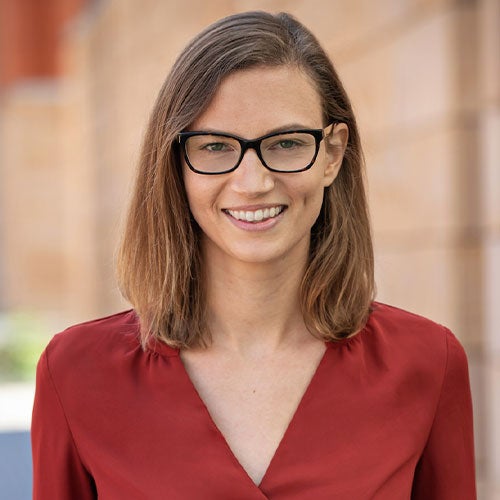
KINGSTON, R.I. – August 18 – Irma Stevens, assistant professor of mathematics, is a recipient of a $1,118,536 CAREER grant from the National Science Foundation (NSF). Over the next five years, Stevens will research variable literacy–the ability to comprehend and use mathematical symbols–and find methods to support students that struggle with using variables meaningfully.
The Dynamic Variables Project seeks to serve the variable literacy needs of undergraduate students by developing a new approach to support students’ meanings for variables through contexts that are relevant to today’s STEM careers. Beyond the theoretical contribution of the learning progression, this project will design and test instructional and training materials for undergraduate precalculus instructors and provide STEM instructors with clear guidance on the professional variable literacy needs of their students.
“Whether [students] are pursuing STEM careers or not, being able to look at equations and put meaning into that is necessary for them to be global citizens and to have that literacy. This might be the last math class they ever see, and they can leave knowing the key relationships represented with different equations. Like the concept of exponential growth, for example,” says Stevens.
Stevens’ interest in mathematics education began as an undergraduate when she tutored, and became fascinated by how different people reason through mathematical problems. Students were not simply correct or incorrect in their approach; they were thinking in unique and valid ways. This prompted a shift from focusing on rules and formulas to focusing on where the student is and what supports are actually relevant for them.
While earning her doctorate degree from the University of Georgia, this research extended further by specifically bringing meaning to the mathematical symbols rather than treating them as purely procedural tools. While working on her dissertation, she studied how future high school math teachers used dynamic, manipulatable software tasks, to connect verbal quantitative reasoning to symbolic representation.
During Stevens’ postdoctoral work in the University of Michigan, she shifted perspective from individual student to classroom-level teacher decision-making. She researched how teachers, unable to give individual tutoring attention to every student, organize observations of student work and contributions to support the whole class.
Now entering her fifth year teaching at the University of Rhode Island, her research will be broken up into two phases. The first phase will include conducting interviews and focus groups with precalculus students, and STEM professionals to better understand what mathematics they actually use and in what contexts. These findings will help identify which supports are helpful for different student profiles, ensuring tasks reflect real-work quantitative relationships. Phase two will implement the refined tasks across URI precalculus courses and Stevens will gather feedback from instructors on implementation challenges and observe whether student thinking shows measurable shifts.
Stevens is the lead PI on the grant, and will include graduate students, a postdoctoral researcher, undergraduate students, and advisory board members, to help execute the project.