
Stefanie Vining ’25
French IEP & Chemical Engineering
Stefanie Vining relocated to Bordeaux, France, after receiving an offer to remain at Unither Pharmaceuticals full time, where she interned through the URI International Engineering Program.
Finding Her Way Within the IEP
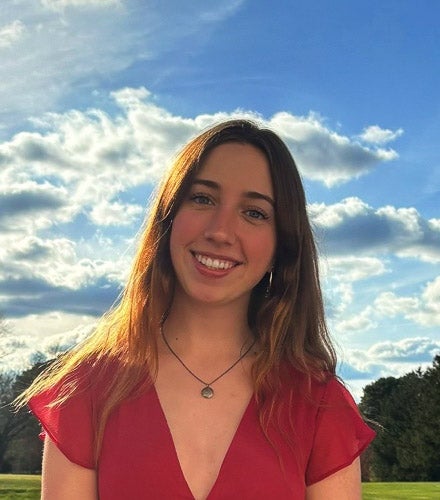
Growing up, Stefanie Vining was always immersed in French culture due to her familial ties. Though her academic interests lay in engineering, she always knew she wanted to better her understanding of the language. It wasn’t until she discovered URI’s International Engineering Program (IEP) that she was able to pursue both.
It’s kind of hard to find a program that makes it possible to study abroad while doing engineering,” Vining said. “So I heard about the French IEP program, did a little more research, and actually visited.”
During her visit to the department, she was able to tour the IEP house, meet students involved in the program and shadow French IEP director, Lars Erickson, during one of his classes.
It was difficult for Vining to practice both studies because of the rigorous curriculum as an engineering student. Even through a similar program, like studying abroad, there would not have been an equal possibility to combine both interests.
“Engineering is a very, very strict curriculum,” Vining said. “You know from the moment that you choose engineering what classes you’re going to take, which year, there’s not really any wiggle room.”
However, Vining found a way to combine her passions that would not derail her academic timeline. During her senior year, she studied at the Université de Technologie de Compiègne in Compiègne, France. She spent an entire year in the region, where she completed six months of studies at the university and a six-month internship as a business developer at Unither Pharmaceuticals, global CDMO for pharmaceuticals in Bordeaux.
In her role at Unither Pharmaceuticals, Vining assessed new potential collaborations. As clients approached with a proposition or interest in Unither’s services, she and her team would evaluate the opportunity and compatibility with the company. When starting with the company, they had expressed a potential interest for the future if the internship were to go well. The Global Ophthalmic Team was very supportive to work out a formal offer for a full-time position.
The intern experience was the driving force behind Vining’s practice of the French language as opposed to her studies. Housing for the program is designed for international students, whose most commonly spoken language was English. It was working in an environment that only utilized French that helped her lean into the fluidity of the language.
Beyond the language barrier, moving from a small Rhode Island town to a French city came with its own set of adjustments. Similar to most U.S. cities, Vining relied on public transportation and walking to get around. France also had more specialty shops, such as patisseries (bakeries), fromageries (cheese shops), and rôtisseries (chicken shops).
“It’s just really nice having access to more things,” Vining said. “Also not having the reliance on a car is really nice and being able to walk everywhere.”
Being open to everything is key when studying abroad, according to Vining. Putting yourself out there, even if it feels strange at first, will get you far.
“Don’t feel awkward about it, because I guarantee, everyone’s open to being your friend,” Vining said. “So just go to those events. Even if you’re going by yourself for the first time, just go, it’ll all work out.”
During her time at URI, Vining was involved in multiple intramural sports and three engineering clubs. She served as a mentor in the Women in Engineering Mentor Program, and was an active member of the Society of Women Engineers (SWE) and the American Institute of Chemical Engineers (AIChE). She was also a member of the ski team and participated in basketball and football, which she continued at the Université de Technologie de Compiègne.
Building a Global Life Post-Graduation
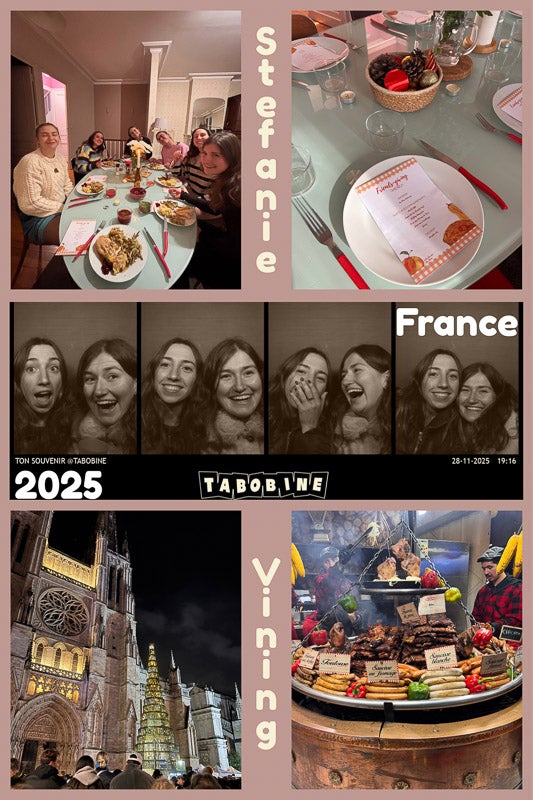
Since moving back to Bordeaux more permanently, a lot has been happening both professionally and personally, Vining shared. In her current role as a business developer at Unither Pharmaceuticals for early-stage ophthalmic products, she has been taking on more responsibility, which has been both challenging and rewarding. “It has been exciting to feel more and more settled and confident in my work here,” she said. “I’m lucky to be part of an excellent Global Ophthalmic Team and am very appreciative of their support and positive spirit.”
Outside of work, Vining has really enjoyed building a sense of community. She hosted a “Friendsgiving” with her French friends this year as a way to share a bit of American culture and celebrate the holiday together. “It was a lot of fun to share foods they had not previously experienced, although we did opt for a rotisserie chicken instead of a full turkey!” Vining admitted. Over the winter, she also visited several Christmas markets in Bordeaux, Paris, and small tucked-away châteaux (castles), which really highlighted for her how festive and communal the season is there.
One interesting cultural tradition she learned about recently is la galette des rois, which is eaten in January to celebrate the Christian holiday of Epiphany. A small decorated bean is hidden inside the frangipane filled pastry-esque cake, and whoever finds it becomes the “king” or “queen,” similar to the King Cake tradition in the United States. To keep things fair, the youngest child goes under the table and decides who receives each slice, which was a tradition she had never seen before.
For students or alumni considering working abroad after the IEP, Vining excitedly shared her insights. “My biggest piece of advice would be to participate in community events and join an expat Facebook group. Joining an expat Facebook group in Bordeaux has been incredibly helpful for practical advice, local information, and meeting people,” she stated. “Through one of these groups, I even found a country dancing group here in Bordeaux, a surprisingly popular activity despite being far from the Midwest. Making connections and having a support system really helps ease the transition and makes a new place feel like home much faster.”
This article has been updated from its original version, which was published in September by Erin Malinn, class of 2028. To see the original version, please visit https://web.uri.edu/artsci/news/stefanie-vining-25/.