
KINGSTON, R.I. – May 1, 2026 – The University of Rhode Island’s hosted their academic excellence award ceremony on April 30, 2026. URI proudly sponsors the University Academic Excellence Awards to recognize outstanding achievements in research and scholarship, teaching and service, and graduate education. These awards celebrate the faculty, staff, and students whose contributions advance URI’s mission and strengthen academic community. Nine recipients this year are from the College of Engineering.
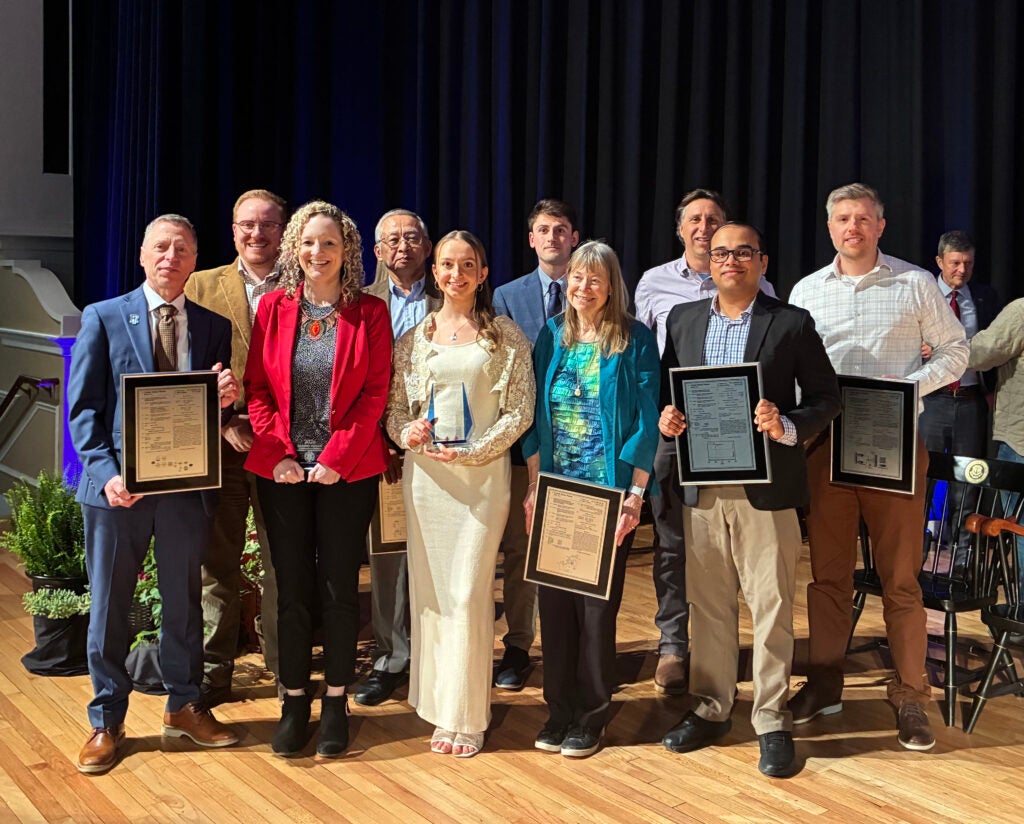
“Our community of faculty, staff and students in the College of Engineering embody the spirit of the public, R1 land- and sea-grant university in service to the state of Rhode Island,” said College of Engineering Dean Anthony Marchese. “As evidenced by the numerous Academic Excellence Awards that our team received, the College of Engineering is unquestionably an amazing community of students, teachers, mentors, researchers, innovators and entrepreneurs who take pride in their important role in society.”
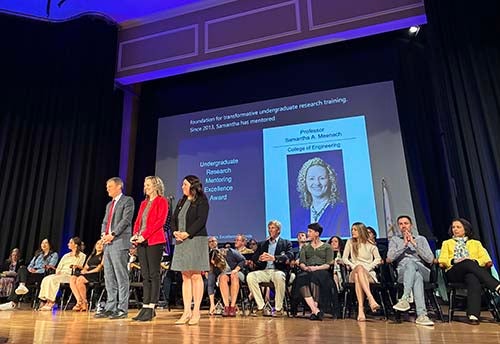
The Teaching and Service Awards honor those who demonstrate excellence in teaching, advising, mentoring, and service to the University and the broader community. Recipients foster inclusive, engaging learning environments and provide leadership that supports the academic success and well-being of students and colleagues. This year, the Undergraduate Research Mentoring Excellence Award went to Samantha Meenach, Professor, Department of Chemical, Biomolecular, and Materials Engineering and Pharmaceutical Sciences. Since 2013, she has mentored more than 70 undergraduate students, many who have earned major national honors. Her mentorship approach emphasizes intentionality, inclusivity, and sustained engagement. She has developed and led accessible research programs, particularly for students from underrepresented backgrounds that have helped students build early research identity, confidence, and long-term academic success.
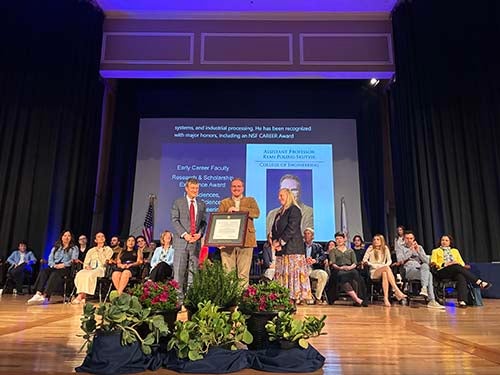
Research and Scholarship Awards recognize individuals who demonstrate exceptional achievement in research, creative work, and scholarly contributions with the potential to make significant contributions in their field. The award for Early Career Faculty – Life Sciences, Physical Sciences, and Engineering went to Ryan Poling-Skutvik, Assistant Professor and Graduate Director, Department of Chemical, Biomolecular, and Materials Engineering. A leading expert in soft matter physics and complex fluids, his work has resulted in nearly 40 peer-reviewed publications in leading journals, which have been cited more than 1,000 times. Poling-Skutvik is a dedicated educator and mentor known for his engaging, student-centered teaching style. His accomplishments have also been recognized with prestigious honors, including an NSF CAREER Award and designation as a Cottrell Scholar.
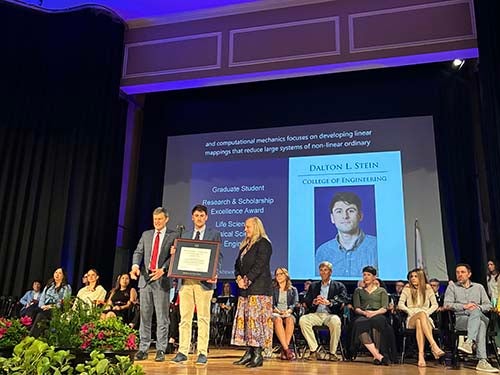
Dalton L. Stein, a Ph.D. candidate in the Department of Mechanical, Industrial and Systems Engineering, was awarded the Graduate Student Life Sciences, Physical Sciences, and Engineering Research and Scholarship Excellence Award. His dissertation focuses on model order reduction of nonlinear mechanical systems, addressing a fundamental challenge in accurately simplifying complex dynamic systems while preserving their essential behavior. He has authored and co-authored more than seven publications and demonstrates exceptional initiative and leadership. He conceptualized and drafted a successful $441,000 Office of Naval Research grant and developed a numerical continuation code.
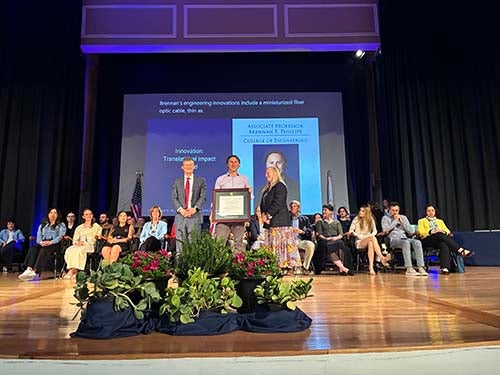
The Innovation: Translational Impact Award was awarded to Brennan T. Phillips, Associate Professor, Ocean Engineering. His work is centered on overcoming the limitations of traditional, large-scale equipment by engineering a miniaturized fiber-optic cable as thin as a fishing line, yet capable of transmitting high-bandwidth signals, including live video, from the deep ocean. Through strategic collaborations, he developed a high-strength braided tether and a suitcase-sized winch system that drastically reduced the weight of subsea deployment systems from tons to pounds, securing a joint patent for this groundbreaking innovation. This technology has successfully transitioned to the commercial sector.
The cornerstone of this commercialization effort is the HIGH DIVE system (patent pending), which integrates an unmanned aerial vehicle with the patented fiber winch to create a rapid-response ocean-sensing and real-time video feed platform. The HIGH DIVE system represents another milestone of Phillips’ translational impact, providing a scalable solution for defense, energy, and scientific research.
Phillips is actively engaged in URI’s innovation and translational research ecosystem, with participation as an inventor on two URI issued patents and additional pending patent applications. He also leads COE’s Engineering Entrepreneurship Minor program.
Intellectual Property: United States Issued Patents honored include:
Polymeric Compositions and Corrosion Resistant Systems, Associate Professor Sumanta Das, Sumeru Nayak Department of Civil and Environmental Engineering.
Wearable Optical Microfibrous Material with Encapsulated Nanosensors for Wireless Monitoring of Chemical Analytes, Associate Professor Daniel Roxbury, Mohammad Moein Safaee, Mitchell Gravely Department of Chemical, Biomolecular, and Materials Engineering.
BUS Authentication and Anti-Probing Architecture, and Method and Apparatus for Runtime Detection of BUS Probing/Tampering in Computer Systems, Professor Qing Q. Yang, Professor Tao Wei, Zhenyu Xu Department of Electrical, Computer and Biomedical Engineering.
Glass-Ceramic Thermal Paint System and Method Using Uv:vis Spectroscopy and High Temperature Heat Flux Sensors, Professor Otto J. Gregory, Noah Alexander Burke, Panagiotis Panoutsopoulos, Zachary Ahlquist, Department of Chemical, Biomolecular, and Materials Engineering.
The Graduate School Awards recognize graduate students, postdoctoral scholars, and mentors whose academic achievements, research, teaching, and service significantly contribute to URI’s graduate education community.
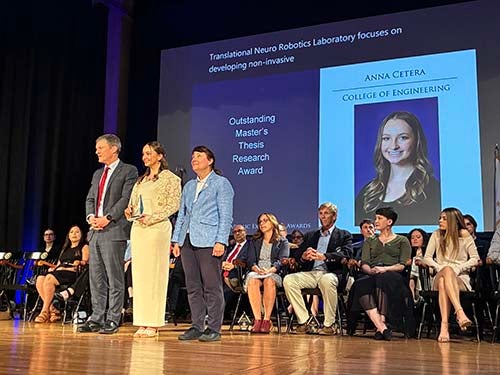
This year, the Outstanding Master’s Thesis Research Award went to master’s student Anna Cetera, electrical engineering. She earned dual degrees in biomedical engineering and Spanish through URI’s International Engineering Program. In the Translational Neurorobotics Laboratory, under the guidance of Assistant Professor Reza Abiri, her master’s research focuses on developing noninvasive brain-computer interfaces to decode brain activity during visuomotor tasks. Cetera studies the neural mechanisms underlying upper-limb movement, examining how the brain coordinates and executes motor processes. Using advanced signal processing and deep learning, she identifies frequency-specific brain patterns linked to hand movements and motor intent.
Her work supports the development of clinically accessible brain-machine interfaces and neuroprosthetic technologies aimed at restoring hand function and improving independence for individuals with paralysis. By integrating neuroscience, engineering, and data-driven modeling, her research contributes to the advancement of next-generation assistive neurotechnology.
Photos courtesy of Yan Sun.