
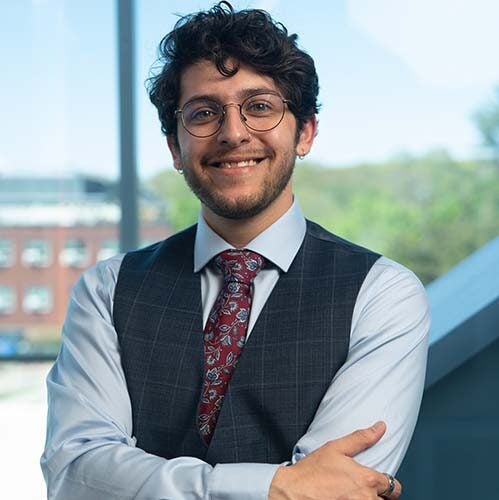
Having spent nearly a decade advancing through all levels of his academic training at URI, Jonathan Villada is completing his Ph.D. this year. He started at the University of Rhode Island as a civil engineering undergraduate in 2016 and then went on to obtain an accelerated M.S. in 2021. Villada has made a significant impact throughout that time co-authoring multiple peer-reviewed publications, working closely with numerous undergraduate researchers providing guidance, sharing expertise and fostering a supportive and productive research environment in associate professor Sumanta Das’ Multiscale Multiphysics Materials Lab. “Jonathan embodies the qualities worth recognizing such as academic excellence, dedication to research, mentorship, and a strong connection to URI,” said Das.
Villada, of Pawtucket, Rhode Island, also spent time performing research in the Water for the World as an undergraduate and minored in mathematics. He also spent two weeks in India for a J-term class with Dr. Manbir Sodhi.
“I have always been determined to do my best in school, but it was URI Engineering that gave my work a greater sense of purpose by allowing me to apply what I learned in meaningful ways,” said Villada. He has since had the opportunity to travel to several more countries since that trip to India, which sparked his interest in exploring new places and cultures.
“The curriculum is designed to expose you to many aspects of your major and minor,” said Villada. “While much of the work is learning the content, you are also developing soft skills to be able to think critically and, on your feet, when it comes time for your career. The research was inspiring in so many ways and allowed me to be creative in my field.”
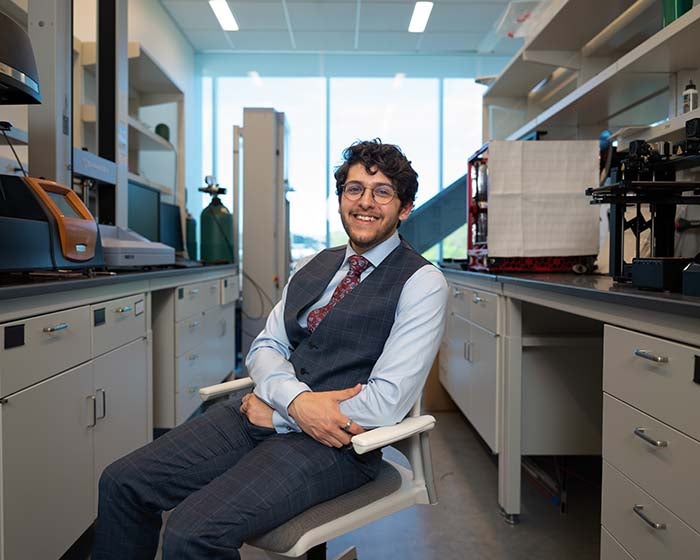
Villada was a member of the American Society of Civil Engineers (ASCE) student organization and served as treasurer, was a part of the Graduate Student Association and outdoor club along with being an avid runner in his free time.
He plans to continue his research interests as a post-doctorate at a national research lab assisting other scientists in ways to push our society forward. “I think once I work in this sector for many years, I’d like to become a professor in civil and environmental engineering one day.”
“As I prepare to leave URI, I am proud to have contributed to multiple published research papers, gain valuable experience through internships that helped shape my career interests, and build lifelong friendships that continue to be an important part of my life.”
“URI Engineering gave my work a greater sense of purpose by allowing me to apply what I learned in meaningful ways.” Jonathan Villada, Ph.D ’26