
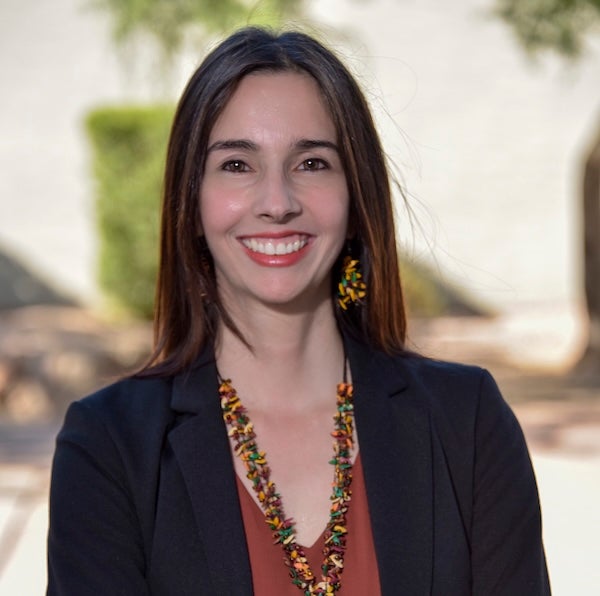
Dr. Carolina Michel was born and raised in Bogotá, Colombia, and has also called Phoenix, Arizona home for the past 17 years. She earned her Ph.D. in Geology from Arizona State University and taught Earth science and geology courses at the community college level for seven years before completing a postdoctoral fellowship at Michigan State University, where she worked in participatory and community-engaged STEM education research.
Michel joins URI as an Assistant Professor of Earth Sciences in the newly formed Department of Earth Sciences, Planning, and Design (ESPD), where she is excited to explore how Earth systems, education, and sustainability intersect across disciplines.
Q. What first sparked your interest in this field?
A. I’ve always been curious about how different pieces of a system fit together, which is why I think of myself as a systems thinker. What drew me to STEM and sustainability education research is that it sits at the intersection of many fields. As a geologist, I was trained to study Earth systems, but I became fascinated by how people learn about those systems and use that knowledge to make decisions about the future. This field allows me to connect Earth science, education, and sustainability while working with people from a wide range of disciplines. The chance to learn across boundaries and tackle complex challenges collaboratively is what first attracted me to the field and what keeps me excited about it today.
What questions are you most excited to explore in your research?
I am fascinated by how educational experiences shape the way students see themselves and their role in the world. In my research, I explore how arts-integrated and place-based learning can enrich geoscience and sustainability education. I am particularly interested in understanding how these approaches influence students’ confidence, their sense of belonging and identity in interdisciplinary fields, and their aspirations for future careers. Recently, my colleagues and I received funding to study how student drawings can be used as assessment tools, which is an exciting example of how creative approaches can provide new insights into learning. My hope is that this work can help create learning environments where more students feel empowered to engage with complex sustainability challenges and contribute to positive change.
How would you explain your research to someone outside your field?
I study how people learn about the Earth and the environment in everyday settings, not just in schools. One focus of my research is finding ways to bring Indigenous knowledge and Western science into conversation with one another to create learning experiences that are relevant to local communities. I am especially interested in approaches where learning goes both ways, meaning that researchers and educators learn from community members just as community members learn from them. I believe that combining different ways of knowing can lead to richer understandings of the environment and help communities address sustainability challenges together.
What excites you most about being part of building something new in ESPD?
I am thrilled to join a department where interdisciplinarity is not an afterthought but part of its identity from the very beginning. As a systems thinker, I have always been drawn to questions that cannot be answered by a single discipline, so the opportunity to collaborate across Earth science, planning, and design is especially exciting.
I am eager to learn from colleagues who are helping shape the communities and landscapes of the future. I am particularly interested in the ways sustainability, Earth systems, and the built environment intersect. On a personal note, my sister is an artist who specializes in architectural drawing, and our conversations have shown me how deeply design influences the way people interact with each other and with nature. I am excited to be part of a department where these connections can be explored and where we can work together to imagine more sustainable futures.
What will you be teaching at URI?
I will be teaching Introduction to Sustainability, a course that gives students the opportunity to explore the many disciplines that contribute to sustainability and how they work together to address complex environmental and societal challenges. I am especially excited about helping students see the connections between fields across the College of the Environment and Life Sciences and how those connections can contribute to a more sustainable future.
Beyond that, I look forward to developing new graduate courses in community-engaged geoscience and geoscience education research. I am passionate about preparing the next generation of scholars and practitioners to work across disciplinary boundaries, collaborate with communities, and use their expertise to address real-world sustainability challenges. I am also excited to build a research group that explores innovative approaches to geoscience and sustainability education.
Is there anything else you’d like the URI community to know about you?
Beyond my research and teaching, I am a wife and mother of two school-age children, and my family and I are excited to make Rhode Island our new home. I look forward to building meaningful relationships both within the URI community and beyond. As someone whose work is deeply connected to place, community, and learning, I am eager to get to know the people, landscapes, and stories that make this region unique and to contribute to the vibrant community at URI.