URI Cooperative Extension’s newest train-the-trainer program is designed to train professionals and engaged residents to reduce their food waste footprint at home and contribute to grassroots change in the community.
URI Students: You can get credit for this course!
URI Students (from any major) can take this course for 3 URI upper division Credits. Register for PHL 477G (contact Prof Krieger for details: Krieger@uri.edu) when you apply for the Food Recovery Class and we will set up weekly discussion sessions that will culminate in you creating a presentation or paper focused on your Food Recovery interests (social, ethical, etc).
What do I learn?
The Food Recovery Course is offered each fall and is open to all Rhode Islanders (and members of surrounding communities). Designed as a choose‑your‑own‑adventure learning experience, the course allows participants to explore different food recovery pathways and focus on what matters most to them.
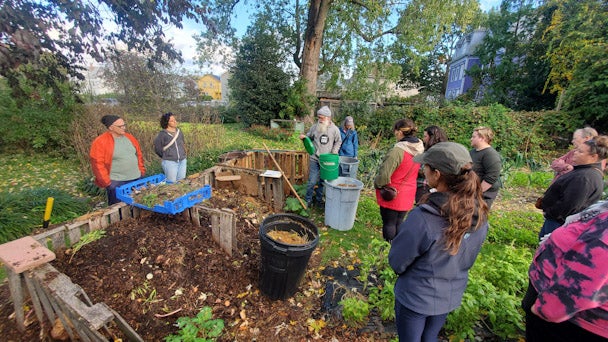
Through self‑paced online learning and hands‑on field experiences, participants learn about food waste, food access, environmental sustainability, and local food systems. Topics include meal planning, food storage and preservation, composting, food rescue, and food donation. Field sessions with community and university partners offer real‑world experiences such as visiting the Central Landfill, touring community farms, participating in food recovery efforts, and practicing composting and food preservation skills.
“What I enjoyed about the course was the hands on feeling of it. Walking the areas where recycling is happening, where compost is being produced … walked away from this experience knowing that I can definitely do something to make a difference around me.”Erwin LeGrand, ’24
Accessible at every stage of life, the course is designed to work for people with full‑time jobs, families, and retirees. Coursework is completed on your own schedule, and participants select field sessions during registration. Field sessions are offered on weeknights, evenings, and afternoons.
The Fall 2026 course is $255 for the online component, 4 field sessions and internship. Scholarships are available. Explore our sample syllabus and field session options. [syllabus PDF] [Field session]
Join our Community
Fall URI Food Recovery Course
Application deadline has passed

Making a Difference
A central part of Food Recovery for Rhode Island is putting learning into action through community‑led projects. Participants have opportunities to serve as volunteers or paid interns with partner organizations across Rhode Island, contributing to real food recovery efforts while gaining hands‑on experience.
FRRI projects include rescuing and redistributing surplus food, such as gleaning fruits and vegetables from local farms with Hope’s Harvest RI, rescuing food with Feed RI, and delivering surplus bread and pastries from local businesses with FoodRecovery.org.
Many projects focus on diversion through composting at schools, events and community farms. Participants assist with community composting operations at sites like Harvest Cycle Compost and Barrington Farm School, where food scraps are turned into nutrient-rich soil that supports local food production. Others work with schools and municipalities through partnerships such as the RI Schools Recycling Project and WasteNaut Consulting, helping implement lunchroom composting programs, educate students, and track waste diversion. Zero waste event teams are staffed at iconic events such as newport FILM.
“My career has completely changed since taking the Food Recovery Course! I have added a whole second career at the RI School Recycling Project. The kids teach me so much every day, and I feel like I am making a real difference in the world.”Kendra Gay, ’23 Operations Director RI School Recycling Project
Additional opportunities include supporting community food preservation efforts with the Sankofa Initiative, helping residents build skills through workshops and garden projects, engaging neighbors through Zero Waste Providence’s Street Team, and donating home‑grown produce through Plant a Row for the Hungry.
By working alongside partner organizations, participants gain practical skills, build professional connections, and make a measurable impact on food waste reduction and food access across Rhode Island.
After the course
Graduates of the Food Recovery Course become part of an ongoing service‑learning community supported by URI Cooperative Extension. Participants are eligible to become certified URI Extension Food Recovery volunteers by completing additional service hours with approved projects.
FRRI alumni stay connected through workshops, group volunteer opportunities, community events, and networking. For some, the program supports new career pathways in food systems and sustainability. For others, it strengthens skills, relationships, and leadership in their existing work. Together, this growing community continues to reduce food waste, improve food access, and strengthen Rhode Island’s food system.
” I have found that the things we learned left such a profound impact on me that I am hoping to pursue a Master’s degree in World Food Studies …” “It was a wonderful experience that really changed my perspective in a critical way.”Paige Shaprio, ’23