
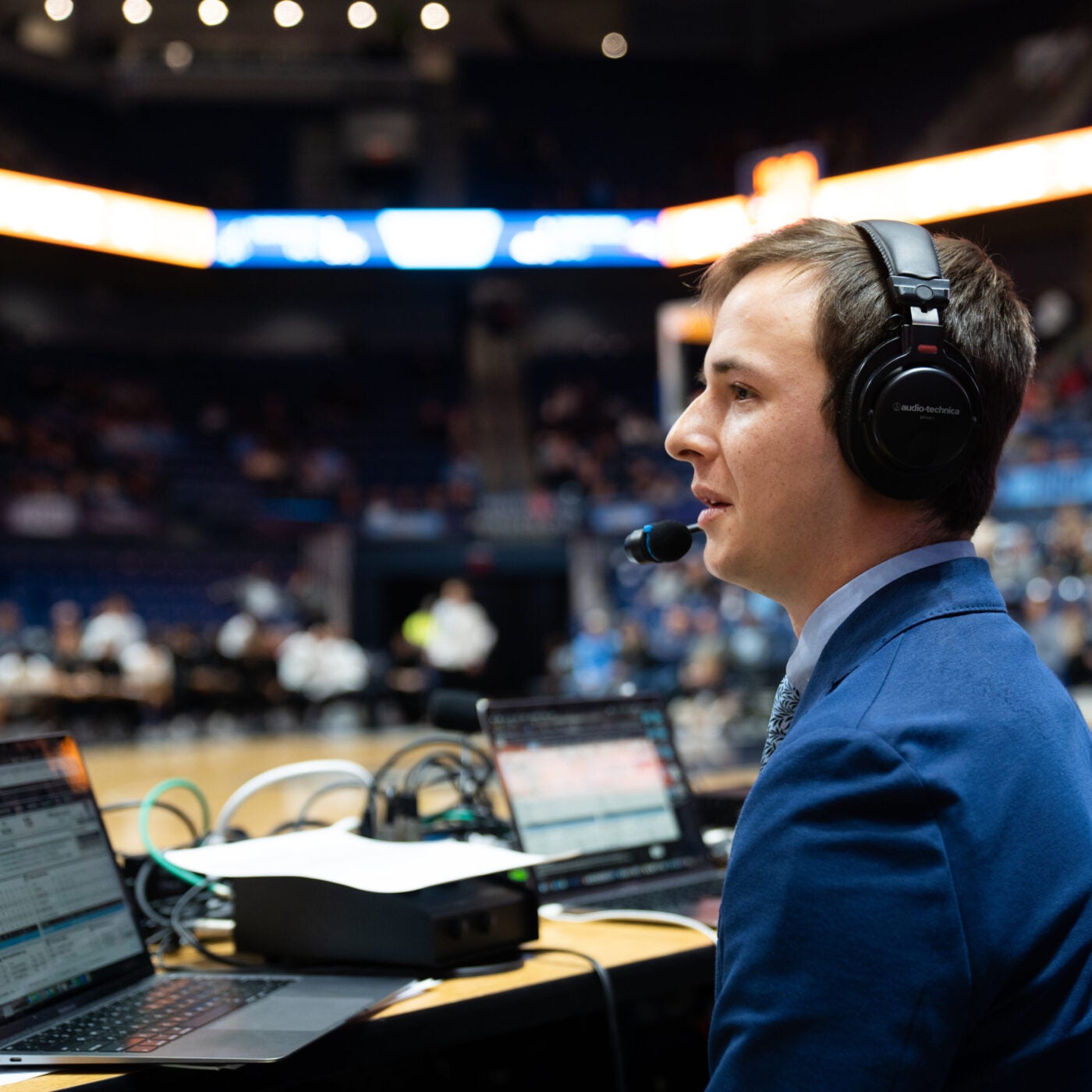
While a great deal of change is coming with Sports Media and Communication’s new curriculum (currently going through the approval process with the anticipated launch of Fall 2026), director Molly Yanity is keeping one thing the same: a commitment to URI’s critical cultural courses. A strength of the university is that these are the analytical skills that all of URI’s sports media students should have in common, and what differentiates them from other graduates in the eyes of Yanity.
That’s why the 12-credit core of the new curriculum remains grounded in critical cultural analysis: a 100-level course on the history of sports media, a 200-level course on audiences and fandom, SMC203, which focuses on sports, media, and culture, as well as a 400-level course akin to a senior seminar that addresses a contemporary topic in sports media.
“It’ll be really interesting and exciting and fun to spend 14 weeks on these big questions. While also helping students learn how to do research, how to communicate these ideas in a variety of ways, and how to ask questions” said Matthew Hodler, professor of sports media; whose background in the cultural study of sports was key to designing the core of the curriculum.
While the program has always had a strength in critical and cultural analysis, an area Yanity saw room for growth in was the program’s writing requirements. As a former journalist for Seattle’s Post-Intelligencer, clean and effective communication is something she’s passionate about. In creating a six credit, two hour requirement for writing courses, students are able to hone their ability to communicate the conceptual ideas they learn in class in a way that’s confident and field ready.
“It’s so nice to have professors who have real experience in the field,” says Max Peebles, a freshman majoring in sports media and communications, “It gives me more trust in listening to what they have to say.”
Another exciting addition alongside writing is a block for professional skills and tools. This would include a multimedia toolbox and a sports media capstone that Yanity sees evolving into a practical newsroom and boardroom that would cover local high school sports and issues. While the program’s critical cultural core gives students a lens through which they can effectively analyze new developments in the field, these new additions give them the skills to apply that analysis in a way more competitive for a changing job market.
Supporting that focus are a bevy of new electives and an expansion from three required electives to four, including staples like sports history deep-dives, advanced sportscasting, and production courses, but also social media analytics for sports, and podcasting, allowing graduates to effectively communicate with new, digital audiences while maintaining the signature critical cultural approach of URI’s program.
“If we remember the humanities and teach the humanities, the human aspect of sport will continue in sport media,” said Hodler, whose Com 414: The Rhetoric of Sports in Film, is being retitled to reflect a refocusing on cultural analysis.
Starting their sophomore year, each student in the program should have the same advisor every year; either Yanity herself, Hodler, Chris Henderson, or Maria Grover, newly hired to help instruct the courses of this revamped program. Yanity believes a consistent and dedicated advisor ensures every student enrolled can create a clear plan with their advisor on what electives to take, internships to pursue (strongly encouraged, but no longer mandated under the new curriculum), and how to best craft their interests for the real world.
“Molly Yanity especially has been super helpful to me,” said Peebles, “I have asked her various questions about things related to academics as well as just personal input on her experiences so Molly has been a huge resource for me.”
When sitting down with their advisor at the beginning of their journey, “they’re not committed to a specific track,” said Yanity. “They don’t have to decide their sophomore year and say, ‘I want to take these four classes.’ We can change them up as long as there’s something sequential.”
Current freshmen will have their catalog year changed to match that of incoming freshmen in the fall 2026 semester, and juniors and seniors will be able to take these electives, as well.
“The thing that I really want to point out is if students have any concerns or they’re worried or they think they’re going to miss out on something, I want them to be able to know that they have four professors in sports media who are there to help them. No one is going to get left behind in this,” said Yanity.
Written by Jonah Major, interim executive assistant to the Dean of the College of Arts and Sciences and research assistant.