
This is a report summarizing the activities and impact of the University of Rhode Island’s Artificial Intelligence Lab, specifically regarding our work between Spring 2026–Fall 2026 academic semesters.
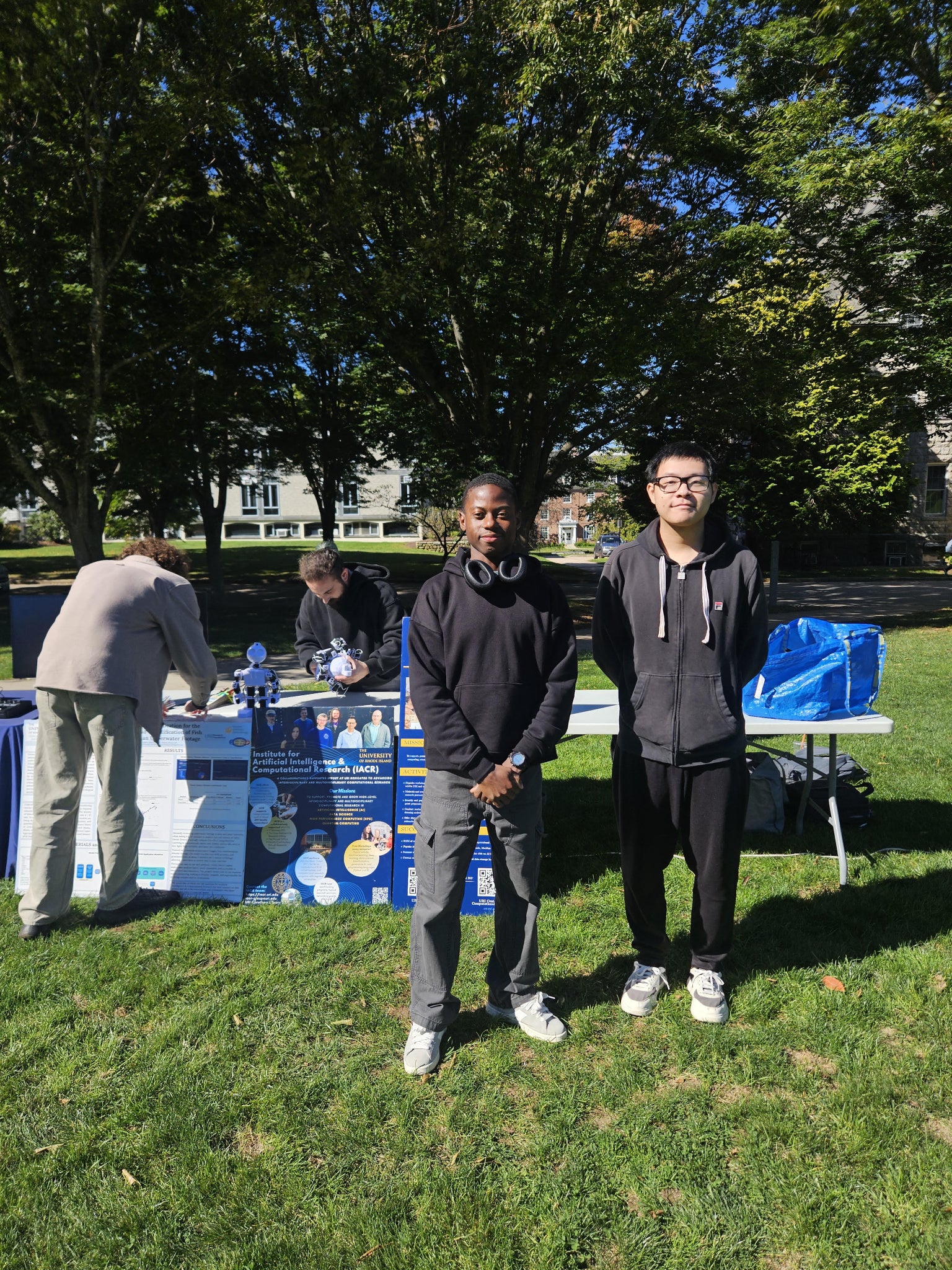
Project Teams by Semester
Fall 2026
Music project
- Donnie Gardner
- Jad Albatal
- Patrick Sullivan
Agentic AI SBDC
(Division of Research & Economic Dev)
- Zachary Johnson
- Isaac Craft
- Angel Lucario
- Hyber Gamboa, COE
- Ifeanyi Ibeh, COE
- Emily Sawyer, COB
- Cansu Kornosor, COB
AI Clinical Learning Coach(Pharmacy)
Todd Brothers
- Borano/ Liam
- Snaha Pokharel
- Jacob Choi
- Richard Montgomery
- Morufat Yakubu-Owolewa
- Sara Cho, Pharmacy
- Gavin Murphy, Pharmacy
- Shuno Kim, Pharmacy
- Courtney Poon
Governor's Workforce Board (OSI)
- Liam McKenzie
- Ekambeer Grewal
- Kat Toolan
- Aila Chin
- Kanyinsola Yekini
- Madeline Mitchell
Provost Office
Final Grades
- Borano
- Han Lam
OceanDetect
(GSO)
Christine de Silva
- Zachary Johnson
- Jad Albatal
- Yue Mao
Iceberg (GSO Ocean Engg)
Dr. Russell Shomberg
- Liam McKenzie
- Julianna Della Selva
- Alyssa Portofee
SBDC Training (Division of Research & Economic Dev)
- Liam McKenzie
- Ekambeer Grewal
- Aila Chin
Kuali Assistant
FacSen
- Liam McKenzie
- Junrong Liu
Volunteer
- Cadije Louis
- Johnangel Lora
- Ivan Koptiev
OceanDetect
Volunteers(Marine Biology)
- Alex Velleca
- Samantha S
- Ana Bradley
- Isabella Bolientino
OceanDetect
Volunteers(Marine Biology)
- Alex Velleca
- Madison H.
- Cody Pinsky
- Lily Gugino
OceanDetect
Volunteers(Marine Biology)
- Mayson Mohr
- Brooke Keeney
- Kieran Salls
Summer 2026
Provost Office
25% Change
- Borano Llana
- Madeline Mitchell
- Han Lam
Provost Office
Final Grades
- Borano Llana
- Alison Vomaska
- Junrong Liu
Kuali
FacSen
- Liam McKenzie
- Junrong Liu
- Richard Montgomery
FinTech
COB
- Liam McKenzie
- Cameron Washburn
- Ekambeer Grewal
- Kat Toolan
- Aila Chin
Agentic AI SBDC
(Division of Research and Economic Development)
- Zachary Johnson
- John Cullinane
- Alexander Garcia
Fish Classifier
GSO, PI: Dr. Andy Davies
Christine de Silva
- Zachary Johnson
- Kamron Aggor
- Nehemiah Speaks
- Yue Mao
- Jad Albatal
- Alex Velleca, Marine Bio
- Kayleigh McEvoy, Marine Bio
BlueTIDE
- Callum Magarian
- Kamron Aggor
- Patrick Sullivan
- Richard Montgomery
- Gerald Garcia
SBDC Training
- Liam McKenzie
- Lily Hayes
- Jeena Weber Langstaff
A&S Fellows Program
- Anna Numme
- Liam McKenzie
Music project
- Donnie Gardner
- Jad Albatal
- Callum M
- Patrick Sullivan
Iceberg reconstruction
(GSO Ocean Engg)
Dr. Russell Shomberg
- Liam McKenzie
- Julianna Della Selva
Spring 2026
Agentic AI
(Division of Research and Economic Development)
- Mani Subramani
- Judd Lizarda
Fish Classifier
(GSO)
Christine de Silva
PI: Dr. Andy Davies
- Zachary Johnson
- Kamron Aggor
- Zihara Delgado
- Jad Albatal
- Marine biology
Cody Pinsky
Victoria Lysik
Hunter O’Kussick, Fisheries, Animal and Vet Sciences
Seton (Salve)
GenAI Workshops
(AI Lab)
- Ashraf Alashwal
- Matthew Connors
- Lauren Holly
- Jeena Weber Langstaff
RI Small Business Development Center (Division of Research and Economic Development)
- Callum Magarian
- Sean Marois
- Courtney Poon
- Nick Lehourites
- Patrick Sullivan
Chatbot(Engineering)
Prof. Resit Sendag
- Jack Light
- Richard Buckley
- McKenzie Allen
Structural Biology Information Extraction(Pharmacy)
Dr. Chris Hemme
- Edwin Hernandez-Zanella
Iceberg reconstruction
(GSO and Ocean Engg)
Dr. Russell Shomberg
- Matthew Barbrack
- Liam McKenzie
- Rafael Lacerda
Plastic-degrading proteins detection (CELS)
Prof. Ying Zhang
- Aidan McCrillis
- Omar Dovesi
- Arybella Theul
BlueTIDE
- Callum Magarian
- Lily Nguyen
- Lauren Holly
- Richard Montgomery
- Gerald Garcia
Volunteers
- Yue Mao
- Zuzanna Bajer
- Nehemiah Speaks
- Julianna Della Selva
- Ekambeer Grewal
Provost Office
25% Change
- Nicolle Cuterez
- Thomas Williams
- Madeline Mitchell
Provost Office
Final Grades
- Borano
- Ethan Moreta
- Nick Lehourites
- Courtney Poon
- Callum
Meeting Muncher (Engineering)
Prof. Resit Sendag
- Jack DeMarinis
- Ryan Kraus
- Ryan Megna
Media and Comm
- Patrick Sullivan
Project Highlights
AI Clinical Learning Coach
Project Partner: Dr. Todd Brothers, Pharmacy
We often say, “You can’t teach experience.” But what if students could begin building that experience before caring for real patients? The University of Rhode Island’s Artificial Intelligence Clinical Learning Environment (AICLE) initiative brings together the Institute for AI & Computational Research (IACR), faculty, and students from different university programs to explore that possibility. Through an interactive student interface, learners will encounter realistic, AI-generated virtual patients, make clinical decisions, and see how those decisions influence a patient’s condition. Beginning with pharmacy education, cases will be reviewed, validated, and annotated with teaching guidance by pharmacy faculty. Designed to protect patient privacy, this safe learning environment will allow students to practice applying scientific evidence to medication selection and individualized treatment while developing the judgment, communication, and confidence needed for clinical care.
AICLE aims to make these practice experiences meaningful for both students and faculty. By helping faculty identify specific learning needs such as interpreting patient information, developing treatment plans, or explaining clinical decisions, the tool can support personalized feedback and repeated opportunities to improve. These simulated encounters will complement classroom instruction and supervised clinical training, giving students more opportunities to learn through experience. The longer-term vision is to expand into nursing, physical therapy, occupational therapy, medicine, physician assistant education, and other healthcare fields, allowing learners to practice working together. Through this collaboration, URI and IACR seek to help future healthcare professionals turn knowledge into thoughtful action and prepare to deliver coordinated, evidence-based, patient-centered care.
Student Researcher: Liam McKenzie, Borano Llana, Richard Montgomery, Snaha Pokharel, Jacob Choi, Morufat Yakubu-Owolewa, Courtney Poon
Pharmacy Team: Sara Cho, Gavin Murphy, Shuno Kim
GWB (OSI)
Project Partners: Dr. John Olerio, Stef Nelson, OSI
To better support rural-serving healthcare providers, we are partnering with the Office of Strategic Initiative (OSI) and the Governor’s Workforce Board (GWB) to develop a workshop series focused on practical AI/ML applications and best practices in medicine. Topics will span diagnostic imaging, predictive diagnostics, AI-augmented clinical workflows, AI governance, and more.
Each workshop is designed with the healthcare professional in mind, grounded in current standards for security, patient data privacy, and responsible reporting of AI-generated outputs. This initiative is supported in part by the federal Rural Health Transformation Program, with the overarching goal of equipping healthcare professionals with the knowledge and skills to confidently apply AI tools in their practice.
Students: Liam McKenzie, Madeline Mitchell, Ekambeer Grewal, Kat Toolan, Aila Chin, Kanyinsola Yekini, Johnangel Lora
FinTech
Project Partners: Dr. H. Zafer Yuksel, Dr. Bing-Xuan Lin, COB
In an effort to prepare finance students for building statistical forecasting models of stock market data, a series of introductory workshops and activities notebooks were developed with the support of two professors of finance. These workshops covered an introduction to programming with Python, working with various machine learning libraries, data visualization, creating descriptive statistics reports for financial datasets, and effective LLM prompting methods for writing programs and scripts. With the assistance of the professors, we developed a curriculum for the students to follow in a logical and pedagogically sound fashion. This project ended with a summit where we worked with the finance students to address questions from the materials, address questions about the current state of AI/ML, particularly with LLMs and how to effectively analyze outputs from AI/ML algorithms for truthfulness.
Students: Liam McKenzie, Cameron Washburn, Ekambeer Grewal, Kat Toolan, Aila Chin
Kuali Assistant
Project Partner: Faculty Senate
This project is developing an automated workflow assistant for the Faculty Senate, with regards to course, minor, major, certificate, and program approvals. Currently, all proposals flow through a very manual process involving the Faculty Senate Specialist as a proof-reader. Due to the large number of proposals each semester, a backlog quickly forms, causing delays and logistics issues.
This automated assistant leverages the URI LLM Gateway to perform an initial review of desensitized proposals and returns feedback to proposers with respect to errors regarding formatting, missing information, similar language, and deviations from the NECHE and URI internal templatized standards.
We developed a “2-pass” system, where a low-cost, efficient model scans the proposal for course numbers that are missing or incorrect based on the title attached. For example, “CSC411: Operating Systems and Networks” would be flagged by this pass and offer a binary suggestion, “CSC411: Machine Organization, or CSC412: Operating Systems and Networks”.
After the initial pass, a second, more thorough model reviews the proposal with these suggestions in mind, and searches for formatting errors, inconcise language, and deviations from templates crafted with assistance from the Faculty Senate Specialist. These “errors” are then reported back to the proposer as suggested improvements and delivers a copy/paste ready proposal description.
In addition to this system, we are leveraging Harmony HPC to host the server that will automatically ping the Kuali backend once every 23h59m looking for new proposals to review, with a level of information cutoff, since we do not want to review a half completed proposal.
Additionally, because we can have a website hosted on Harmony, we have built a dashboard for the Faculty Senate Specialist, so they can directly interface with the review system to help speed up the process, if a proposer misses any amendments to their proposal. This dashboard also allows for retroactively correcting listings already published to the course catalog in an effort to standardize the catalog itself.
Student Researcher: Liam McKenzie, Junrong Liu, Richard Montgomery
Final Exam Schedule
Project Partner: Enrollment services
This project developed an algorithm to minimize the time required to grade final examinations by optimizing the university’s final exam schedule. Using historical grading data and the current examination schedule, the project analyzed course sizes, exam timing, grading requirements, and potential student scheduling conflicts. The algorithm prioritizes moving larger classes to earlier exam days while replacing later exam slots with smaller classes. It also introduced a new exam slot each day to further distribute examination and grading workloads. The algorithm identified the busiest time slots and moved large classes into the newly available periods.
Testing resulted in schedule swaps, moving large classes from later in the examination period to earlier slots. The project also measured, with the goal of minimisation, the number of students with multiple final exams in a single day, providing important information for evaluating scheduling tradeoffs. The analysis was shared with the scheduling team to aid them with the decision making process.
Student Researcher: Borano Llana, Han Lam, Gabriella Souder
25% Change
Project Partner: Provost Office
The Provost’s Office conducted a comprehensive review of academic programs across departments to support NECHE accreditation requirements. A key objective was to identify programs that had undergone approximately 25% or more substantive change within the previous five years, based on established criteria provided by the Provost’s Office. To streamline this process, the team developed an application to identify and flag programs with potential significant changes. The application analyzed and compared curriculum sheets, program descriptions, and course descriptions to detect changes that met the defined criteria. It then generated a prioritized list of programs requiring further review.
By automating the initial analysis and narrowing the scope of the review, the application significantly reduced the manual effort required by the Provost’s Office. The resulting shorter list enabled staff to focus their time on manually validating the identified changes and taking the appropriate follow-up actions to support NECHE accreditation compliance.
Student Researcher: Borano Llana, Han Lam, Madeline Mitchell
A&S Fellows Program 2026
Large language models are trained to avoid taking sides on political topics, but that does not mean their output is neutral. This project tested whether five open-weight models lean left or right when completing politically framed sentences, and whether that lean changes once a model has gone through human-feedback tuning. The test battery included 39 prompts across 13 political topics, each with a left-leaning, a neutral, and a right-leaning version of the same incomplete sentence. Every response was scored with a political-lean classifier, producing a number from −1 (left) to +1 (right), and results were compared across five models released between 2019 and 2024. Lean was measurable in most models and generally matched the intended direction of each prompt, though not perfectly. The clearest finding came from the one pair of models that differed only in Reinforcement Learning from Human Feedback (RLHF) tuning, which showed an uneven shift in political lean.
Student Researcher: Anna Numme
AI models are routinely shrunk, or quantized, so they run faster and cost less. The worry is that a shrunken model will start making things up. We built a legal research assistant over one million real US court opinions, ran three AI models at five levels of compression, and graded 18,750 answers on whether every claim and citation actually came from the documents the model was shown. Compression did not make the models invent more. In several cases the compressed models stayed closer to the evidence than the full-size originals did.
Student Researcher: Liam McKenzie
Music Project
Researching generative music models, specifically in the field of corpus-based improvisation and collaborative music. The main production of this research was a multi purpose generative instrument built inside of Max/MSP, using its native Max language. Somax 2, developed at Ircam in Paris, quickly became the model of choice due to its advanced capability to respond accurately to live input inside of Max. The instrument itself uses an interchangeable MIDI dataset to produce live, contextual improvisations.
There is a great emphasis on the practical musical potential of this application, and its utility to casual and professional musicians alike. Live machine improvisation can be applied to practicing tools, such as responsive backing bands and soloists. It can also be used for generating large amounts of MIDI output based on very specific harmonic, melodic and formal filters, bringing the user much closer to the musical output than various other generative systems.
This project is led by a Music Composition major along with our AI lab development team.
Student Researcher: Donnie Gardner, Patrick Sullivan, Jad Albatal, Callum Magarian
Agentic AI
Project Partner: Division of Research and Economic Development
The team is developing several Agentic AI projects for SBDC. One of the projects is Masking Personally Identifiable Information(PII) in transcripts. SBDC clients meet with advisors and the meetings are recorded and transcribed. The transcription contains several sensitive information that are then masked before storing and sharing with the rest of the advisors. The other project is an application that automatically presents all forms one must fill out and licenses one must apply for when they are starting a new business. The developer team is working closely with the client and business majors. The College of Business students are helping the development team with requirement gathering and business specific problem solving.
Student Researcher: Zachary Johnson, John Cullinane, Alexander Garcia, Mani Subramani, Judd Lizarda, Isaac Craft, Angel Lucario, Hyber Gamboa,COE, Ifeanyi Ibeh, COE, Emily Sawyer, COB, Cansu Kornosor, COB.
Generative AI Workshop Series
The workshop series was designed around foundational research in Generative Adversarial Networks (GANs), variational autoencoders (VAEs), and diffusion models—three core architectures driving today’s advances in synthetic media.
The series explored generative techniques in audio. A dedicated segment focused on recurrent neural networks (RNNs) for music creation, demonstrating how sequence models learn patterns in melody and rhythm to produce new musical pieces.
Student Researcher: Matthew Connors, Ashraf Ashawal, Lauren Holly, Jeena Weber Langstaff
OceanDetect
Project Partner: GSO, Christine de Silva, PI: Dr. Andy Davies
This project uses Machine Learning to analyze underwater video to automatically spot and label fish living 200–800 meters below the surface. An AI model trained on both public footage and our own hand-tagged clips recognizes each species and tracks their numbers over time. The goal is to give marine scientists a quick, reliable way to monitor deep-sea life in partnership with URI’s Bay Campus.
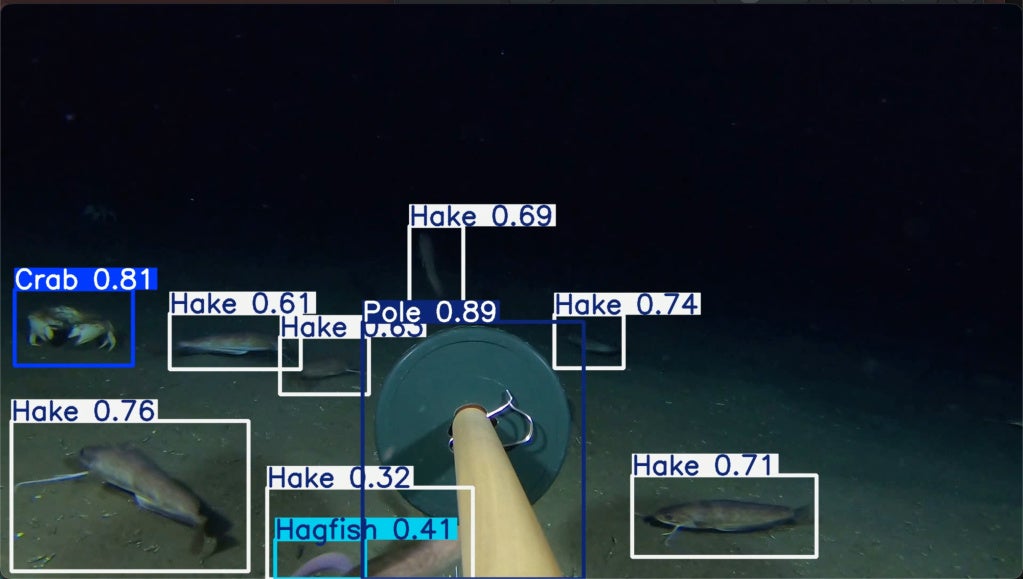
Student researchers: Zachary Johnson, Kamron Aggor, Zihara Delgado, Jad Albatal, Nathan Murphy, Nehemiah Speaks, Yue Mao.
Plastic-Degrading Proteins Detection
Project Partner: CMB, Prof. Ying Zhang
The pollution of plastics has become a universal problem with an estimated 399,000 tons of plastic that has accumulated in the ocean, with 69,000 tons of these being microplastics. One of the most promising solutions to this problem is to identify plastic degrading genes (PDGs) in microbes to degrade plastics. In previous work, a computational pipeline was designed to take in a set of protein sequences and predict which proteins were likely to be able to degrade plastics.
Our existing pipeline identifies a high number of putative PDGs from diverse environment microbiome data. However, more advanced analytical tools are required to differentiate true PDGs from potential false negatives (i.e. genes that are homologous to known PDGs but have no plastic-degrading function). Our goal for the AI lab project is to create a machine learning algorithm that is able to differentiate true plastic-degrading proteins from other non-plastic degrading homologs. To do this, we want to integrate protein structural modeling with sequence alignments to identify key residues with essential roles in the plastic degrading pathway and use this information to create and train an AI model that is able to more accurately predict plastic degrading proteins.
The goal of this project is to integrate the latest developments in AI-based sequence data analysis, such as gLM2, to make more accurate protein function predictions by considering catalytic sites and genomic contexts of proteins. To use these tools, we want to leverage the Gaia method, which takes advantage of the protein embeddings that are provided by gLM2 and compare the embeddings of our unknown proteins and known plastic degrading proteins. We also hope to implement our knowledge of the mechanism and active site for the plastic degrading proteins and confirm that putative PDGs contain a functional active site.
Student researchers: Aidan McCrillis, Omar Dovesi, Arybella Theul
Chatbot & Meeting Muncher
Partner: Engineering, Prof. Resit Sendag
This project aims to advance the retrieval and question-answering capabilities of a chatbot designed to assist students with technical questions related to graduation requirements and coursework. Some specific enhancements include: integrating lightweight or low latency LLMs to speed up intermediary queries, enhancing the document ingestion process by experimenting with different embedding models, etc. These enhancements will allow us to provide faster, more accurate academic support to students.
Participating students working on this project will gain a wide set of skills, including knowledge of RAG systems, creating and orchestrating multi-agent systems, and applying techniques used within research to enhance the capabilities of LLM question answering. Students will also gain some experience in setting up, and deploying, an application to a production environment using Docker containers.
As this project matures, we aim to expand the application to other academic departments and domains, helping students access knowledge more efficiently. While the project has been primarily supported by the ECBE Generative AI Research group (College of Engineering), it has recently evolved into a collaborative effort with the AI Lab at the University of Rhode Island, which has joined to contribute additional resources and student researchers. Currently, the application’s scope is limited to the knowledge base of the URI Electrical, Computer and Biomedical Engineering graduate program, available at https://www.ele.uri.edu/chat.
Student researchers: Jack DeMarinis, Richard Buckley, McKenzie Allen, Jack Light, Ryan Kraus, Ryan Megna
Reconstruction of Arctic Sea Ice Using NeRF-Based Rendering
Partner: Ocean Engg and GSO, Dr. Russell Shomberg
Students: Liam McKenzie, Julianna Della Selva, Alyssa Portofee. Past: Matthew Barbrack
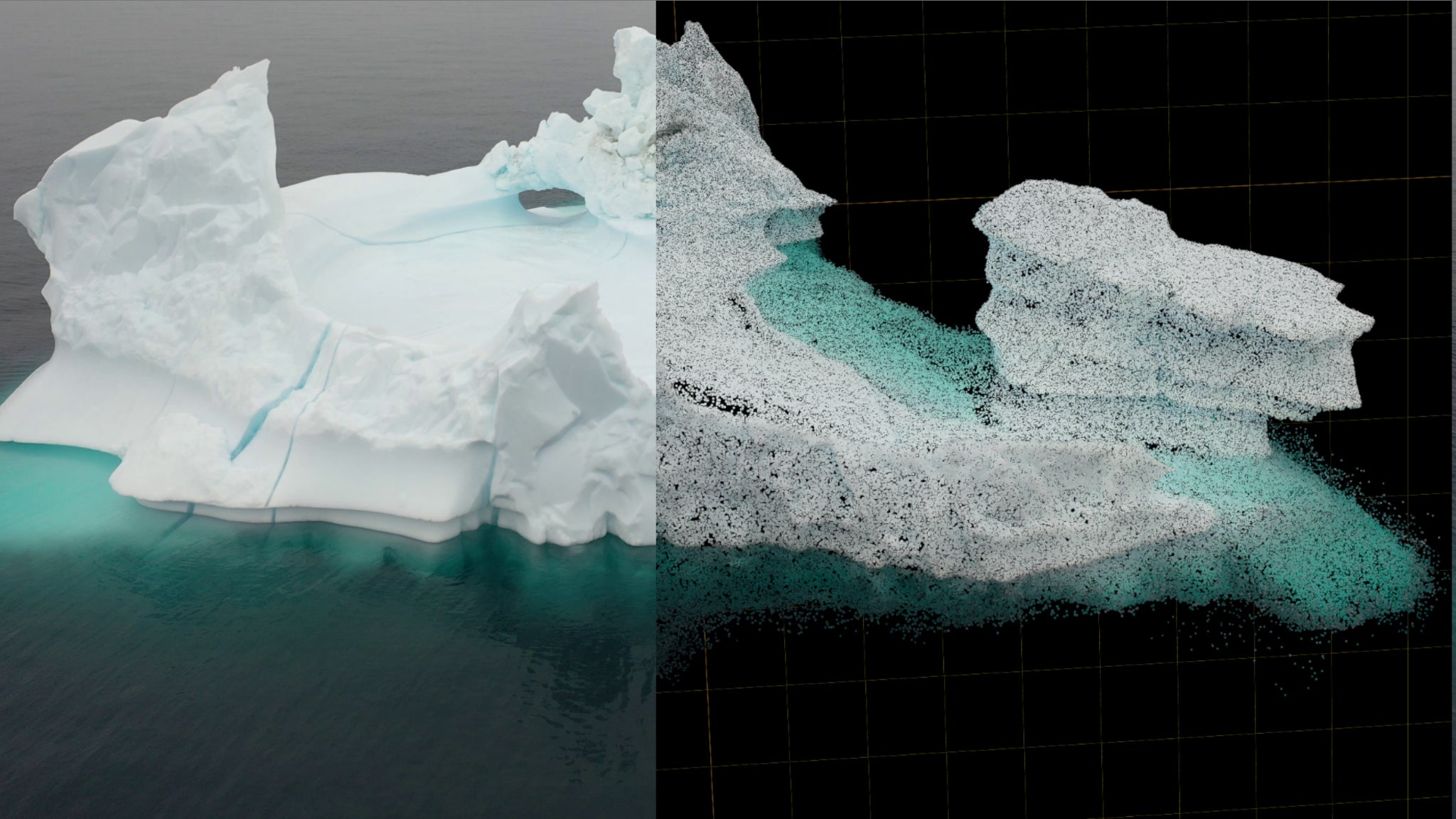
Use of AI through Neural Radiance Field (NeRF) based rendering and reconstruction methods applied to Arctic sea ice and icebergs. NeRFs employ AI-driven neural networks to represent a 3D scene as a light field, enabling reproduction of complex optical effects such as translucency and reflections and allowing output as 3D meshes or point clouds. Our work evaluates AI-based NeRF performance against traditional methods while providing a dataset for benchmarking. The data was collected from Arctic sea ice north of Barrow and icebergs in Disko Bay on the Greenland west coast. Imagery was collected over multiple years and platforms. The Arctic presents unique challenges due to sea ice and iceberg optical properties and the dynamic motion of icebergs, which often degrade traditional photogrammetry results. While lidar and sonar have been used for reconstruction, NeRFs leverage low-cost optical cameras and, with advances in AI-based sensor fusion, offer opportunities to integrate multi-modal datasets. This capability is increasingly relevant as Arctic maritime activity grows, requiring improved situational awareness, mapping, and forecasting to support safe navigation, infrastructure protection, and climate research. Our results demonstrate the potential of AI-based NeRFs to overcome long-standing limitations in sea ice reconstruction while laying a foundation for future advances in Arctic data collection.
This work was recently published as proceedings of OCEANS 2026 Monterey, CA and presented as a poster.
As we continue with this project, we are beginning to develop a multi-sensor fusion system that allows us to reconstruct the keel portion of the iceberg from data collected by multibeam, front looking sonar (MBFLS) and underwater cameras. We will be developing algorithms to stitch individual passes of MBFLS data into a 2D plane, then reprojecting into 3D space to form a point cloud of the keel structure. Additionally, we will leverage traditional photogrammetric processes to fuse the camera based imagery to compare the point clouds. These will then feed into NeRF based applications for overall comparison. We plan on evaluating various photogrammetric algorithms such as SIFT, MVS, RANSAC, and various NeRF based algorithms such as nerfacto, Gaussian Splatting, WaterNeRF, MipNerf, etc.
With these results, we will then be able to stitch the sail portion of the iceberg, which is our already completed work, with the keel portion to create a complete 3D reconstruction of the iceberg for researchers to use in simulations such as drift modeling, environmental impact, and ice decay rates.
RI Small Business Development Center
Project Partner: Division of Research and Economic Development
The Rhode Island Small Business Development Center (RISBDC), part of the Division of Research and Economic Development provides no-cost, confidential business advising to aspiring entrepreneurs and established small businesses across the state. In 2024, the RISBDC served nearly 800 clients, provided 4,700 counseling hours, helped secure $10 million in capital, and supported the creation of 2,700 jobs.
Recently, Google.org announced a $10 million funding initiative for America’s SBDC—our national association. The goal is to develop an AI curriculum and AI clinics that will help 100,000 small businesses adopt and benefit from artificial intelligence across all 50 states, Puerto Rico, and U.S. territories. You can learn more here: https://www.americassbdc-ai-u.org/.
To help bring this initiative to life, two students from the AI lab will support AI-related, student-led projects supporting small businesses across Rhode Island.
Students: Jeena Weber Staff, Patrick Sullivan, Callum Magarian, Aila Chin, Ekambeer Grewal, Sean Marois, Courtney Poon, Nick Lehourites
Structural Biology Information Extraction
Partner: Pharmacy, Dr. Chris Hemme
Structural biology is the science of understanding the 3-dimensional structure of macromolecules like proteins and DNA. These structures in turn provide information about the chemical work the molecules can perform such as drug interactions. An individual structure file defines thousands to tens of thousands of individual atom representing points in 3D space, along with chemical and biological information related to the molecule. With this information, the structural data can be visualized in 2D or 3D space using a variety of visualization formats. While a trained biologist can easily extract information from these figures, the variety of visualization options make it difficult for machine learning algorithms to extract useful data. We are currently working on machine learning methods to extract structural biology data from databases, scientific texts, and figure legends, but we would like to determine if it’s feasible to also extract information from the figures themselves. The goal of our laboratory is to be able to extract the maximum amount of useful information from a scientific manuscript about the structural characteristics of the reported molecule, process the information, and visualize it in 2D, 3D, or virtual reality. This project represents one component of that workflow focusing on the images themselves.
Student: Edwin Hernandez-Zanella
BlueTIDE Data Visualization
Partner: 401 Tech Bridge
BlueTIDE is an annual in-water technology demonstration event. Hosted by 401 Tech Bridge, in collaboration with the U.S. Navy, NavalX, and the Northeast Tech Bridge. The events held in 2024 and 2025 showcase bleeding-edge maritime and undersea technologies like autonomous underwater vehicles (AUVs), surface vehicles (ASVs), advanced sensors, communications tech, and high-resolution seabed imaging. The data generated during the BlueTIDE demonstrations by the Autonomous Underwater Vehicles (AUVs), Autonomous Surface Vehicles (ASVs), Resilient communication and data networks, and High-resolution seabed imaging will be analyzed.
Student researchers: Callum Magarian, Lily Nguyen, Lauren Holly, Richard Montgomery, Gerald Garcia
Workshops
OpenCode/Codex/Copilot: AI-Powered Coding and Workflow Agents
This workshop offers a hands-on introduction to OpenCode, Codex, GitHub Copilot. Participants learn how to sign up for access and set up these agentic workflows locally, with guidance on using it across multiple environments, including the desktop app, terminal, and VS Code extension. The session walks through configuration and setup step by step, followed by a series of guided use-case demonstrations that participants can follow along with on their own devices.
Number of sessions: 1
Number of participants: 17
Target audience: Faculty, Researchers, Administrative Personnel, Students
Prompt Engineering
This workshop introduces participants to the art of communicating effectively with large language models. Attendees learn the fundamentals of how AI thinks, in order to achieve better overall prompt structure, instructions, context, and use examples to guide model output. The workshop covers key concepts such as context and context windows, and how understanding these limitations can improve the quality and relevance of AI-generated responses. Participants also explore techniques like chain-of-thought prompting, role assignment, iterative refinement, and strategies for reducing ambiguity and hallucination.
Number of sessions: 1
Number of participants: 20
Target audience: Faculty, Researchers, Administrative Personnel, Students
AI Tools
This series of general AI Tool overviews provide a comprehensive introduction to Artificial Intelligence for students of all disciplines. This course introduces students to various AI tools that can enhance their academic performance and experience. Through interactive sessions, students will learn to apply AI tools for academic and personal success.
Number of sessions: 7
Number of participants: 5-6 students per session
Target audience: Undergraduate students, Graduate students
Generative AI
This program offers an introduction to Generative AI, particularly focusing on image generation techniques. Participants will explore fundamental generative concepts, tools, and ethical considerations while engaging in interactive activities to create AI-generated images.
R Series
This series is intended to introduce participants to the immense and powerful applications of the R programming language. It covers essential data science concepts and techniques which emphasize hands-on activities with popular R libraries. Attendees will gain practical insights into data manipulation, exploratory data analysis which allows them to extract meaningful insights from datasets.
Number of sessions: 10
Number of participants: —
Target audience: Undergraduate students, Graduate students
SPSS / SAS
These presentations explain first how to begin using the Statistical Package for the Social Sciences statistical software, overviewing syntax and point and click features. Following that, there is another presentation for more experienced students to expand and apply their knowledge using SPSS. This includes advanced analysis, creating tables and figures, and creating subset data files. Additionally, a similar beginner course will be offered for Statistical Analysis System.
Number of sessions: 3
Number of participants: —
Target audience: Undergraduate students, Graduate students
Outreach
AI & Quantum Computing Summer Camp 2026
The summer camp was designed for high school students across Rhode Island and introduced quantum computing and AI.
Number of sessions: 4
Number of participants: 15
Target audience: High school students
OLLI Winter Course
Understanding AI for Safe and Secure Use
Today, everyone is using AI, whether intentional or not, for fun or hobby, or to support a more efficient workplace. Many are also using AI to make critical decisions about health, finances, and voting. This course is intended to provide introductory information about the nature of AI, and how we can use AI safely, ethically, and securely. We will provide enough information to help users to support AI Sustainability of our physical, social, political, and spiritual environments. Three sessions will provide interactive lectures, discussions and demos including the following:
- What is AI under the hood? How does it work?
- Demonstration of the various types of AI, and contemplation of their strengths and weaknesses
- The ethics of AI and the sustainability of our environments under the widespread use of AI in our modern world.
Number of sessions: 3 weeks
Number of participants: 45
Target audience: General public
Events
- State House visit: Gabriele Fariello, Gaurav Khanna, and Indrani Mandal were invited by the Rhode Island Senate Committee on Artificial Intelligence & Emerging Technologies to present on AI.
- Quadfest: Oct 6, 2026
- Hack@URI: We supported the organization of the AI track for Hack@URI in February 2026.
- URI Day at the State House: Spring 2026
- Rhode Island Library Association Conference 2026: May 2026
- Tabled at CS Connect Day: An industry-student connection event focused on AI in the workforce, specifically for Computer Science students
- Tabled at Faculty Research Forum Oct 2026
Class Visits
URI 101-0010 for Computer Science BA/BS, Instructor Melissa Gooding, Spring 2026
Student attendance: 21
URI 101-0014 for Data Science, Instructor Lisa Kuosmanen, Spring 2026
Student attendance: 13
URI 101-0009 for Computer Science BA/BS, Instructor Caroline Phillips, Fall 2026
Student attendance: 23
Students Served by Semester
| Semester | Students served |
|---|---|
| Summer 2026 | 27 |
| Fall 2026 | 45 |
| Spring 2026 | 45 |