
About Roger Figueroa
Dr. Roger Figueroa is the Director and Founder of the Figueroa Interdisciplinary Group (FIG) Lab, and Assistant Professor in Social and Behavioral Science in Nutrition in the Division of Nutritional Sciences (DNS), College of Human Ecology at Cornell University. Roger is a transdisciplinary scientist with expertise in public health, nutrition, implementation, participatory, and team science. Currently, Roger’s research examines the role of social services and policies (such as childcare and food assistance), as well as sustainable food systems on the prevention of diet-related chronic diseases in low-income and minoritized communities. To date, Roger has developed a comprehensive skill foundation in research methods, including training in a broad range of quantitative methods, qualitative methods, and mixed method research. Roger has received training and research funding support from the USDA, NIH, and from other institutional-level grant programs. He recently earned the Chancellor’s Horizon Award for Faculty Research and Scholarship, and was a panelist for Metcalf’s 2025 Fall Lecture.
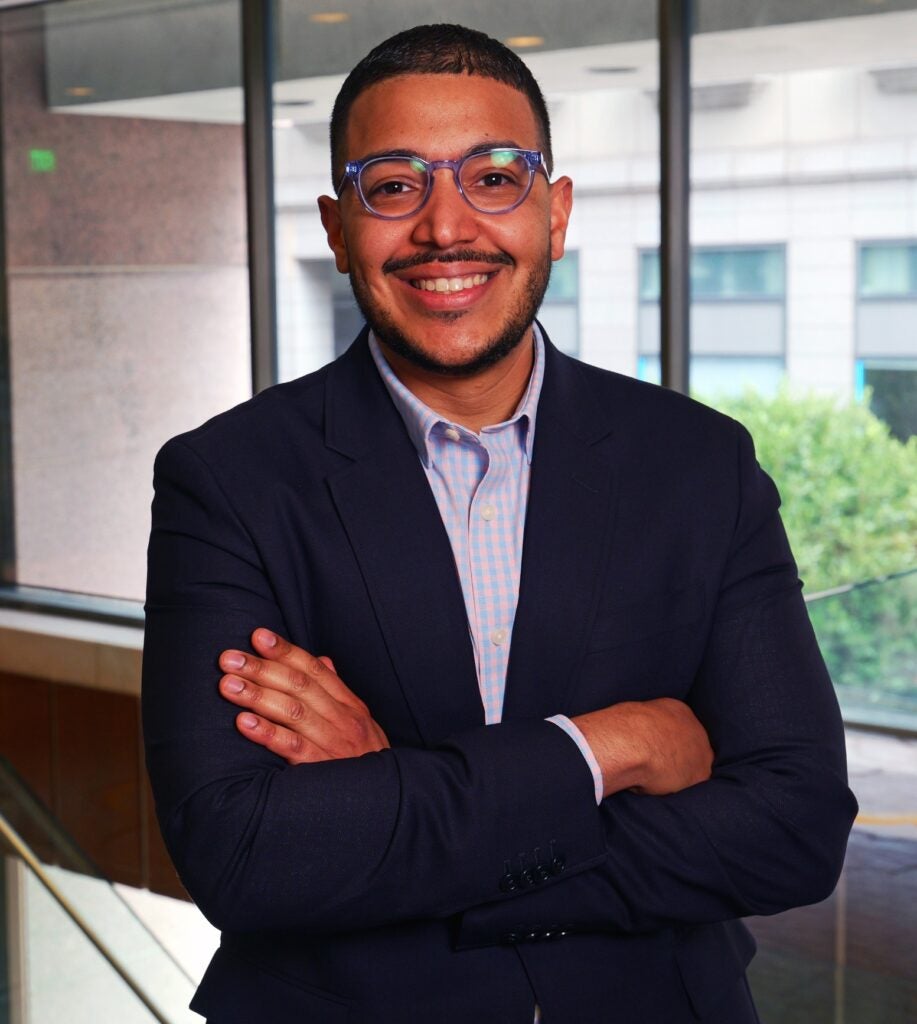
Roger spoke with Metcalf’s Abbie Lahmers about the FIG Lab addressing complex issues surrounding food insecurity, what COVID-19 revealed about traditional programs, and his time as a SciComm Identities Project (SCIP) fellow.
Can you tell me about the FIG Lab and what you’re currently working on?
RF: I direct the Figueroa Interdisciplinary Group at Cornell in the Division of Nutritional Sciences. Essentially, we’re examining how effective and implementable food assistance and food access programs are, including traditional food assistance, such as programs like SNAP, WIC, and school meal programs, as well as more innovative forms of food assistance – one most commonly known as farm-to-food assistance. We’ve done a few implementation studies as well as evaluation projects that aim to understand how these programs are implemented, how they are reaching intended recipients, and whether there are barriers or facilitators to their utilization, as well as the effects of utilizing these programs on nutrition and health outcomes.
Currently we’re doing a lot of model testing and qualitative studies that aim to reach people who are both on the recipient end of these programs, and also those who are helping implement these programs on the ground in community settings, from emergency food relief organization programs, all the way to hospitals and schools.
Why is this work so important, especially right now?
RF: First of all, the traditional models or programs that were in place to alleviate problems like food insecurity – I think that the COVID-19 public health emergency revealed that these programs were insufficient. They weren’t really reaching everybody, but also even when the intended people were reached by the programs, these weren’t fully addressing the issue. Another motive for doing this work is that we know the problem of food insecurity has only gotten worse since the public health emergency, emphasizing that all that we’re doing is insufficient and that we need new ways to address the issue.
The part that makes it critical right now is that we are also navigating a complex political climate that not only weakens the current food assistance safety net as we knew it, but also creates additional challenges for people struggling to make ends meet and trying to access foods in affordable ways. We have an affordability crisis, and that is reflected in increases in gas and food prices, adding to the already challenging food system that people navigate day to day.
What’s something that’s giving you hope these days?
RF: I keep coming back to the importance of building community and engaging on the ground with people who want the same thing, care about the same causes, and share the same values because one way or another, you can always figure out in real time what’s needed and what solutions can emerge from the ground up. It is very evident that we cannot rely on solutions that come from the top down because once those are withdrawn or taken from the people, then we’re left with few alternatives. I find hope in the value of community coming together with people who care about the same issues and try to find solutions where we’re all implicated and committed to solving the problem.
In our efforts locally, we partnered with local organizations so that emergency food relief organizations, which traditionally function as a charity model to distribute donated foods, can build relationships with local producers so that fresh farm foods could reach individuals who are experiencing food insecurity. In the last couple years, we have been very fortunate to work with local partners to not just produce and help distribute more nutritious foods to populations who are experiencing food insecurity but also to better understand how these models are implemented in efficient ways and test whether these are better alternative models to addressing food insecurity and serving as a food assistance safety net innovation. I feel really proud of that. We’ve also seen qualitatively in some of the work we did this last year – from people implementing it as well as those receiving it – elaborating on how satisfied they were with this approach.
How has your experience as a SCIP fellow with Metcalf impacted you and your career?
RF: I owe a large part of my success to the Metcalf team and the SCIP fellowship because it was that training, that community, and the resources that helped me find an angle to my work that I care deeply about, but didn’t have the strategy, or knowledge on how to unlock it. Metcalf and SCIP really helped me find ways to communicate the science I was generating, the science I was engaging with in the real world, and taught me how to put together forms of communication and engage with stakeholders – not just scientists or students or academics – in ways that then allowed me to propel my public engagement. In the last year, I’ve done media engagement, written and television, and policy engagement in Capitol Hill. So I’m really, really thankful to all that Metcalf has provided me and my peers in making sure that science communication is just as strong as the science itself.
What do you remember most about your time with Metcalf?
RF: I’m going to go back to that community concept. What they did very early on is to bring us together and build that sense of community and sense of understanding that we were all in this process together and we each are experts in our own ways in our own work, but how do we speak the same language and acknowledge that we all care about the same things but look at things from different angles? Very quickly, the training brought us together in ways that we felt connected, and I still feel connected to this day to my cohort and to the trainers – Sunshine Menezes and Bruno Takahashi and Iasmim Amiden dos Santos and Amirali Momeni – and all the fellows. I think a sense of community, a sense of belonging that you all were kind enough and generous to provide and to enable – that’s what’s memorable for me.
This interview has been edited for length and clarity.