
Why URI’s Land-Grant Mission Still Matters
By Anna Vaccaro Gray ’12, M.S. ’16
The University of Rhode Island embodies the three-pronged land-grant mission of education, research, and outreach focused on practical service to the state. Today, 163 years after the Morrill Act established land-grant universities—this piece asks: What does it mean to be a land-grant university today? And why does it matter?
The passage of the Morrill Land-Grant College Act in 1862 transformed public education in the United States. At the time, universities were largely elite and exclusive. The land-grant system aimed to make higher education accessible to a broad range of people and to deliver a practical education.
In addition to research and teaching, land-grant universities have a third mission: outreach, often called extension—a commitment to connecting knowledge with real-world application that directly benefits the state in ways that contribute to strong economies and quality of life.
The University of Rhode Island, the state’s only land grant institution, engages with this legacy through a variety of disciplines, from nutrition and education to the humanities and sciences, with a focus on serving communities statewide.
Cooperative Extension, Then and Now
Kenyon Butterfield, URI’s shortest-serving president from 1903 to 1906, felt strongly
about outreach. He organized an extension department in 1904—a decade before other land-grant colleges—and employed agents to liaise between the school and the public, translating evidence-based research into practice while keeping a finger on the pulse of people’s needs.
In 1914, Butterfield’s system was formalized when the Smith-Lever Act established Cooperative Extension programs at land-grant universities nationwide. As society’s needs changed, Cooperative Extensions adapted. During the social and economic turmoil of World War I and the Great Depression, they helped people learn practical skills.
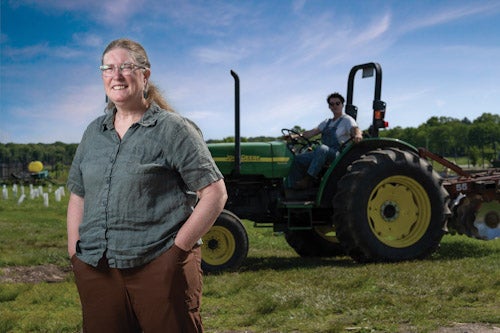
Gardner Crops Research Center on the Kingston Campus. On the tractor is summer
farm crew member and animal science major Simon Tetreault ‘25.
URI’s Cooperative Extension is now active in all 39 municipalities in Rhode Island and partners with state and local agencies to address environmental, social, and economic concerns.
The scope is extensive: from the Aquaculture Extension program, which connects the state’s aquaculture producers to science-based, sustainable, and profitable aquaculture practices, to the Onsite Wastewater Resource Center, which provides education on best practices for protecting water quality and public health and encourages sustainable development.
“It’s gratifying to see students find jobs in agriculture, and to see farmers stay in business.”Rebecca Brown, URI Professor of Plant Sciences and Entomology
Cooperative Extension programs deliver impressive results. In 2024, among other programs, the Food Recovery for Rhode Island program gleaned and rescued 231,785 pounds of food, which was donated to feed Rhode Islanders, and diverted an additional 8,196 pounds of food from the landfill; volunteers with the Watershed Watch program regularly monitored 220 fresh and marine water bodies; and the Plant Diagnostic Laboratory identified more than 500 plant, insect, and disease samples.
Impact by the Numbers
How URI Cooperative Extension helped Rhode Island in 2025.
- 241,960 pounds of wasted food gleaned or rescued and donated to feed Rhode Islanders
- 57,041 pounds of food diverted from the landfill waste stream
- 2,000+ phone, email and walk-in inquiries fielded through the URI Gardening and Environmental Hotline
- 500+ plant, insect and disease samples identified through the URI Plant Diagnostic Laboratory
- 220 fresh and marine water bodies monitored regularly since 1988
- All 39 municipalities served in Rhode Island
Staying Focused on Farms: URI’s Agricultural Experiment Station
In 1887, the Hatch Act established Agricultural Experiment Stations at land-grant schools focused on improving food production and agribusiness. They continue to be important components of land-grant institutions.
Rhode Island has about 59,076 acres of farmland, according to the 2024 Census of Agriculture. The land-grant system’s focus on agriculture has helped protect Rhode Island farmland and support the local economy. According to the Association of Public and Land-Grant Universities, recent data indicates that for every $1 in public investment, food and agriculture research and development from land grants has returned $20 to the American economy.
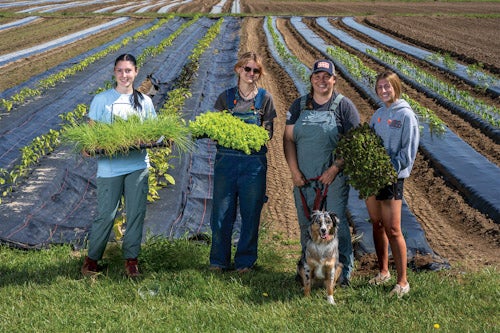
Today, URI’s Agricultural Experiment Station includes three farms and several greenhouses on the Kingston Campus and at East Farm. The Greene H. Gardner Crops Research Center, also called Agronomy Farm, hosts research and teaching plots as well as 4 acres used to grow produce for URI Dining Services, the Free Farmers Market, and Rhody Outpost, a food pantry for students. East Farm is used for research in aquaculture, ornithology, entomology, wildlife habitats, and more. Peckham Farm is home to URI’s animal science program, a variety of livestock used for teaching and research, and 18 acres of hayfields and pastures.
David Weisberger, an agricultural extension agent for URI’s Cooperative Extension, meets regularly with farmers, nonprofits, and state agencies, like the Division of Environmental Management and the Northeast Organic Farming Association of Rhode Island. “What I find most worthwhile about working for a land-grant institution is being a civil servant for the farmers of Rhode Island,” Weisberger says. “Industries can play an important role, but because we are public sector workers, we aren’t selling anything. We’re just sharing information and feedback with farmers to help them solve problems.”
“We have a mission to teach and support agriculture across the state.”Rebecca Brown, URI Professor of Plant Sciences and Entomology
Science Education: Working Symbiotically
the Guiding Education in Math and Science Network (GEMS-Net)
Sara Sweetman, Ph.D. ’13, URI associate professor of education, directs the Guiding Education in Math and Science Network (GEMS-Net), a program that advances science education by helping Rhode Island teachers implement innovative science curricula developed by researchers.
GEMS-Net brings teachers and administrators from 13 public school districts together with URI researchers and educators for workshops, professional development, and mentoring. The programming often takes place in the schools. Sweetman’s own research on topics such as teaching science through media and outdoor education informs—and is informed by—her interactions with teachers in the GEMS-Net program.
“Research is only important if it’s useful,” she adds. “We need it to be translatable.”
An elementary school teacher in North Kingstown, R.I., Christina Broomfield ’09 began attending GEMS-Net workshops early in her career. “I appreciated that it was the same team of workshop facilitators every time, and not a company sponsoring the curriculum,” she says. As GEMS-Net staff co-present workshops with teachers and researchers, Broomfield says she also appreciates the emphasis on collaborative expertise.

science her strongest teaching area.
Science is Broomfield’s strongest area of teaching, she says, because of the professional development and ongoing support she’s received from GEMS-Net.
“GEMS-Net has been a constant in my career,” she says. “I know I’m always going to get support from the team. It makes me feel really empowered.”
“Research is only important if it’s useful; we need it to be translatable.”Sara Sweetman Ph.D. ‘13, URI associate professor of education
Liberal Arts: Ethical and Engaged Work
One of the architects of the 1862 Morrill Act, Jonathan Baldwin Turner, wrote that the land-grant system was meant to “extend the boundaries of our present knowledge.” The liberal arts are a necessary component of that pursuit. While applied scientific research produces measurable impact, the liberal arts fortify land-grant work.
Madison Jones, URI assistant professor of professional and public writing and natural resources science, sits between two worlds: liberal arts and applied sciences. “Humanists do land-grant mission work in a way that has typically gone unseen or unacknowledged because it isn’t necessarily a product,” he says. “But we need the humanist perspective to ask: Why are we doing this? What is it going to do for humans? How is it going to affect our democracy?”
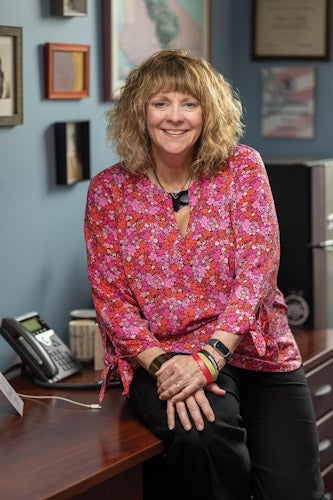
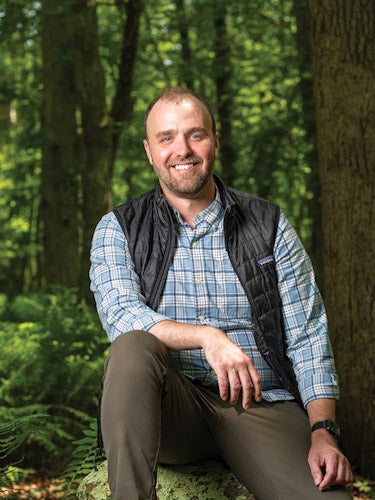
Jones founded the DWELL (Digital Writing Environments, Location, and Localization) Lab at URI to advance innovative approaches to science communication. The lab considers how humans interact with places through deep mapping, which layers media and information to represent not only a place’s physical characteristics, but also its history, the lived experiences of its inhabitants, and more.
One of DWELL’s project sites is North Woods, a 300-acre parcel of unmanaged forests and wetlands next to URI’s Kingston Campus. Jones’ team created an interactive experience about the relationship between URI and the land it uses. They worked with an artist from the Narragansett Indian Tribe to create a walking tour of North Woods based on a traditional Narragansett ecological story about how birds got their song.
“One of the most important things we can do to respond to the world we’re living in is to foster interdisciplinary and transdisciplinary work,” he adds. “It can be an exhausting approach, but it’s a rewarding one, and it brings us toward more ethical and engaged work.”
An Invitation to Respond
The land-grant system epitomizes a fundamental contradiction. “The ‘public good’ [that land-grant] institutions purported to promote was only possible because of violence and dispossession of ancestral Indigenous land, and acknowledging this dissonance is important for true understanding,” wrote URI student Jenny Sullivan ’21, M.A. ’24, in her master’s thesis, “Origins and Consequences of Rhode Island’s Land-Grant Institutions.”
Confronting this history is, according to Jones, something that “compels and invites our response.” Essential to our response are the values at the core of the land-grant mission itself: working and collaborating meaningfully with communities to improve and enrich our shared reality.
“In my experience, people at URI are willing to ask questions and to learn,” says Dinalyn Spears ’95, director of community planning and natural resources for the Narragansett Indian Tribe. “They want to be educated about our history, and they are proactive in working with the Tribe.”
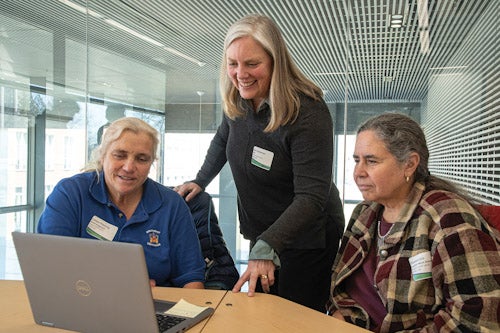
Spears teaches Indigenous uses of native plants and the Narragansett Indian Tribe’s food sovereignty efforts in URI Cooperative Extension’s Master Gardener program, which trains and certifies people to become community educators who teach Rhode Islanders about environmentally sound gardening practices. Spears completed her Master Gardener training in 2015. She has a farm in Westerly, R.I., where she grows vegetables and medicinal and culinary herbs for tribal citizens.
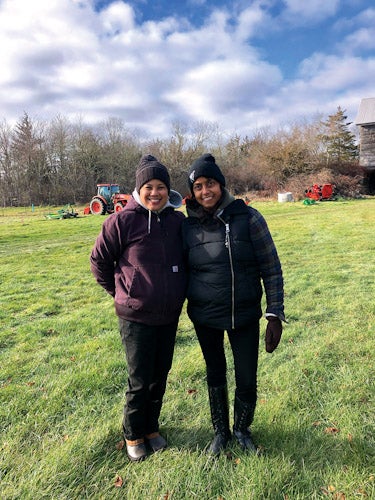
resources for the Narragansett Indian Tribe and a URI Master Gardener. Spears serves as an instructor for the Master Gardener program, offering traditional ecological knowledge around the indigenous uses of native plants. URI Master Gardener program leader Vanessa Venturini ’08, M.E.S.M. ’11, calls Spears “a true community leader, a respected elder in the community, and a connector to URI Cooperative Extension, where she now sits on our advisory board.” Spears is pictured (left) with fellow Master Gardener Maria Rivera-Saillant.
Spears notes that at URI, there are growing efforts toward achieving a more fully realized version of the accessibility and inclusivity promised by the original land-grant legislation. A scholarship was established for undergraduate students who are citizens of the Narragansett Nation. URI’s land acknowledgement, a public statement recognizing that the University occupies the land of the Narragansett Nation and the Niantic People, was written in collaboration with John Brown, the Narragansett Indian Tribe’s tribal historic preservation officer. And the Tomaquag Museum, one of the oldest tribal museums in the country, is slated for a new location on URI’s Kingston Campus.
While there is more that can be done, Spears points to these examples as emblematic of the current climate. “The past is important,” she says, “but there is a time to come together, move forward, and build new relationships.”
The complexity of the land-grant system’s history, not unique to URI, is not lost on faculty engaged in land-grant work; rather, it fuels their desire to contribute to the public good through equitable, engaged work.
Being part of a land-grant university carries with it a debt born of a complicated history. “It’s a debt,” Jones says “that we owe to taxpayers in the state, to the communities that call Rhode Island home, and to each other. It’s an obligation and an exigency.”
Please see the full article A Debt to History: Why URI’s Land-Grant Mission Still Matters in the University of Rhode Island Magazine summer 2025 issue.