
By Monica Allard Cox
The University of Rhode Island was designated one of the first four Sea Grant Colleges in the U.S., thanks to the leadership of Rhode Island Senator Claiborne Pell and URI’s founding Oceanography Dean John A. Knauss.
“Dr. John Knauss and Senator Claiborne Pell were visionaries who teamed up to create the National Sea Grant College Program, understanding that Rhode Island’s way of life is intertwined with the health of our coastal and marine resources,” says Senator Sheldon Whitehouse. “Rhode Island Sea Grant has since been integral in helping Ocean State communities adapt to climate change, while nurturing countless leaders to take on the biggest oceans and coastal issues facing our nation. I’m always so pleased to support Sea Grant and all the wonderful work being done at the world-class Graduate School of Oceanography at URI.”
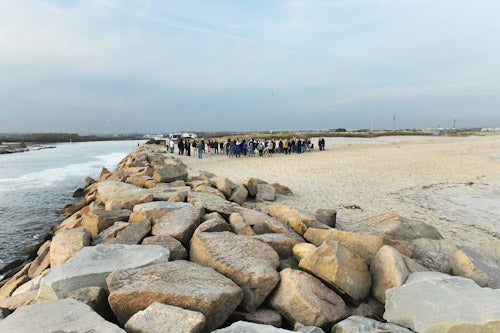
The small crowd clustered in the dirt parking lot of Jamiels Park in Warren, RI. High tide waters swirled up through the storm drain behind them, running from Belchers Cove and under the parking lot into the adjacent field.
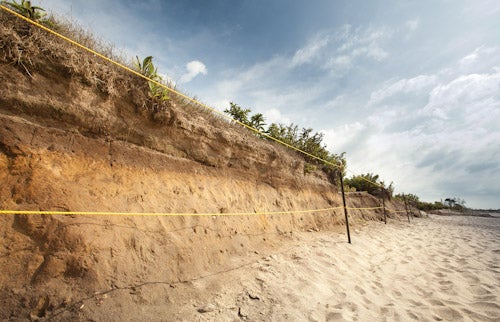
Butch Lombardi, a member of the Warren Conservation Commission says, “I was here for Hurricane Carol, and this whole area was underwater. If you look at the topography of Warren, there’s not much elevation anywhere … I think the Hurricane Carol flooding is probably symbolic of what’s going to be normal around 2050.”
Lombardi was referring to the 1954 hurricane that unleashed a devastating storm surge up Narragansett Bay.
“Projects like this, I think, will hopefully get people to understand that, you know, this is real. It’s going to happen, and it won’t happen in my lifetime, but it’s going to happen in my grandkids’ lifetime,” he says.
Lombardi spoke to the group gathered this past fall for the Warren Resilience Walk, an event sponsored by Rhode Island Sea Grant, the University of Rhode Island Coastal Institute, and other partners. Participants compared at locations threatened by sea level rise with those developed with resilience in mind. Walk leaders talked about URI research and outreach projects taking place in Warren, including the National Science Foundation-funded “Risks, Impacts, and Strategies for Coastal Communities: Advancing Convergent Science to Support Climate Change Adaptation and Resilience” project.
Emi Uchida, professor and chair of the Department of Environmental and Natural Resource Economics and principal investigator of URI’s $1.5 million portion of the grant, said in a press release that “finding solutions to this very complex problem requires … a range of expertise” to support communities in decision making.
Rhode Island Sea Grant coastal resilience specialist Eliza Berry, one of the co-leaders of the walk, is the outreach specialist for that project. She synthesizes the experiences and points of view of Warren residents from varying backgrounds, business owners, nonprofit organizations, and municipal leaders.
Berry connects with groups like the East Bay Community Action Program’s Warren Health Equity Zone (HEZ). The HEZ Safety and Community Resilience Work Group consists of residents engaged in conversations around flooding and community resilience. Berry worked with the group to bring URI researchers, community members, and town employees to their August meeting to weigh in on flood mitigation strategies they would like to see further evaluated through URI research.
“Warren and its residents are still trying to get their hands around the scope of the flooding problem along Market Street,” says HEZ director Kristin Read. “It is the heart of the city’s business district. Our workgroup has been trying to understand the complexities of sea level rise, wetter weather, and inadequate drainage, and how can we share knowledge about adapting to living in a flood zone. Eliza and her colleagues are committed to listening carefully to the knowledge and experience of our neighbors, which is evident in the way they have matched technical support to available resources.”
Berry and Casey Tremper, also a Rhode Island Sea Grant coastal resilience specialist, are often tapped to serve as liaisons between researchers and communities. In another NSF-funded multi-institution research project, Brown University’s Sol Cooperdock, research associate in Earth, Environmental, and Planetary Sciences, developed sensors that detect even slight increases in water levels and can be placed over rivers, parking lots, or roads to help identify flood-prone areas. Tremper talks to community groups about the project and the sensors to identify places that could benefit from their installation.
“Rhode Island Sea Grant plays an essential role in bridging the research conducted at URI and Brown with community needs.”Austin Becker
Austin Becker, URI Department of Marine Affairs professor and chair says, “Rhode “Rhode Island Sea Grant plays an essential role in bridging the research conducted at URI and Brown with community needs. Tremper and Berry understand the technical side of the research efforts around coastal resilience and help researchers understand how our work can best be tailored to address the challenges Rhode Island decision makers face in emergency management and long-term resilience planning.”
Rhode Island Sea Grant, one of the 34 university-based programs around the U.S. that make up the National Sea Grant College Program, supports a healthy coastal environment and economy through funding top-notch research, extension, workforce development, communications, and a legal program that is based at Roger Williams University School of Law.
In addition to coastal resilience work, other extension team members focus on fisheries and aquaculture and the blue economy—that part of the economy that relies on marine resources for business and industry, research and development, energy resources, national defense, culture, or recreation.
Rhode Island Sea Grant also provides students with the opportunity to have hands-on experience in research, extension, communications, and policymaking.
One of those students was Joe Langan, who completed his Ph.D. with Graduate School of Oceanography Professor Jeremy Collie, a fisheries scientist funded by Rhode Island Sea Grant to study the decline of winter flounder in Narragansett Bay. While at URI, Langan also completed an M.S. in statistics with Associate Professor Gavino Puggioni.
“We found that the population decline of winter flounder in Rhode Island was due largely to increasing juvenile mortality. We were able to identify a few different factors that appear to be involved, most having to do with climate change. Our research became part of a broader suite throughout the region that was actually used to change how the regional winter flounder stock was managed,” Langan says.
Langan says this opportunity gave him a chance to “work with state biologists, biologists from other states, other universities, as well as interface directly with fishermen, which I thought was also really valuable to get their perspective.”
His research assistantship led to a National Marine Fisheries Service/Sea Grant Population and Ecosystem Dynamics Fellowship, and from there to a staff position at the National Oceanic and Atmospheric Administration (NOAA), where he is currently a research fish biologist.
Emily Patrolia, founder and CEO of ESP Advisors, a Washington, D.C.-based consulting firm, also forged her career with Sea Grant support. Patrolia came to URI’s Marine Affairs program for a Rhode Island Sea Grant-funded research assistantship with Professor Rob Thompson to study human uses of Rhode Island’s coastal salt ponds through observational mapping and interviews. The goal of the project was to support state policymaking around aquaculture and mixed uses of the salt ponds.
“The research we fund is rigorously reviewed not only for scientific merit, but also for relevance. Our home at URI, as a Land Grant and Sea Grant university and an R1 institution, allows us to call on world-class experts to address issues from the seafood supply chain to sea level rise, and to bring them together with communities to effect real change.”Tracey Dalton
Patrolia received her M.A. in marine affairs in 2016 and followed that up with a Sea Grant Knauss Fellowship, which gives highly qualified graduate students an opportunity to spend a year working in Congress or the legislative branch on federal policy issues affecting marine and coastal resources.
She worked for Sen. John Thune, the chair of the Commerce Committee, which oversees NOAA. She was given the opportunity to draft what she calls a “small” piece of legislation on illegal fishing that eventually made its way into a larger maritime security bill and became law.
After her fellowship, Patrolia worked at large firms on sustainability issues for major corporate clients, but her heart was still with the nonprofit organizations in the coastal and ocean world that couldn’t afford to work with D.C.’s premier lobbying agencies. This led her to start her own smaller firm, ESP Advisors, “to see if I could bring some of the more sophisticated lobbying activities back to the ocean space at a more approachable price point for those groups.”
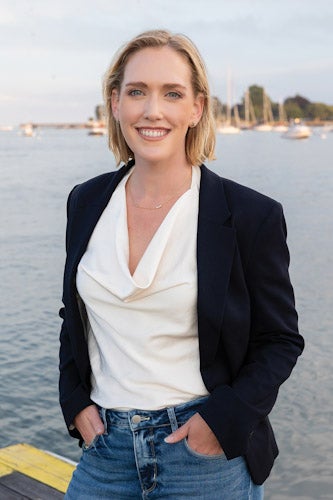
Founder and CEO of ESP Advisors
She encourages graduate students to consider Knauss Fellowships, “if you want to grow and learn and change the way you think and see the world.”
“What you learn,” she adds, “is context.”
Context is key to Sea Grant work as well.
“The research we fund,” says Rhode Island Sea Grant Director Tracey Dalton, “is rigorously reviewed not only for scientific merit, but also for relevance. Our home at URI, as a Land Grant and Sea Grant university and an R1 institution, allows us to call on world-class experts to address issues from the seafood supply chain to sea level rise, and to bring them together with communities to effect real change.”
“We’ve been at URI for more than 50 years, and we look forward to many more to come.”