
By Shaun Kirby ‘07
Daniel Roxbury is used to developing sensors that help us explain complex environments, such as cancer cells in the body or chemical pollutants in seawater. Studying microplastics, however, presents a whole new challenge, one new initiative funded by the U.S. National Science Foundation (NSF) aims to overcome.
“It’s been really eye-opening to see how much we don’t know about microplastics,” says the associate professor of chemical, biomolecular, and materials engineering at the University of Rhode Island.
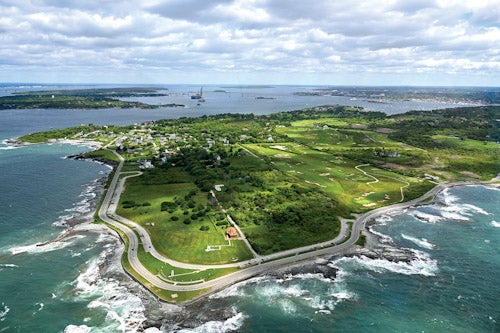
Roxbury is the principal investigator of SIMCoast (Socio-ecological Impact of Microplastics in Coastal Ecosystems), a $7 million, four-year grant building Rhode Island’s research capabilities to measure and study the impacts of nano- and microplastics (NMPs) throughout the Narragansett Bay watershed, an area spanning approximately 1,700 miles in Rhode Island and Massachusetts and home to nearly two million people.
Scientists consider any fragment no greater than 5mm in size as a microplastic, while nanoplastics are less than 1 micron, similar in size to a speck of dust. As plastic materials like water bottles and fishing gear enter the state’s rivers and coastlines, they break down into what’s called secondary plastics. They then move through water bodies in unknown ways and with varying shapes like microfibers, films and jagged particles.
SIMCoast, a grant awarded through NSF’s Established Program to Stimulate Competitive Research (EPSCoR), is trying to better understand how, and to where, microplastics are moving throughout the watershed.
“There’s all different kinds of sizes and compositions of NMPs,” Roxbury says. “It’s a monumental technical challenge to be able to detect these plastics.”
The project is split into three research themes with faculty from institutions across the state. One group is developing new methods for sampling microplastics in diverse water environments, including from the sediments of Narragansett Bay, areas of outwash from rivers, freshwater lakes and stormwater basins.
“A large part of our economy relies on the bay and the ocean, and we wanted to pick a topic that critically affects it. We chose to study the socio-ecological impacts of microplastics within coastal ecosystems as the theme of our E-RISE project.”Daniel Roxbury
Through this work, Roxbury and his team seek to establish standardized practices for studying micro and nanoplastics in Rhode Island and beyond. Current techniques to detect and image plastics at such small sizes are very limited, as well as being time-consuming and cost prohibitive. New methods from SIMCoast investigators work could provide better information to communities and policymakers about the potential impacts of these nearly invisible particles.
“What we’re finding is that no approach is perfect,” he says. “How much do you want to sample versus how accurate do you want to be? New techniques are coming down the pipeline, and we’re seeing if they’re suitable to our needs.”
The ways in which microplastics move through water bodies, in rivers and wastewater canals all the way to Narragansett Bay and out into the Atlantic Ocean, are complex and understudied. Scientists don’t currently know, for example, where microplastics are more likely to accumulate in coastal habitats.
A second group of investigators are developing computer models to bring these flow patterns to light, as well as forecast where hotspots for collected plastics may be occurring.
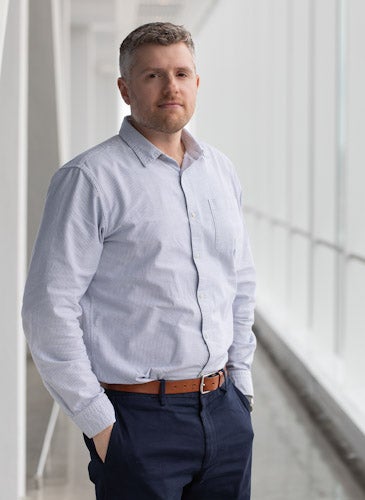
“Even if we have all the proper sampling, we need to develop empirical models about how these microplastics are being transported,” says Roxbury. “We’re creating models that will predict how plastics are making it into the watershed and then all the way down to the bay and ocean.
“One of the main goals here is to try to create that level of model that you can actually run time backwards to see where microplastics are originating from.”
Critical to understanding microplastics in the Narragansett Bay watershed is how the impact marine and terrestrial species. Which animals are ingesting microplastics and being harmed by them? Which species seem unfazed? How do microplastics travel through the food web to impact human health? SIMCoast is answering such questions by supporting researchers in multiple areas of study, from wildlife conservation to aquaculture.
But why conduct all this research and build Rhode Island into a go-to resource for studying microplastics? Who should know, and benefit from, this progress? SIMCoast has gathered a team to engage with local community members, state agencies, and industry to ensure that decision-makers are well-informed about how microplastics are impacting their cities and towns. This group will also develop inclusive approaches and programs to increase
accessibility of SIMCoast research findings.
“We are saying that microplastics are bad, right?” says Roxbury. ‘But when you go to
local communities and say something like that, they’ll list 10 problems that are actually affecting their daily lives, and microplastics isn’t on that list.
“We don’t want to push this science onto them, but if we can understand their perspectives, we can hopefully relate this work to their daily lives.”
Roxbury has reflected often in the past year about what he’s learned from colleagues all trying to tackle the problem of plastics at such fine scales and how humans are, and will be,
impacted by them. He hopes that the SIMCoast team can advance our knowledge of these pollutants, one particle at a time.
“Being on this team of such diverse perspectives has been enlightening,” he says. “My job is to facilitate synergies where I can, making sure all rudders are heading the same direction.”
SIMCOAST COLLABORATORS:
Anabela Maia, Co-Principal Investigator, Associate Professor of Biology, Rhode Island College
Baylor Fox-Kemper, Co-Principal Investigator, Professor of Earth, Environmental, and Planetary Sciences, Brown University
Stephen O’Shea, Co-Principal Investigator, Professor of Chemistry, Roger Williams University
Katherine Lacasse, Co-Lead, Professor of Psychology, Rhode Island College
Daniel Hewins, Co-Lead, Professor of Biology, Rhode Island College
Lillian Jeznach, Associate Professor of Engineering, Roger Williams University
Mara Freilich, Assistant Professor of Earth, Environmental, and Planetary Sciences, Brown University
Emanuele DiLorenzo, Albert Davis Mead Professor of Earth, Environmental, and Planetary Sciences, Brown University
Karianne Bergen, Assistant Professor of Earth, Environmental, and Planetary Sciences and Data Science, Assistant Professor of Computer Science, Brown University
Carla Narvaez Diaz, Assistant Professor of Biology, Rhode Island College
URI @SIMCOAST:
Daniel Roxbury, Principal Investigator, Associate Professor of Chemical, Biomolecular, and Materials Engineering
Vinka Oyanedel-Craver, Co-principal Investigator, Associate Dean of Research, Professor, Civil and Environmental Engineering
Andrew Davies, Co-Lead, Professor of Biological Sciences
Lewis Rothstein, Co-Lead, Professor of Oceanography
Coleen Suckling, Co-Lead, Associate Professor of Aquaculture/Fisheries
Melva Treviño Peña, Co-Lead, Assistant Professor of Sustainable Agriculture/Food Systems
Emily Diamond, Co-Lead, Associate Professor, Director of Communication Graduate Studies
Peter Rumsey, Co-Lead, Chief Business Development Officer
Geoffrey Bothun, Chester H. Kirk Professor and Department Chair of Chemical, Biomolecular, and Materials Engineering
Matthew Kiesewetter, Professor, Department Chair of Chemistry
J.P. Walsh, Professor of Oceanography
Sarah Davis, Postdoctoral Fellow
Animesh Pan, Research Associate
Ali Akanda, Associate Professor of Civil and Environmental Engineering
Scott McWilliams, Professor of Natural Resources Science
Katrina Vickery, Doctoral Student
PARTNERS:
The Narragansett Bay Commission
401 Tech Bridge
Rhode Island Commerce
RI Department of Environmental Management
Woonasquatucket River Watershed Council
“Being on this team of such diverse perspectives has been enlightening. My job is to facilitate synergies where I can, making sure all rudders are heading the same direction.”Daniel Roxbury