
Eelgrass, Zostera marina, represents one of the most ecologically impactful and globally distributed seagrass species. As a foundational coastal aquatic flowering plant, Z. marina, supports marine fisheries habitat, stabilizes coastline sediments, sequesters large quantities of carbon, and contributes significantly to nutrient cycling and water quality.
The publication of the eelgrass genome in 2016 by Olsen et al., revealed astonishing insights regarding marine colonization, such as significant gene loss for terrestrial plant traits and adaptations to saline marine environments; traits of interest to agricultural crop plant translational research. Now Zostera marina is a focus in the PBL to establish a transformation and genome editing capability. These tools will provide understanding to the basic biology of this important species and the capabilities to support conservation and restoration efforts by generating new strains and cultivars with traits such as heat tolerance and pest resistance, higher seed yields, and increased vegetative growth.
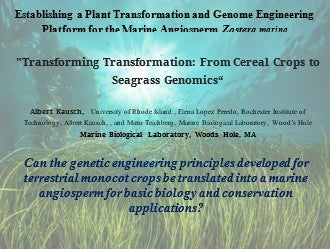
Project title: Establishing a Genome Engineering Platform for the Marine Angiosperm Zostera marina Elena Lopez Peredo, Rochester Institute of Technology, Albert Kausch, University of Rhode Island, and Mirta Teichberg, Marine Biological Laboratory, Wood’s Hole.