
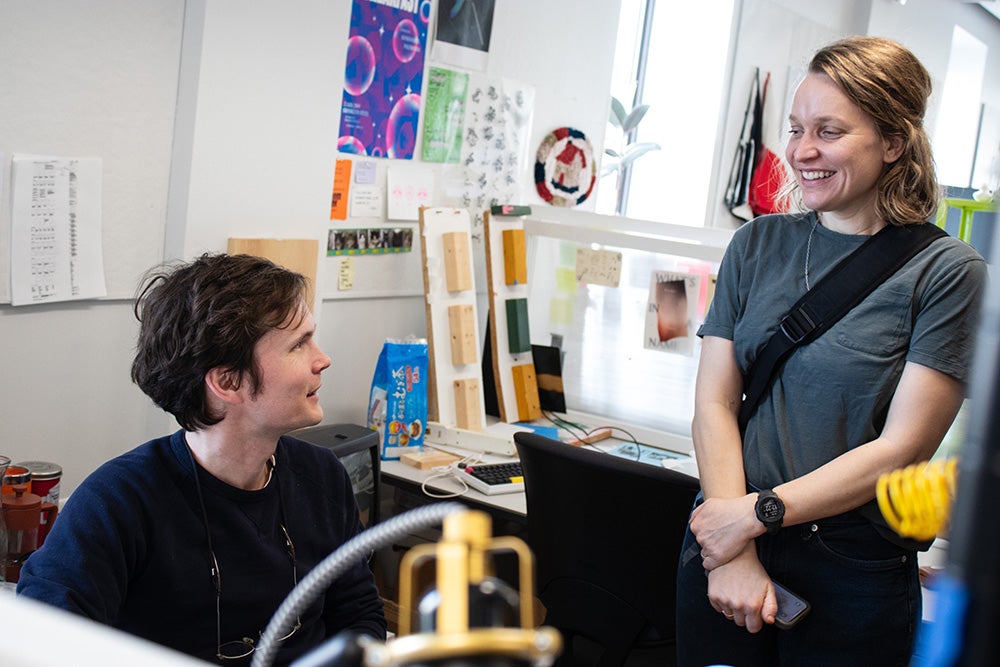
How can art help scientists explain the mechanisms that allow bats to change course mid-flight? Would an interactive sculptural installation encourage kids to take an interest in the “drumming signals” local woodpeckers use to communicate? Is it possible to make art explaining the concept of undersea quasi-permanence and the impact of ocean movement on coral reefs?
Researchers from Brown University, the University of Rhode Island, Roger Williams University and Rhode Island College are seeking answers to such questions as participants in Vis-a-thon 2025, a unique collaborative program hosted by RISD’s Edna W. Lawrence Nature Lab and led by visionary bio-educators Georgia Rhodes and Stewart Skylar Copeland MFA 19 DM. Now in its fifth year, Vis-a-thon allows scientists to view their sometimes arcane areas of expertise through fresh eyes and to communicate complex findings with non-scientists.
The program is supported by the National Science Foundation, which awarded RISD and partner institutions $8 million in funding over the next four years as part of the Rhode Island Network for Excellence in Science and Technology (RI-NEST), including $709,000 earmarked for the Vis-a-thon and related programs.
This piece was originally published by RISD News and Events on March 10, 2025. Read the full story!
 RI NSF EPSCoR is supported in part by the U.S. National Science Foundation under EPSCoR Cooperative Agreements #OIA-2433276 and in part by the RI Commerce Corporation via the Science and Technology Advisory Committee [STAC]. Any opinions, findings, conclusions, or recommendations expressed in this material are those of the author(s) and do not necessarily reflect the views of the U.S. National Science Foundation, the RI Commerce Corporation, STAC, our partners or our collaborators.