
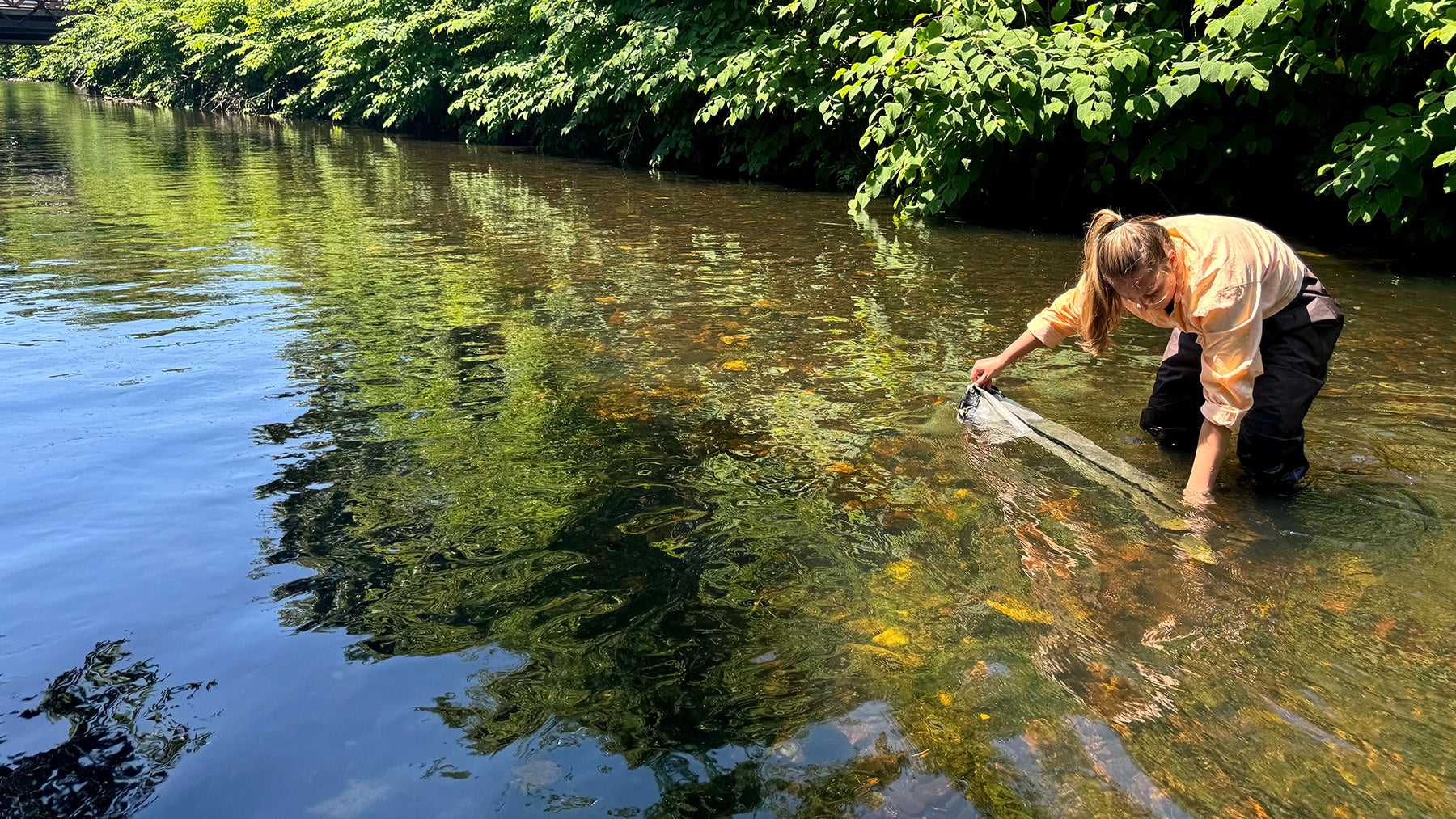
Across Rhode Island, faculty and students grapple with the most pressing issues around science that impact communities throughout the state and beyond. Students are also out in front telling these research stories, developing new pathways of inquiry and collaborating with professionals in art and journalism.
Latest News
 RI-NEST Graduate Completion Fellowship Supports Three URI Doctoral Researchers - The University of Rhode Island Graduate School has named three doctoral candidates as recipients of the 2026-27 RI-NEST Graduate Completion Fellowship, recognizing outstanding graduate researchers whose work addresses pressing challenges facing Rhode Island and communities worldwide.
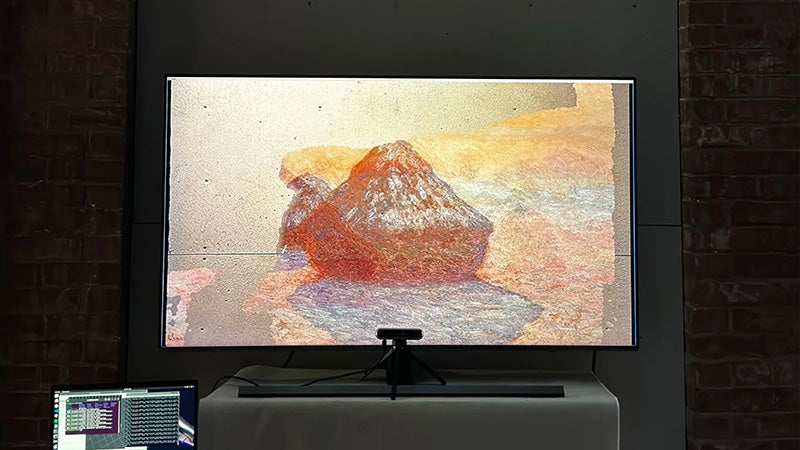
 CCRI students bridge art and science in ‘Prismosities’ exhibition - What happens when you mix advanced microscopy, biological research, and studio art? At the Community College of Rhode Island (CCRI), it results in an incredible outburst of student creativity and scientific inquiry. Fellows selected for the 2026 Open Newsroom - Experiential learning program introducing undergraduates from the University of Rhode Island, Brown University, and the Community College of Rhode Island, to reporting on science with local communities.
 Fish and Tribal Foodways in RI – A Community Teach-In - Friday, May 1, 4-5:30pm
@Whaler's Brewing Company
1174 Kingstown Rd, South Kingstown, RI 02879
Please join Brown's Native American and indigenous Studies Initiative and the Rhode Island Network for Excellence in Science and Technology (RI-NEST) for a community teach-in on Rhode Island's spring river herring run and its connections to tribal foodways and indigenous sovereignty.
Fish and Tribal Foodways in RI – A Community Teach-In - Friday, May 1, 4-5:30pm
@Whaler's Brewing Company
1174 Kingstown Rd, South Kingstown, RI 02879
Please join Brown's Native American and indigenous Studies Initiative and the Rhode Island Network for Excellence in Science and Technology (RI-NEST) for a community teach-in on Rhode Island's spring river herring run and its connections to tribal foodways and indigenous sovereignty.
Science around Rhode Island
Want to learn more, join our community and offer your unique perspective on RI NSF EPSCoR and programs like RI-NEST?
 RI NSF EPSCoR is supported in part by the U.S. National Science Foundation under EPSCoR Cooperative Agreements #OIA-2433276 and in part by the RI Commerce Corporation via the Science and Technology Advisory Committee [STAC]. Any opinions, findings, conclusions, or recommendations expressed in this material are those of the author(s) and do not necessarily reflect the views of the U.S. National Science Foundation, the RI Commerce Corporation, STAC, our partners or our collaborators.