
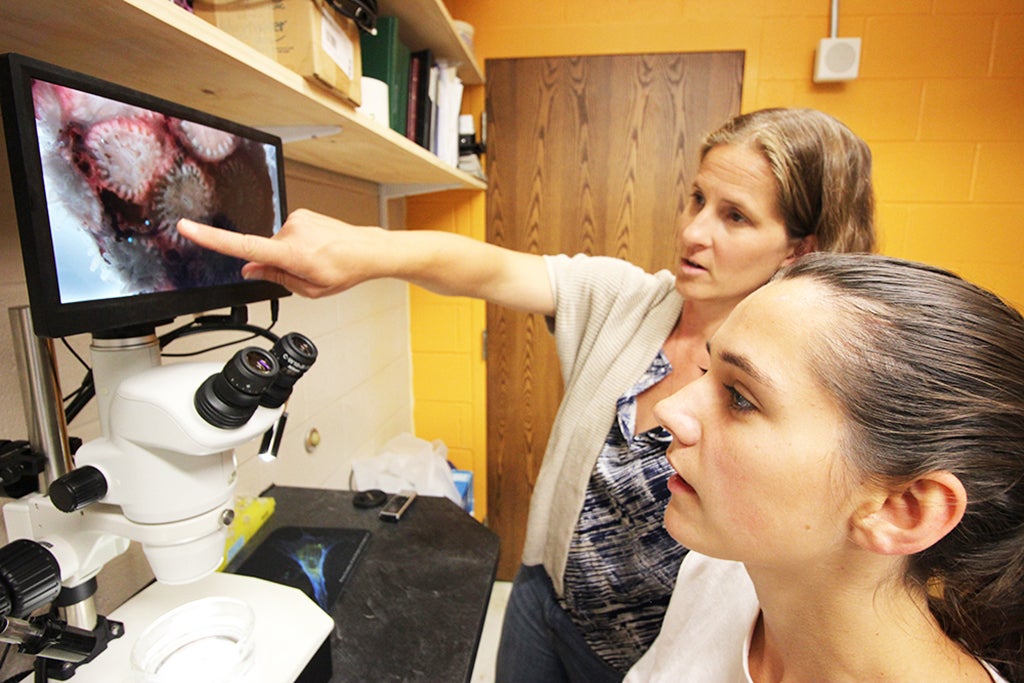
A decade-long collaboration led by RWU researchers, supported in part by Rhode Island NSF EPSCoR, developed methods to spawn, breed and culture the temperate coral Astrangia poculata, creating new opportunities to study coral biology and animal-microbe symbiosis.
A decade of research at Roger Williams University’s Center for Economic and Environmental Development (CEED) is helping scientists develop a new model organism for studying corals and their relationships with microbes.
Led by Koty Sharp and her research team in CEED, the 10-year, multi-institutional effort established standardized methods for spawning, breeding and culturing the temperate coral Astrangia poculata in the laboratory. The findings, based on collaborative research conducted from 2016 through 2025, are now published in Frontiers in Marine Science.
The work expands scientists’ ability to use Astrangia poculata as a model organism for studying coral biology, including the ecology and physiology of coral symbiosis. The temperate coral, found in the Northeast, could help researchers better understand how corals respond to climate change and ocean warming and identify approaches that could help protect threatened tropical coral reef ecosystems.
“This is a really exciting opportunity to use a temperate coral as a model for understanding questions that affect corals around the world,” said Sharp, CEED Director and Associate Professor of Marine Biology and Environmental Science. “Having an experimental model species like Astrangia – one that we can predictably raise in the laboratory – opens up fantastic opportunities for innovating and applying research solutions to the global coral reef crisis.”
This piece was originally published by Roger Williams University on September 8, 2026. Read the full story!
 RI NSF EPSCoR is supported in part by the U.S. National Science Foundation under EPSCoR Cooperative Agreements #OIA-2433276 and in part by the RI Commerce Corporation via the Science and Technology Advisory Committee [STAC]. Any opinions, findings, conclusions, or recommendations expressed in this material are those of the author(s) and do not necessarily reflect the views of the U.S. National Science Foundation, the RI Commerce Corporation, STAC, our partners or our collaborators.