
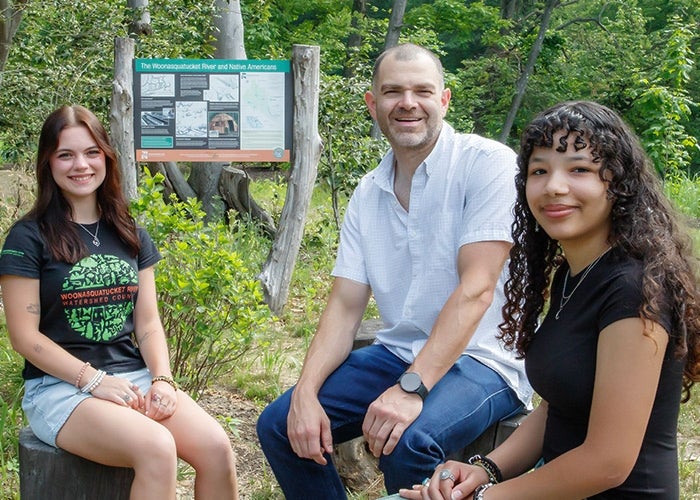
Daniel Hewins, Judith LaRose and Elizabeth Turbi Padilla worked with the Woonasquatucket River Watershed Council educating youth on plastics in Rhode Island waterways.
Microplastics permeate our environment. We inhale them in the air, ingest them in our food and absorb them through our skin. They travel through our bloodstream and settle throughout our body. They’re in our bones and brain, semen and placenta, breast milk and meconium (a newborn’s first stool).
The reality is that plastics don’t degrade, they don’t disappear, they just fragment into tiny pieces until you can’t see them. They become microplastics and even smaller nanoplastics that can enter our cells.
This summer RIC Professor of Biology Daniel Hewins is working with a social science team made up of two undergraduate students and the Woonasquatucket River Watershed Council (WRWC) to learn from and educate the public about the impact of microplastics.
This piece was originally published by RIC News on June 16, 2026. Read the full story!
 RI NSF EPSCoR is supported in part by the U.S. National Science Foundation under EPSCoR Cooperative Agreements #OIA-2433276 and in part by the RI Commerce Corporation via the Science and Technology Advisory Committee [STAC]. Any opinions, findings, conclusions, or recommendations expressed in this material are those of the author(s) and do not necessarily reflect the views of the U.S. National Science Foundation, the RI Commerce Corporation, STAC, our partners or our collaborators.