
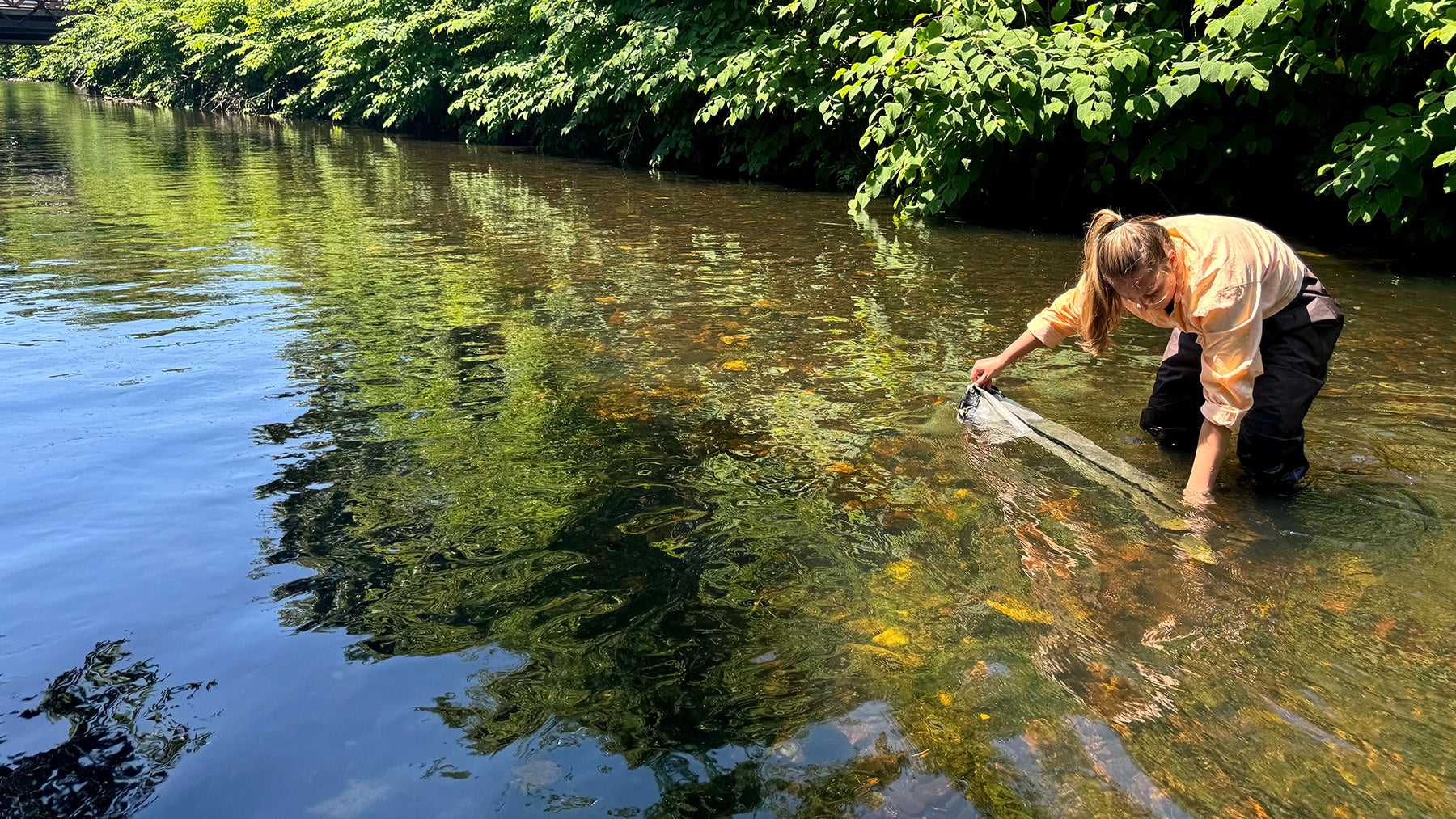
IBES Fellow Baylor Fox-Kemper is the leading Brown faculty member involved in SIMCoast, an NSF initiative to track how microplastics move from land to sea and explore what this means for ecosystems, climate, and communities.
Nano- and microplastics are showing up everywhere — in our oceans, our food, our own bodies. Now, thanks to a major new grant, Rhode Island scientists are teaming up to understand what these pollutants mean for ecosystems and communities.
IBES Fellow Baylor Fox-Kemper, a professor in the Department of Earth, Environment, and Planetary Sciences (DEEPS) and co-director of the Equitable Climate Futures initiative, is Brown’s faculty lead in SIMCoast, a $7 million project funded by the National Science Foundation that brings together URI, Brown, Rhode Island College, and Roger Williams University to take on one of today’s most pervasive environmental challenges.
“SIMCoast is just getting started,” Fox-Kemper said. “Our group’s overall goal is to model the transport and fate of nano- and microplastics, and predict their physical, ecological, and societal impacts in present and future climates.” Other groups involved in the project will work on measuring nano- and microplastics throughout the region, improving measurement techniques, working with community partners, government, and industry to understand their concerns and needs, and tracking and modeling the flow of plastics through the food web.
This piece was originally published by the Institute at Brown for Environment and Society on October 28, 2025. Read the full story!
 RI NSF EPSCoR is supported in part by the U.S. National Science Foundation under EPSCoR Cooperative Agreements #OIA-2433276 and in part by the RI Commerce Corporation via the Science and Technology Advisory Committee [STAC]. Any opinions, findings, conclusions, or recommendations expressed in this material are those of the author(s) and do not necessarily reflect the views of the U.S. National Science Foundation, the RI Commerce Corporation, STAC, our partners or our collaborators.